Showing posts with label scion. Show all posts

Saturday, February 3, 2018

How To Keep Up As A Gunslinger in Scion

White Wolf was best known for the World of Darkness, but one of the most popular titles outside that particular setting was Scion. The premise is that the titans have escaped from their prisons, and the Godwar has resumed. What's your part in this? Well, you are the children of the gods, and as they awaken the ichor in your veins, you need to step up to stop the titans from tearing the world down to its foundations, and burning away everything you've ever known in an apocalyptic inferno.

No pressure, though, no pressure. 
Scions are gifted with extraordinary powers, and they're capable of epic feats. They can lift loads of several tons, leap to the heavens, wrestle giants, and instantly heal from grievous wounds. These are the main tools in their fight against the titans and their spawn... but for players who like to mix the modern with the mythic, it can feel like there's a small hiccough when it comes to weapon choice.

The Scaling Problem of Guns in Scion


When you start off in Scion, guns are going to be your best friend. Pretty much every attack, except for grappling a foe, is your Dexterity plus your relevant skill (Brawl, Marksmanship, Thrown, or Melee). Then, if you successfully overcome the opponent's defense, you roll your damage. Your damage pool for a firearm is made up of the damage dealt by your weapon, and the number of threshold successes you achieved (one die for every success you beat the opponent's defense by), plus one. However, your damage with melee weapons, thrown weapons, or your fists is that, but you also add bonus damage dice to your pool equal to your Strength score (with additional successes from epic Strength factored in).

So, while it might take a little while to invest the necessary points to get both a high Dexterity to actually hit your target and a high Strength to deal a lot of damage, the guy throwing javelins, or the woman swinging the sword, is capable of doing a lot of harm once they hit their stride. Which leads some players who have invested in firearms wondering how they are going to keep up.

Don't panic... seriously, you've got this.

Piercing, Increased Damage, And Threshold Successes


The first thing to remember about guns is, well, they're guns. A firearm allows you to keep some healthy distance between you and an enemy, ensuring that unless they have eye lasers, or the ability to throw a semi-truck a few blocks (not uncommon in Scion), that you might be able to poke them in the eye without them poking back. This is particularly useful if you can turn yourself invisible, or if you want to shoot from behind cover while you and your fellow godlings are trying to take down a rampaging frost giant.

Tactical benefits aside, there are some good reasons to use guns. The first is that they all inherently have the piercing quality, which cuts the damage soak from armor in half unless it has the bulletproof quality. Guns all have a bonus to damage, ranging from +3 to +7 lethal, as well. This allows you to bypass all that bashing damage malarchy, and the traditionally higher damage soak that comes with bashing damage. To compare, no melee weapon offers a higher starting bonus than +5 lethal, even if the wielder could use their Strength to increase the damage.

And when we crunch the numbers...
Where you get money for value with firearms is in your threshold successes (the number that you beat your target's defense value on). Well, that, and because you can't parry bullets without some very specific abilities, which means the target has to use their dodge defensive value. So, in order to deal the biggest amount of damage with your gun, you need to make sure you hit your enemy's sweet spot every time.

The first thing you want to do is make sure you have the highest Dexterity, epic Dexterity, and Marksmanship scores possible (easy enough to do). As a starting character, it's possible to have 10 dice (5 Dexterity and 5 Marksmanship), plus one automatic success to throw around in that setup. Then you add in your weapon's accuracy rating, which for a gun will typically give you another +1 to +3 (though not all guns give you more accuracy to your attack). So, you could potentially be rolling 13 dice, with 1 automatic success from epic Dexterity. If you take the Aim action, that adds between +1 and +3 bonus dice to your attack, or a +2 to a +6 if you have the Trick Shot knack.

So, if you need to make that big shot on the rampaging titan, you could have a dice pool of 19 plus one automatic success with the right skill, attribute, knack, and weapon. Not too shabby. Then, if you want to add on to your pool, a relic firearm can have increased accuracy, which allows you to get even more bonuses to your shots. You could also spend a Willpower to add a number of bonus dice equal to an applicable virtue, which can bulk up your dice pool substantially.

However, if you're an unlucky player, even an attack pool of 20 with a free automatic success might not net you more than 7 or 8 successes. Which is enough to hit an enemy, but not really enough to get you a lot of threshold successes (assuming you're fighting titanspawn who are slightly tougher than a beefy scion). That's why you need to take advantage of defensive value penalties on your target.

The More You Do, The Lower Your Defense


Your defensive values are your dodge, and your parry. However, those values will change depending on the circumstances you're fighting in.

As a good example, if your target is unaware that combat has been joined (or simply can't see you, in many cases), then they can't apply their defensive values against your attack. That means if you quick draw your widowmaker, or squeeze that trigger from 200 yards out, the target won't be able to apply their defensive values against that attack without some kind of power that lets them. In that case, you only need one success to hit them, which means those 7 or 8 successes now nets you 6 or 7 bonus damage dice on your shot.

However, even if your target is aware of you and on the defensive, you can still take advantage of timing and environment to hit them when they're vulnerable. If a target does pretty much anything (like attack, or cast a spell, etc.) that action will give them a defensive penalty. Not only that, but if the target is getting attacked, then they'll be subject to an onslaught penalty as well (receiving a number of attacks equal to Legend rating + 1 before their next action) which reduces their defense by -1. If the target is wearing bulky armor, that reduces their dodge and mobility. If there is poor footing, they're slogging through mud, or some other environmental negative, then their defense goes down even further. This is a great reason to take the Aim action, and wait for your friends to smack the bad guy around. After all, you can interrupt your Aim at any time to take your shot.

One And Done


Godlings are tough, and titans are tougher, but it's important to remember that if you can get past their defensive values, and punch through their soak, they don't have all that many health levels. A scion has 7 health levels, and if you fill all those levels up with bashing, their lights go out, and they're down for the count. You fill it up with lethal, and unless they get some medical attention in a big hurry, they're dead. While titans might have more health levels, or just be harder to hurt because of increased soak, doing even a few lethal damage is not nothing. You put two or three of those "small" holes into them, and they aren't long for this world.

That's all for this week's Crunch topic. Figured folks could use a break from Pathfinder, and for those who want to give Scion a try, it's time to lock and load. For more content from yours truly, check out my Vocal archive, and head over to the YouTube channel Dungeon Keeper Radio to take a listen to skits, world building, and advice videos that several talented gamers as well as myself make. If you want to stay on top of all my releases, follow me on Facebook, Tumblr, and Twitter. To help support Improved Initiative so I can keep bringing content right to you, consider dropping some change over at The Literary Mercenary's Patreon page. It really helps, and as little as $1 a month gets you some sweet gaming swag as a thank you.

Or, if you like, you could just Buy Me A Coffee!

Friday, November 28, 2014

What To Do When Your Player Characters Become Gods

The idea of player characters rising to godhood is not new. Practically any gamer who's bounced around between different groups has been in at least one game where the dungeon master thought this would be a great transition to keep the game going past purely mortal concerns. The book Deities and Demigods written for Dungeons and Dragons 3.5 even provided rules for how you can do this, and much like drugs at a party even people who knew it was a bad idea had to give it a try.

Before we progress I'd like to give you a disclaimer: It is rarely a good idea to turn your PCs into gods. Ever. It might sound like fun, and the idea of cosmic adventure sounds appealing, but you can't put the genie back in the lamp. If you must play a game where the party achieves massive levels of power and advances to true divinity it is best to pick a game where that is the whole point.

*Ahem*
If you've come this far and decided that you really must turn your party into gods then here are the main issues you need to contend with as the dungeon master.

Issue #1: How Did The Characters Become Divine?


The first question you have to answer is how did the characters become gods? Did they pass a grueling ordeal like Pathfinder's Test of the Starstone? Did the character sacrifice himself nobly in the service of a god, and is chosen to bear a part of that god's power as a result? Did the character kill a goddess, and in so doing absorbs her power Highlander-style?

You sure that was a reef you just hit?
There are a multitude of ways to become a divine being, but generally speaking they come with either triumph or sacrifice. Does the prayers and worship of an entire country push a national hero beyond truly human bounds? Is the character descended from a divine (or infernal) bloodline that can more easily step between the mortal and the divine? Whatever the reason is, you need to be sure it isn't just you made level 20, congrats, you're all gods now! Otherwise the achievement will feel less like a real milestone and more like just another power the character has acquired.

Issue #2: What Are They Gods Of?


Gods in games like Dungeons and Dragons or Pathfinder are largely based off of mythological pantheons, where every god and goddess has some area of influence. Gods of rain and storm, the hunt, hearth, the city, darkness, death, destruction, fire, battle, and so forth are the order of the day, and people will pray to a god in charge of a given area for aid or assistance with that particular portfolio.

So what are your PCs gods of?

The God of Metal, perhaps?
Sometimes it's easy to pick an area of divine influence. Say your party rogue is a master thief, and he always steals treasure without being caught. He might become known as the Black Hand, god of thieves and burglars whose favor grants dark nights and drunken guards. Perhaps your greatsword fighter is known for confirming critical hits and pursuing guilty parties making her the Bloody Headswoman, a goddess who will grant swift and terrible justice if you earn her favor.

You need to remember that being a god is more than just adding a template to your character; you have become an inextricable part of the world. You are part of the cosmology, with responsibilities you could never have imagined as a mortal. As such you need a legend capable of spring-boarding every character into godhood, and then you have to build on that legend as your players continue. That legend also needs to be unique to each character, which is why if you have two party wizards you should either make them very different (one god of knowledge and one goddess of pure magic, perhaps?) or make them a part of a dual deity (Rhyme and Reason, the Lord and Lady of the Arcane).

Issue #3: Why Are They Gods?


This is not a question of how the characters became gods, but rather a question of why your plot requires them to be divine. Divinity is not a prestige class or an obscure feat, and as such it isn't something you just allow willy-nilly into your game. If your players become gods in their own right then you need to have a game that absolutely requires that in order for things to work.

You know, something like this.
When your characters become gods mortal concerns are now beneath them. They're not fighting dark cults, but rather they're going toe-to-toe with the gods those cultists worship. PC gods are fighting against extraplanar entities like Nyarlathotep, or they're subduing rebellions in the abyss that could lead to the destruction of the mortal world. They're re-enforcing the prison keeping Rovagug locked away from the world, or they're hunting a being that's killing other gods and stealing their powers to put a stop to its activities.

In short you don't turn the party into gods as a lark or just to play with a new set of rules. You don't test drive a tank, and you only take it out when you're pretty sure you need it.

Issue #4: Who Worships You? And Why?


Gods are more than just beings of great power; they are subjects of adoration. You need to know who worships you, and you need to know how these followers know about you in the first place. Did you have a following before you achieved godhood? Perhaps you were a renowned paladin who regularly led armies against forces of evil, meaning that you might have hundreds or thousands of people that looked up to you. Did you use your new divine power to somehow benefit a group of people? Perhaps you single-handedly stormed the Black Tower and cast down the Red King, freeing his subjects and bringing hope to a hopeless land?

Even if worshipers aren't required for you to gain power (though if you're using the Deities and Demigods system they totally are) what kind of god would you be if you didn't do anything worth knowing about? As such you need to ask what your church is like, what your doctrine is, what sorts of favors you grant, and what actions you find holy and worthy. Do you consider prayer to be a mealy-mouthed form of whining, and only reward those who endure and fight on their own two feet? Do you accept sacrifices of animals and blood, or do you prefer tithes of gold and gems? Do you have holy days? What role does your clergy serve?

No one said being a god was easy, but if you ignore the trappings that come with it then all you are is an adventurer that's harder to kill.

Consider Very, VERY Carefully


It is possible to turn player characters into gods, if that's the kind of thing your plot requires. That said, ask yourself if it's truly necessary to bring in this aspect. Instead of making the party into gods you could instead grant them mythic levels (something else you should consider very carefully before bringing into your game), give them relic items, or simply tone down your plot so that it's less save all of the known universe and more save a nation of people.

Making a game more epic doesn't make it better. It does however mean that you need to have a lot more skill in order to maintain that suspension bridge of disbelief your party is walking across.


If you'd like to support Improved Initiative then stop by my Patreon page and become a patron today! To make sure that you get all of the latest updates plug your email address into the box on the right, or follow me on Facebook and Tumblr!

Monday, April 28, 2014

The Best Gods You've Never Heard Of: Africa's Orisha Pantheon

Roleplaying games have used world mythology as a free idea bucket for decades. Most editions of Dungeons and Dragons have Norse gods in them (speaking of, there's a build for Thor here, and Loki here), White Wolf's Scion offers a number of world pantheons including Egyptian, Greek, and Japanese, and even H.P. Lovecraft's Old Ones have been drawn up and statted out for their own game. Despite this obsession with the divine though, most of our games come from a uniquely Western view. What I mean is that we're more likely to include completely made-up gods like Cthulhu and Hastur (say that three times fast if you dare!) than we are to take inspiration from African gods.

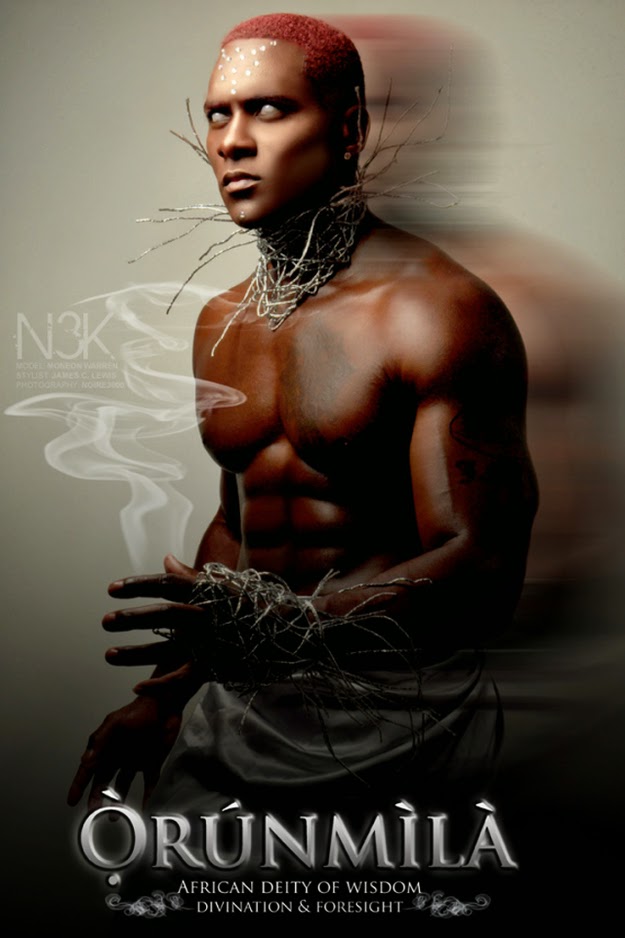
This series by photographer James C. Lewis might change your tune, though.

The Gods

According to the original post on Buzzfeed here, this project was born out of discovery and a touch of frustration. Lewis had been reading about mythology in school since he was young, but found that most of the pantheons taught in America tend to exclude African folklore. Lewis didn't find anything on the Orishas, an ancient African pantheon from whom the modern day loa of Voodoo are descended, until he really looked for them. When he completed his research he decided to portray them in a way that showed their youth, strength, and power that would catch the attention and hold the imagination of audiences not familiar with these gods. The names he used are spelled in the Yoruba language, common to Nigeria and surrounding regions


It looks like Lewis hit the nail right on the head!

Why Not Spice Up Your Game a Bit?

There's no reason to cut out the gods your game already has... but take a moment and ask yourself how much richer the world would be if you had additional gods and cultures. Haven't we had enough Celtic knock offs and tongue-in-cheek Greek references to last for a bit?


As always, thanks for popping in and having a look. If you'd like to help keep Improved Initiative going so we can bring you more great content then feel free to click the "Bribe the DM" button on the top right, or stop by our Patreon page to become a patron today! If you'd like to stay up to date with our latest and greatest then make sure to follow us on Facebook and Tumblr. Or you could just plug your preferred email into the box in the upper right hand corner.