Showing posts with label personality. Show all posts

Saturday, December 11, 2021

What Lines Will Your Character Cross in Pursuit of Their Goals?

For the past year I've been releasing a new supplement for my Sundara: Dawn of a New Age setting every month. While I've covered locations and species galore, one of the releases that put my brain into a whole different gear was Gods of Sundara, because it was this book where I made it clear that this is a world and setting without alignment... a place where there is no such thing as universal good or universal evil. And while there are spirits and powers, gods and outsiders, there are no angels or devils. What is good and what is evil, what is right and what is wrong, needs to be determined by individuals for themselves.

This isn't a new take on morality in RPGs by any stretch of the imagination. However, thinking about a game in this manner gave me an interesting perspective. Because a lot of us have an idea of our character's morality, but we don't always ask how it's going to act under pressure. Or, in other words, how far will they go in pursuit of their goals?

Rules? Oh, those don't apply to me.

Before we get into the details, don't forget to sign up for my weekly newsletter! Also, if you have the spare cash and you'd like to make my holiday, consider becoming a Patreon patron as well.

Lastly, if you want to make sure you're following all my followables, make sure you check out my Linktree as well!

How Badly Do You Want It?


There was a comic I saw a long time ago where two men were talking. One said to the other, "I really want to be rich." The other said, "Then go rob a bank." The first man was appalled by this, "I can't do that, that would be wrong!" The second shrugged and said, "Then I guess you don't want to be rich that badly, do you?"

Guess not.

The comic went on with the second man listing different immoral (or at least highly questionable) things the first man could do to get rich. He said no every time, but it was never because he disagreed that doing this thing would, in fact, put a lot of money in his bank account. It was always because the act was deplorable, or harmful to other people. It showed that, while the individual would have liked to be wealthy, he was not willing to compromise his morals in order to satisfy that want.

While the first character didn't come out and state his morality, we saw it in what he was willing to do. And this is something we don't always think about when it comes to our characters. We think about their goals and their driving motivations, but we don't always ask what they'd be willing to do in order to achieve them. Or, more specifically, what they wouldn't be willing to do.

For instance, say you have a common sellsword who dreams of one day being knighted, and climbing the ranks of the aristocracy to become a noble. How far are they willing to go in pursuit of this goal? Will they guard caravans against desperate people, using lethal force if necessary? Will they accept the patronage of a corrupt, or even wicked, nobleman if it means they're one step closer to their ultimate end? Who are they willing to oppress or kill as long as they can step over those bodies on their road to the castle? Is the title, the prestige, and the position more important than what they had to do to get there? And if not, then where do they draw the line?

Or, to reach back to the advice I gave in both 5 Tips For Playing Better Paladins and 5 Tips For Playing Better Clerics, it's one thing to have vows and a stated code of morality. But if those things are never tested, or put under any kind of pressure, then how strong can they truly be?

Everyone Has Their Own Lines


Something that's worth pointing out is that every character should have their own lines in the sand, and where they draw those lines should be informed by their culture, their religion, their history, and their experience. And while those reasons may seem arbitrary to other people, it's important that the rules have some internal consistency to the character themselves.

As an example, someone raised by a street gang who had to steal for a living may have no compunctions against theft in general, but they draw a hard line at stealing from friends and family because they're the only ones you've got on the street. Alternatively you might have someone who grew up in a strict warrior culture, with specific rules and codes about managing shame and demanding satisfaction for insults given. How much of that clings to them, and how much they care about once they're not living within that society may vary, though. Someone may feel that violence is wrong, and that there is no worse act than taking another person's life... but do they feel strongly enough to stand by that principle when they're in danger? When a loved one is in danger? What about when someone near and dear to them has been killed?

Lastly, it's important to ask what happens when a person crosses a line. Do they feel bad? Did the ends justify the means? Do they resolve to never do it again... or does it get easier to cross it because the last time you did it achieved the ends you wanted? Does it change their morality in meaningful ways, re-orienting their position as they go forward?

These breaking-point situations are often what creates some of the greatest drama in our stories, because it makes us ask whether a character's morals hold strong, or if they go further than we, their comrades, or even the antagonist expected them to go in order to achieve their goals. So take a moment and ask yourself what your character is going to do when the chips are down, and a decision needs to be made.

Like, Follow, and Stay in Touch!


That's all for this week's Fluff post!

For more of my work, check out my Vocal archive, and stop by the YouTube channel Dungeon Keeper Radio. Or if you'd prefer to read some of my books, like my alley cat thriller Marked Territory, it's sequel Painted Cats, my sword and sorcery novel Crier's Knife or my recent short story collection The Rejects, then head over to My Amazon Author Page!

To stay on top of all my latest releases, follow me on FacebookTumblrTwitter, and now Pinterest as well! To support my work, consider Buying Me a Ko-Fi, or heading to The Literary Mercenary's Patreon page to become a regular, monthly patron. That one helps ensure you get more Improved Initiative, and it means you'll get my regular, monthly giveaways as a bonus!

Saturday, May 2, 2020

Everything is Weird in Fantasy RPGs (But That's Not How You Make a Character Stand Out)

Many years ago I got invited to play an RPG with a group I'd never met before. It was pretty large, and the general gist of things was that it was a high-fantasy world with a lot of magic and some rapidly advancing technology. The party, as I was introduced to them, included the following;

- A powerful psychic warrior who'd escaped from a brutal, repressive nation
- A halfling paladin who literally shown with a halo of light.
- A half-elf alchemist smart enough to understand the very fabric of the cosmos.
- A cyborg mercenary with a gambling problem wielding a sword that had slain a powerful lich.

There was one guy who was standing off in the shadows and playing it coy, though. Rather than just introduce his PC, the way the others did, he made a big deal about how there was this tall figure in a black robe that obscured his features. And he was carrying this huge scythe. Then he pulled back the cloth, revealing... well, basically exactly what you're expecting with that lead up.

Hey man, you got any twos?
The player had gotten super special permission from the DM to play a pseudo-undead race, and he had chosen to make this living skeleton a cleric of the god of death. It was, of course, then completely necessary to walk around in a ragged robe that really did very little to conceal what he was for long, and while carrying a big, obvious weapon. The loud kind of mysterious that is not, in fact, mysterious at all.

This player continually expected to get a big reaction out of this character, and he never did. And that's something I'd like to talk about today, because there are a lot of players (and DMs as well) who seem to forget that when everything is weird, the flip side of that is that nothing is weird.

The Fantastical Mundane


I talked about this over on The Literary Mercenary in Making Use of The Fantastical Mundane in Sci-Fi and Fantasy, but if you didn't catch that when it first came out, the concept is pretty simple. In short, the world you are in decides when something is or isn't unique, strange, or special. If you're in a setting where, for example, magic is rare and wondrous, then just the act of being a magical creature, much less a wizard or a sorcerer, would immediately make you a target of fear and awe. In a setting where magic is everywhere, though, it ceases to be a spectacle. In that sort of setting, sorcerers might be casting spells on street corners for pocket change, and levitating trains might run between cities on the power of ancient runes.

In New York, this is terrifying. In hell, this is Tuesday.
This is something a lot of players sort of forget about when making their characters. Base races, even the notably inhuman ones, aren't some impossible creature that only exists in stories. People have heard of them before, and in more cosmopolitan areas there may be entire neighborhoods of them. Whether you're a six-and-a-half-foot-tall cat person with a massive crossbow over your back, or you're a fuschia-haired, jade-eyed gnome riding around on a floating pink cloud instead of a mount, you might be unusual, but you're still mundane by the standards of the world.

Which is to say that you might get a, "Huh, haven't seen that before," or perhaps some curious questions or funny looks out in the hinterlands, but you're probably not going to cause riots simply by existing the way you would in a low-magic world.

Interesting Characters Are More Than Skin Deep


And we need to explore them over time.
A common mistake that lots of players make is to assume that making a character look weird, frightening, or unusual is the same as making that character interesting. It isn't. A standard human fighter can be the most interesting character in the party, and the drow wizard/assassin might be the most boring... it all depends on what's going on beneath the skin, and how you lead the rest of the party down that path to figure it out.

Let's go back to the overly-grim reaper for a moment.

To add some context to that introduction scene, it was the new PC being introduced to the squad he was going to work with through the adventurer's guild. They were in the middle of a major city, so even though the new guy had never seen a sentient undead before, there were dozens of possible explanations for what this thing was, and why it was here. It was unique, but it was far from unheard of just in the context of what one might see walking down the street in the high magic district.

But the character displayed no unique personality after that initial reveal.

As a cleric who seemed to be the party healer, the player missed a golden opportunity for the others to call him Bones (the age-old nickname for the sawbones). The character, post-reveal, could have offered a bony hand and apologized for the state of himself, but he was in the middle of conducting a service when he got the call to come in and thus was still in his "official" robes/costume rather than something a little more casual. Even something as simple as asking for alignment, deity of choice, and funerary rite preference should the new guy meet a terrible end while on a mission, as disposing of his earthly remains would likely fall to the cleric would have added some personality.

Any of those simple quirks would have instantly made the leper in the room into one of the most interesting characters at the table. Alternatively, if there had been some effort put into genuinely disguising what he was (say, being under a constant illusion spell that he never risked someone seeing through by avoiding physical touch whenever possible, or wearing actual concealing robes, veil, etc. that would have genuinely shrouded him), then it would have been a big surprise when the party realized they'd been traveling with a living skeleton this whole time. Combined with an interesting personality, that sort of long-term reveal could have been really interesting as well. But, alas, it's not what happened.

Solid concept for this game, by the by, so go check it out!

Get Weird (And Go Deep)


To address the other side of this coin, though, there are also a lot of players who claim that by picking a big, loud, colorful, or bizarre class or race that you are inherently less interesting as a character. This comes back to the Stormwind Fallacy (the idea that a mechanically optimized character cannot be roleplayed well, and vice versa), except that this time it's players arguing that the weirder, more unusual, or more inhuman a character is, the less roleplaying there will be as a result of that choice.

I would, instead, argue that the more inhuman, weird, or bizarre a concept or character is, the more opportunities you have to really embrace the things that make them strange and unique as characters.

Don't mind fluffy, he gets me where I'm going, and he's a friendly sort.
From the bizarre habits and comforts that inhuman characters have (such as a tiefling putting hot coals in his mouth to think, or an orc or goblin eating things that would never be acceptable to a human palate), to the bigger implications of their cultures, background, upbringing, and even their age, I fully endorse players getting as weird as a setting will allow and really stretching out into those roles.

As long as you're aware that what makes you interesting isn't the race on your sheet, or the levels you have in a given class. It's what you do with your character's personality, and how you make them stand out in meaningful ways that also bring the characters around them deeper into their orbit, and their story.

For more recommended reading and inspiration, check out some of the following:

- Reveal Details About Your Character Through Flavor-Based Skill Checks A unique strategy for bringing across your character's details, and getting other PCs involved in the process.

- 100 Random Mercenary Companies: If you are, of have been, a mercenary, then you likely carry some specific gear, linguistic quirks, etc. from that life that could make other folks curious about who you served with. Other entries that might provide similar background information include 100 Knightly Orders as well as 100 Gangs For Your Urban Campaigns.

Like, Follow, and Stay in Touch!


That's all for this week's Fluff post! If you've used this in your games, share a story down in the comments!

For more of my work, check out my Vocal archive, and stop by the YouTube channel Dungeon Keeper Radio. Or if you'd prefer to read some of my books, like my sword and sorcery novel Crier's Knife or my recent short story collection The Rejects, then head over to My Amazon Author Page!

To stay on top of all my latest releases, follow me on FacebookTumblrTwitter, and now Pinterest as well! To support my work, consider Buying Me a Ko-Fi, or heading to The Literary Mercenary's Patreon page to become a regular, monthly patron. That one helps ensure you get more Improved Initiative, and it means you'll get my regular, monthly giveaways as a bonus!

Saturday, April 4, 2020

What Are Your Character's Cultural Misunderstandings?

"This food, it's good," Grond said, tossing the rest of the bones onto his plate. They'd been seated on the higher tier, the fireplace off to one side to ensure they were warm. Filial had only managed to get Grond to dress his best with the promise of a hearty meal. He looked a little strange wearing fresh linen and a velvet doublet with his wild hair and scarred hands, but he was clean and presentable, which was a feat in and of itself.

"Didn't I tell you?" Filial asked, toasting his hulking companion with a wine glass.

Grond raised his glass, returning the toast, but rather than sipping he tilted his head back and drank deeply. The smile fled from Filial's face, but before he could say something Grond opened his mouth and let forth a deep, echoing belch that was just this side of a roar. Silverware clattered, and people stared, their eyes wide. Filial put his hand to his face, shame turning his ears red. Grond nodded, and picked up one of the last rolls, buttering it with his belt knife.

"The kitchens are far from here," he said, taking a bite of the bread. "I wanted to be sure the cooks knew of my appreciation."

Is something wrong, my friend?

Cultural Misunderstandings, Quirks, and Personalities


Everyone's unique perception of the world is colored by where, how, and by whom they were raised. While some of us are more cosmopolitan than others, we still have certain baseline behaviors and cultural taboos that we consider "normal" in our lives. Our characters are typically the same way. This often leads to cultural misunderstandings that can really bring across how different things are in a fantasy world, and make characters instantly memorable.


Most of us have done some spin on this at one point or another in our lives. Maybe you had a half-orc version of Crocodile Dundee, who took the most terrifying monsters and brutal hellscapes in their stride, and who was confused by the sheer panic and terror other party members reacted with. Maybe you played around with an elf who had exacting rules of decorum, and whose behavior could often seem strange or alien to those who have never studied the social structure of their home city. Perhaps it was a dwarven crusader with unusual grooming requirements as part of their oath, a tattooed mystic from a fringe school of sorcery, or someone who was raised by an evil cult and who has to unlearn the habits of their strange and brutal upbringing (check out my recent 100 Cults to Encounter if you're looking for inspiration on that front).

However, this is something I'd encourage us to do more of as players. Because even if we build in something as a joke, it can end up telling us a lot about a character, where they come from, and the way they see the world around them.

Making Misunderstandings That Work


The key to setting up a unique misunderstanding or cultural quick typically relies on something that is either unusual in the individual background, or which is different about how an individual character experiences the world. These things can be blatant or subtle, but the real trick is to make sure that that these misunderstandings are interesting or unique, and that they tell us something meaningful about the character.

Only one who has walked the peaks of Zhai Zho can bear such marks.
As an example of a cultural misunderstanding, say a character was raised deep in the blowing sands of the desert. Over the years the cultural norms evolved to say that people must keep themselves covered except when in the presence of friends and loved ones. This may have started out as a matter of practicality to avoid harm from sandstorms and the sun, but it's become ingrained in the society as a whole. So among those from this part of the world, long, flowing robes are common, and veils are often worn whenever one is in public. Someone who doesn't understand this culture may not understand that telling someone to show their face is the equivalent of demanding they undress in front of you, meaning they could give grave insult without intending it.

On the flip side of things, say a character comes from the frozen north where hot springs are often turned into communal bathhouses. Regular washing and grooming may be an intimate part of their culture, and as a byproduct of necessity nudity is not seen as shameful or even unusual in any way, shape or form. You could even take it to a Drax the Destroyer level of casualness, where the character finds southern notions of propriety and modesty to be strange and confusing.

Alternatively, you could ask what sorts of cultural norms develop around a character's inherent abilities, if they possess any. Does an elf rarely raise their voice, for example, because of how sensitive their people's ears are? Thus when they do actually shout, it's shocking to those who know them, and it lets people know they mean business. Does your dwarf tend to dress in shades of black and white, because in the hold they were raised in most people used their natural darkvision, so colors were never a part of a fashion motif? Perhaps this went even further, with intricate and broad-sweeping makeup and hairstyles marking one out by standing and profession that could be recognized from afar? Does your halfling, or by contrast a half-orc or a goliath, just not grasp a world built to a scale that doesn't fit them? Constantly ordering food, or drink, and being surprised or disappointed at the portion size they receive, or finding that room accommodations are never something they can take for granted? Or do they have their own norms for meals, or sleeping arrangements, that outsiders just don't understand?

While it's tempting to make these changes really big and really obvious (the fighter whose culture is to always grapple with a friend you haven't seen for some time to test each other's strength, the barbarian who comes from a tribe that states lingering eye contact is a challenge to one's rank, etc.), sometimes you can get just as much out of the smaller, subtler things that are unusual about a character's view of the world.

Do Not Set This Up To Be A Jerk


And now we play the ax-catching game, as tradition dictates.
As I said back in The Dangers of The Phrase "I'm Just Playing My Character", it's important to remember that you are directly responsible for everything that goes onto your character's sheet, and all the things they think, say, do, or believe. So while it's entirely possible for you to make a character who considers any slight an occasion to begin a duel to the death, that doesn't excuse you from constantly going around and attacking anyone who takes the piss out of you. It still makes you look like a jerk, because you tried to design a quirk that demanded your character make everyone else's life difficult.

Now, to be clear, a character who is willing to duel for their honor with those who've slighted them is a fun little background tidbit. Especially if that character has something of a reputation as a duelist, and if you use the threat sparingly, or only when it's warranted. But just as with any other quirk, or unusual bit of cultural difference, think about whether it's going to add to the story, or take away from it. Because if you're constantly throwing a monkey wrench into the game and justifying it with, "Well, that's the way they were raised," that is going to get really old really fast.

Like, Follow, and Stay in Touch!


That's all for this week's Fluff post! If you've used this in your games, share a story down in the comments!

For more of my work, check out my Vocal archive, and stop by the YouTube channel Dungeon Keeper Radio. Or if you'd prefer to read some of my books, like my sword and sorcery novel Crier's Knife or my recent short story collection The Rejects, then head over to My Amazon Author Page!

To stay on top of all my latest releases, follow me on FacebookTumblrTwitter, and now Pinterest as well! To support my work, consider Buying Me a Ko-Fi, or heading to The Literary Mercenary's Patreon page to become a regular, monthly patron. That one helps ensure you get more Improved Initiative, and it means you'll get my regular, monthly giveaways as a bonus!

Saturday, September 21, 2019

Why Does He Do That? (Thinking About Your Character's Habits)

"Why's he doing that?" Jeren asked, nodding his head toward the corner table.

"What?" Kyros asked, glancing where his drinking companion indicated. A dark elf sat in the corner, the hood of his cloak pulled up. His eyes glimmered in the candlelight, and he ran a steel dart through his fingers, walking it from one end of his hand to the other, the sharpened tip flashing.

"That," Jeren said, adding emphasis as if it should be obvious. "Looking all mysterious and playing with that sharp. He think it's scary, or something?"

"He's from the Dark, idiot. The moon is brighter to him than the sun is to us. The fireplace is practically enough to blind him if he's not used to it." Kyros looked at his companion for a moment before sighing, shaking his head, and tossing back the rest of his drink. "And if you'd ever traveled outside this little burgh, you'd know they don't use coins down where he's from. That spider walk is something kids learn to keep their fingers agile. I had to guess, it's probably something he does when he's nervous."

Jeren glanced back at the dark elf, who dabbed at his eyes. Sure enough, they were starting to water. He favored them with a small smile, and nodded.

"Also, he can probably hear us," Kyros said, getting a fresh drink. "So you're aware."


Seriously, how do you see in here? It's so damn BRIGHT!


Some Adventurers Are More Different Than Others


You've probably seen Marvel's Avengers by now, and if you haven't, go watch it. Seriously, it's worth the time, I won't be mad.

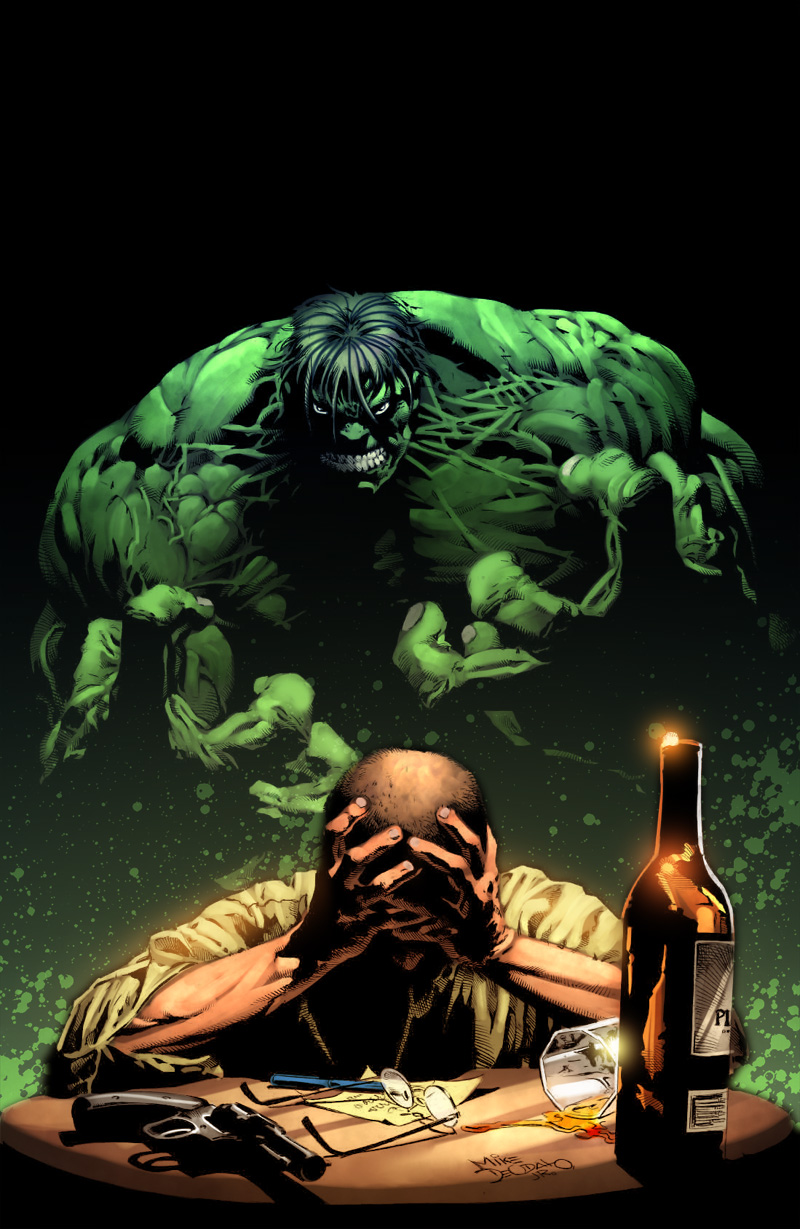
Now, if you watch Mark Ruffalo's performance of Bruce Banner, you'll notice that he purposefully shrinks himself down. He keeps his arms close, and often holds his hands together like he's trying not to break anything. If you've ever had a friend who was on the bigger side, these are all mannerisms of someone who is very large, and very strong, who is trying to be careful around delicate things. It shows that, even when he's in his weaker form, Bruce is keenly aware of the power he contains in himself, and that one wrong move might turn this whole thing into the proverbial rampaging bull in a China shop.

Incidentally, I have a Pathfinder conversion for Hulk, for those who are interested.
 
This mannerism makes perfect sense when you track it back to its source, and it's a fun exercise in character building. That's why, when you sit down to make a character, ask yourself why they speak, act, fidget, or believe a certain thing. The answers you find are often surprising, and can make for some fun character moments.

For example, if your character is a gnome, they've had the ability to talk to animals their entire life. It might not even occur to them that other people can't do that, especially if they were raised in communities where magic was common. Does this lead to them being unusually sensitive to the moods of animals around them? Are they confused when people treat nature like a tool, rather than a living thing? Do they have opinions about animals that are wildly different from those held by other races, making them seem like a tiny version of the crocodile hunter?

You can pick almost any racial modifier/ability and apply this kind of logic to it. Elves get a bonus on Perception, for example, but does that also make the world around them unbearably loud beyond the quiet boundaries of deep forests? Is this why an elven character might speak softly, or keep their hood up, providing their sensitive ears some protection against the violence of the louder world? Tieflings and ifrit both have natural fire resistance, so does it feel good for them to drink scalding tea, or to relax into a fire the way other people would enjoy a sauna? Goblins are capable of eating spoiled and rotten meat, but does what smells and tastes putrid to humans instead have a more nuanced palate to this sharp-toothed race? And is a food or fruit humans would find sweet something that tastes rancid to a goblin, their tongues not being built to handle that flavor?

And that's before we get into the weirdness of cultural norms.
 
Even if you're playing a bog-standard human, though, you can find unusual tics, quirks, and attitudes in the cultural norms of where they grew up. Everything from fashion, to forms of address, to food, to language, to little rituals that have clung for life can make them seem odd or strange... and every one of them can add some flavor to who your character is, and why they are they way they are.

As an example, did your character come from a culture with a strong warrior ethic, where even childhood games were meant to make you a canny fighter (such as how the wrestling martial art Glima was sort of a national pastime among the Norsemen)? Alternatively, was your character raised in a communal society where everyone was referred to with familial terms since the whole village raised the next generation? Were weapons seen as a taboo where you came from, or were they to be displayed proudly? Did you pray to the spirits, to the elements, to your ancestors, or to the gods? Do you wash, groom, and comb yourself every day, keeping a razor and comb in a kit on your belt? Or do you go for days, maybe weeks, between full baths without noticing?

Every Habit Started Somewhere


No matter who your character is, they had a life before they show up at the table. If they have a quirk, ask where it came from. Is it something they picked up during their stint with the militia? Was it something their uncle taught them? Or is it just how they deal with having sharper eyes, feeling less pain, or living in a world made of cardboard?

As a note for readers, I cover a lot of aspects like this in articles like 5 Tips For Playing Better Tieflings and Aasimar and 5 Tips For Playing Better Paladins, and I keep the full archive of these tips over on my 5 Tips page. So stop on in, check it out, and see if you find yourself some inspiration!

Like, Follow, and Stay in Touch!


That's all for this week's Fluff post! If you've used this in your games, share a story down in the comments!

For more of my work, check out my Vocal archive, and stop by the YouTube channel Dungeon Keeper Radio. Or if you'd prefer to read some of my books, like my sword and sorcery novel Crier's Knife or my recent short story collection The Rejects, then head over to My Amazon Author Page!

To stay on top of all my latest releases, follow me on FacebookTumblrTwitter, and now Pinterest as well! To support my work, consider Buying Me a Ko-Fi, or heading to The Literary Mercenary's Patreon page to become a regular, monthly patron. That one helps ensure you get more Improved Initiative, and it means you'll get my regular, monthly giveaways as a bonus!