Pretty standard stuff, really.
 |
| Crap. |
If you've played a long-running campaign, though, then you know armor class is a sucker's game the longer the story goes on. And as someone whose characters draw critical hits like a magnet draws iron, I'd like to share some of what I've learned on the subject of making sure you don't get smashed to a pulp whenever initiative is rolled.
As always, if you haven't done so yet, sign up for my weekly newsletter to make sure you don't miss any of my latest updates! And if you'd like to do your part to help keep Improved Initiative going strong, consider becoming a Patreon patron... even small donations make a big difference at the end of the month.
Diminishing Returns on Your AC
Let's lay some foundational points, here. I'm not saying that armor class is a bad mechanic. I'm not saying that it's broken, or that you shouldn't use it at your table. What I am saying, though, is that if you want your armor class to actually provide a lot of protection as you level up then it's basically the only thing you're going to be investing your resources in to allow you to keep pace with your enemies.
 |
| You spent HOW much on that?! |
I'll give you a perfect example from my recent Rise of The Runelords playthrough. For that campaign I was running a paladin with a Dexterity focus. At lower levels all it took was decent armor and a shield to avoid getting hit a majority of the time. Sometimes the GM got in a lucky shot, but the character sometimes went through entire encounters with barely a scratch. By the time the party's level hit double digits, though, it didn't matter how high my armor class was. I had enchanted armor, a boosted Dexterity bonus, natural armor, a shield bonus, deflection modifiers, boost spells from the party enchanter, and the huge bonus from active smite on a target, and I was still practically guaranteed to tank at least 2 hits per big bad per round.
Why the change?
Well, part of it is that once you hit high single digits to double digits for character level, you start dealing with one big threat a lot more often than you do squads of smaller threats. While one big threat stands less of a chance of winning (because the party gets more actions, and is therefore more likely to cream that single enemy), these enemies tend to have huge attack bonuses that are practically guaranteed to hit at least once when they unload on a PC. And it's usually more, which can be a problem if those hits are all targeted at one PC instead of spread out among the party. Or, even worse, enemies tend to pack potent magic that targets your touch AC or your saving throws (thus ignoring a lot of buffs), or they opt to try to grapple characters, which targets your combat maneuver defense instead of your armor class.
So, to sum up, the higher your character level gets the less often enemies rely on purely physical attacks to harm you... and when they do rely on physical attacks, they tend to come from massive enemies with huge bonuses to hit so that even the tankiest of tanks is going to lose a hefty chunk of hit points by the time the GM is done rolling dice.
Thinking Beyond Armor Class
Now, for the record, I'm not saying you shouldn't invest in your armor class. Getting a good AC is going to save you from a lot of damage over the long-term, and you'll often be able to shrug off attacks from smaller minions, traps, and other sources of damage that can still pose a serious danger if you go running into battle with nothing but a bedsheet and a buckler.
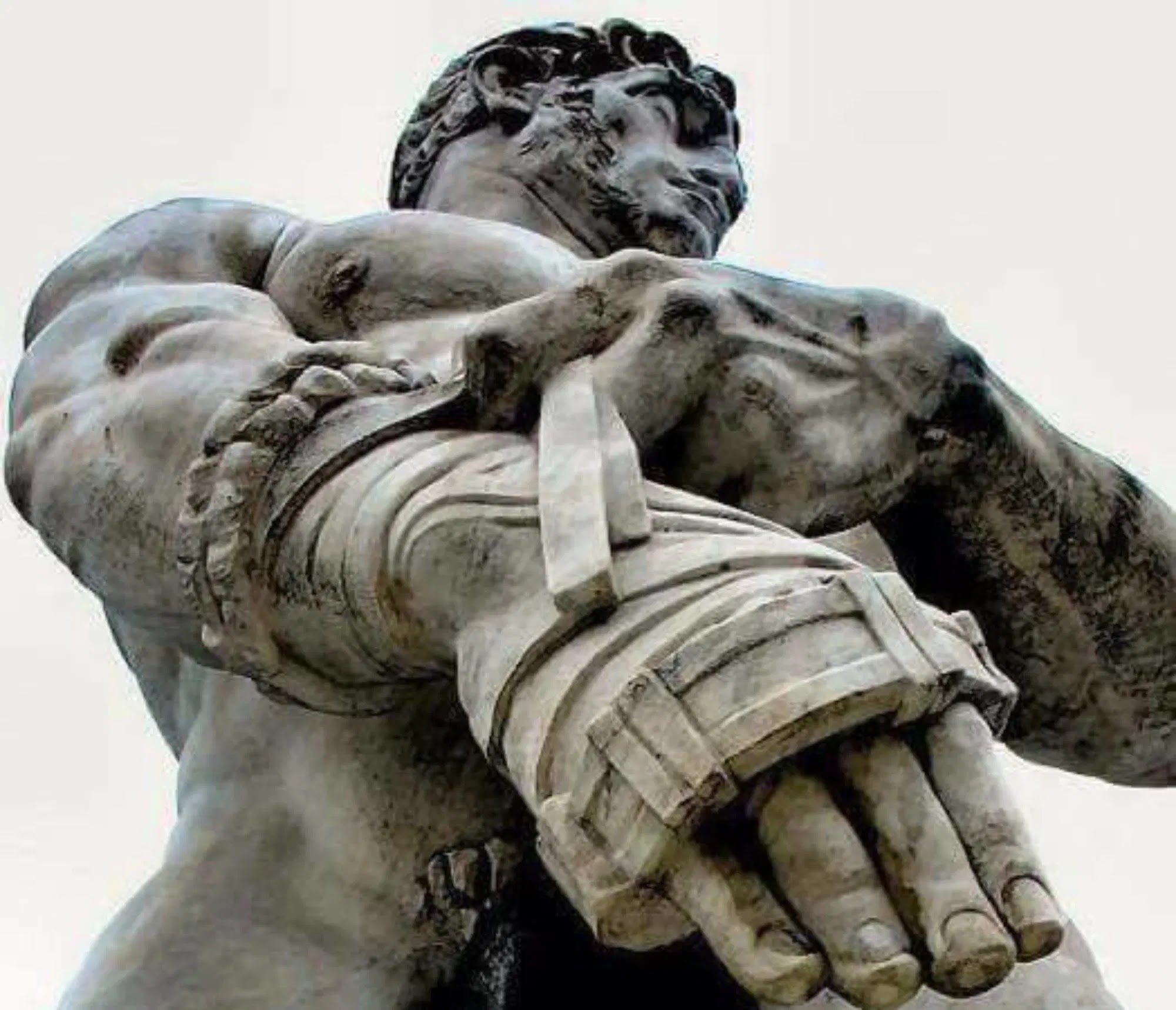 |
| All right, I'm ready. Let's do this! |
There are three categories of defense that I find a lot of players don't invest in, but they can often provide you far more protection than spending all of your gold to get the best magical amulets, shields, cloaks, and armor you can find to boost your armor class. Those areas are:
- Attack Negation
- Miss Chance
- Damage Reduction
The first category is, admittedly, one of the rarest out there. Not only that, but it tends to be pretty narrow in its application. However, this covers class abilities like the swashbuckler or duelist parry, as well as feats like Deflect Arrows, Missile Shield, and Ray Shield. It also covers feats like Snake Style, Cut From The Air and Smash From The Air as well. The idea is that these abilities directly counter an attack that might otherwise hit you, allowing you to use your own prowess instead of relying on your armor class. These abilities tend to have a small pool of uses (they require you to spend attacks of opportunity, or they only function once per round), but they are ideal for characters with high attack bonuses (or just Improved Unarmed Strike) who want to use that offense as a defense.
These don't help much with magical attacks, of course. For that you need a counterspell, or for the caster to miss you entirely... which is where the second category comes in.
Miss chance is what happens when an attack should hit, but due to poor lighting, a magical effect, etc., there's a percentage chance that it doesn't land. You've got either a 20 percent miss chance for concealment, or a 50 percent miss chance for total concealment... and these are going to be far more effective than pumping all your money into your AC just to eke out another 1-4 points that won't stop you from getting your teeth knocked out.
This can be done at all levels, depending on the situation you're involved in. A first level tiefling when fighting humans can use their darkness spell-like ability to lower the lighting conditions in an area, granting themselves a 20 percent miss chance due to concealment. Orcs fighting in total darkness in a cavern can get a 50 percent miss chance if they snuff all the lights in an area. Tossing down a smoke stick creates a cloud of vapor that makes attacks pretty likely to miss you, and is a good strategy if you're all sitting ducks in a hallway with an archer or a blaster at the other end. An invisible character gets that 50 percent miss chance, while a blurred one gets the 20. Magic items like a cloak of displacement are going to be worth more than their cost in terms of blood and suffering when it comes to how much pain they save you. And what's even better is that a miss chance can often save you from precision damage like sneak attack, meaning that even if the rogue or assassin manages to strike a blow, that mountain of d6s isn't going to accompany it.
While some would argue that mirror image isn't technically a miss chance spell, I'll remind folks about it here, because it is a life saver.
 |
| What if they don't miss, and you can't block? |
If that blow does land, and you're going to take damage, there's still one more trick you can keep up your sleeve... damage reduction.
Damage reduction is usually something monsters get, but players can get their hands on it as well. The most common examples are when it's a class feature, which you see with barbarians, bloodragers, and some fighter and monk archetypes (such as the one I used for my Luke Cage character conversion). Anyone who've ever played a high level barbarian can tell you that ticking off a dozen points of damage that you just don't have to take adds up over the course of a fight. Adamantine armor also grants damage reduction, and spells like defending bone (one of my personal favorites) will also take some of the hits for you. If you have a divine caster who really likes you then you might be able to get them to use shield other on you. Or if you get a familiar, then one with the Protector archetype can do much the same thing around level 5 as long as the two of you are touching.
Layered Defense Works Best
There is no way to completely avoid taking damage in Pathfinder. Sooner or later a lucky shot, an area of effect spell, a trap, or an invisible assassin is going to make you bleed. However, you're going to have far more flexibility (and get screwed far less often) if you can create a layered defense against the threats you're facing.
The first layer of that defense is your armor class, and while it will stop some attacks, there's no way it will stop all of them. An active defense might cut some arrows out of the air, or parry some strikes, but it won't stop every shot coming your way. A miss chance might mean that even a few of the ones that do get through fly harmlessly past. And, lastly, even if the blow manages to land, damage reduction can chop that number down so that it's barely a flesh wound.
This isn't perfect either. Area of effect spells that require Reflex saves are still going to be something you need to contend with, Will saves are going to be a serious threat, and while a miss chance might stop you from getting grappled or tripped, none of the others will affect those attacks. Choking gas clouds, fear effects, an inability to reach flying enemies, illusions... there are still dozens of different challenges and threats you'll need to be ready for.
So keep that in mind before you start feeling too invincible.
Like, Share, and Follow For More!
That's all for this week's Crunch topic! For more of my work, check out my Vocal archive, and stop by the YouTube channel Dungeon Keeper Radio! Or if you'd like to read some of my books, like my alley cat noir novel Marked Territory, my sword and sorcery novel Crier's Knife or my latest short story collection The Rejects, head over to My Amazon Author Page!
To stay on top of all my latest releases, follow me on Facebook, Tumblr, Twitter, and now on Pinterest as well! And if you'd like to help support me and my work, consider Buying Me A Ko-Fi or heading over to The Literary Mercenary's Patreon page to become a regular, monthly patron! Even a little bit of help can go a long way, trust me on that one.


