Showing posts with label half-orc. Show all posts

Monday, December 27, 2021

Combining Half-Orcs and Half-Elves Into One Category... The Blooded

When it comes to fantasy species in RPGs there is never more debate than you find around the so-called "half" options. Whether it's arguing about which species can have children with which, what powers their offspring inherit, or stating that you need X amount of a bloodline in order to qualify for these species at all, these arguments often get pretty far into the weeds.

It was with these discussions in mind that I recently created the Blooded for my Sundara setting... a category of species that I hope gives more players more freedom, and expands options in a way that everyone can enjoy.
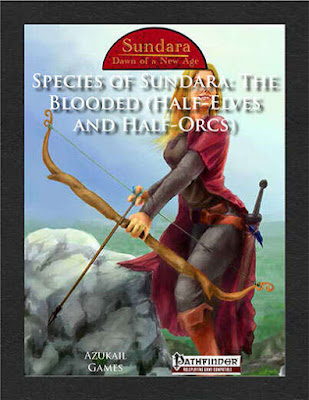
Because more options leads to better games all-around!

Before we get too deep into the latest release, don't forget to sign up for my weekly newsletter. If you've got a little extra dosh, and you want to help me keep the content coming, then consider becoming a Patreon patron, too!

Lastly, if you want to make sure you're following all of my followables, make sure you stop by my Linktree, too!

What Are The Blooded?


I've been putting out more and more setting expansions with the Species of Sundara splat books for Pathfinder, and so far I've covered elves, dwarves, orcs, and halflings (and if you prefer the DND 5E versions you can get them here at elves, dwarves, orcs, or halflings). And in those books I've made it clear when individuals are capable of having children with other species, and when they aren't. Elves, for example, are capable of having children with any other sentient species... some partners may take more work (and pose more risk) but it is possible. While orcs are not as capable as elves, the fact that they can have so many children of mixed heritage is one of the reasons so many people believe that orcs were created by the elves (or, in some tales, that orcs were elves who had transformed themselves far enough away from their base species that they became something entirely new).

This, of course, led to the "half" question that has led to so many debates around so many tables. So I thought I would change things up with the creation of the Blooded as a category of creature.
My great-grandmother always said we had elven blood...

First and foremost, this eliminates the "half" idea that one parent was one species and the other parent was a different species. The status of "Blooded" simply means that whatever your heritage, it is dominant enough that particular traits manifested in you, conferring the species template. So someone may have had elven ancestors on their grandfather's side, but it's not until their birth that those traits manifested. Alternatively, someone might have orcish blood on their mother's side, but it doesn't become dominant until they've had children.

In addition to the Blooded not necessarily being the specific, first-generation offspring of an elf or an orc with another species, this species option makes it clear that anyone capable of having children with elves and orcs may fit under this category. This means you may have Blooded who are small-sized, combining halflings and elves. You may have an orcish child of elven blood. And so on, and so forth, according to the limitations put out in the respective splats. Other than those rules, and the fact that you only gain elven or orc blood as the dominant part of your Blooded heritage, the sky's the limit!

Lastly, there's been this pervasive idea in RPGs that so-called half-elves and half-orcs are always outsiders or outcasts in some way, shape, or form. Half-elves are stifled by their elven culture, and fetishized or misunderstood by humans. Half-orcs are sneered at by "true" orcs, and feared by humans. We've seen this time and time again, and I kicked this idea right to the curb.

Each of the five cultures laid out for elves and orcs has specific names and social niches for the Blooded within their ranks. I expanded on them, listing alternative species traits and abilities to represent their unique heritages, and talked a bit about the sort of treatment they receive, and the expectations (or lack thereof) that are placed on them. Because the Blooded aren't some new and strange phenomenon, so the cultures of Sundara have grown and changed over time to accommodate them.

And because I seem to have forgotten to put the link in here in the first place, check out The Blooded for both Pathfinder Classic, as well as Dungeons and Dragons 5E!

Don't Forget To Check Out The Rest of Sundara As Well!


I'm taking a short break from Sundara for the holidays, but I'll be coming back to add more to the setting once I'm back home and stuck in for more heavy lifting.  But while you wait, consider checking out the stuff that's already come out to bring yourself up to date while you get ready for new cities, new species, items, and more!

- Ironfire: The City of Steel (Pathfinder and 5E): Built around the Dragon Forge, Ironfire is where the secret to dragon steel was first cracked. The center of the mercenary trade in the region, as well as boasting some of the finest schools for teaching practical sciences, Ironfire is a place where discovery and danger walk hand in hand!

- Moüd: The City of Bones (Pathfinder and 5E): An ancient center of trade and magic, Moüd was lost to a cataclysm, and then buried in myth. Reclaimed by the necromantic arts of the Silver Wraiths guild, this city has once again become a place teeming with life. Despite the burgeoning population, though, it is the continued presence of the undead that helps keep the city running, ensuring that Moüd is not swallowed up once more.

- Silkgift: The City of Sails (Pathfinder and 5E): Built on the cottage industry of Archer cloth (an extremely durable material used for sails, windmills, etc.), Silkgift is a place that prizes invention and discovery. From gravity batteries that store the potential of the wind, to unique irrigation systems, to aether weapons, the city positively churns out discoveries... and then there's the canal they cut through the mountains that makes them a major center of trade across the region.

- Hoardreach: The City of Wyrms (Pathfinder and 5E): A center of power across an entire region, Hoardreach is ruled over by a Cooperation of five different dragons. A place for refugees and outcasts of all sorts, Hoardreach boasts some of the most unusual citizens and creations from across Sundara. Infamous for their sky ships, which require the cast-off scales and unique arcane sciences of the Dragon Works to take to the air, one never knows just what they'll find in this city built atop a mountain.

- Archbliss: The City of The Sorcerers (Pathfinder and 5E): A floating city in the sky, Archbliss has been a refuge for sorcerers for thousands of years. It's only in relatively recent years that the city has allowed those from the ground below who lack the power of a bloodline to join them in the clouds. However, while there are certainly amazing wonders to behold, there is a darkness in Archbliss. Something rotting away at its heart that could, if not healed, bring the city crashing to the ground once more.

Gods of Sundara (available for Pathfinder and DND 5E): In a world with no alignment, and where the gods are often genuinely mysterious forces that are far too large for mortals to truly comprehend, the divine feels genuinely strange and unknown... something that really does have to be taken on faith. This supplement provides a sample pantheon for Sundara, but also provides instructions on how to easily make your own gods in a world where you can't cast a spell and tell whether someone is good or evil.

Like, Follow, and Stay in Touch!


That's all for this week's Moon Pope Monday. To stay on top of all my content and releases, make sure you subscribe to my newsletter at the bottom of the page!

Again, for more of my work, check out my Vocal archive, and stop by the YouTube channel Dungeon Keeper Radio. Or if you'd prefer to read some of my books, like my cat noir thriller Marked Territory, its sequel Painted Cats, my sword and sorcery novel Crier's Knife or my latest short story collection The Rejects, then head over to My Amazon Author Page!

To stay on top of all my latest releases, follow me on FacebookTumblrTwitter, and now Pinterest as well! To support my work, consider Buying Me a Ko-Fi, or heading to The Literary Mercenary's Patreon page to become a regular, monthly patron. That one helps ensure you get more Improved Initiative, and it means you'll get my regular, monthly giveaways as a bonus!

Monday, April 27, 2020

Orcs- Problematic, Or Just Poorly Written?

If you're a gamer on any social media right now, then you've no doubt seen the firestorms surrounding the Why Orcs Are Problematic post that's been going around. On one side of the argument you have players shouting, "We know, we've been saying this for years!" and on the other side of it you have players rolling their eyes and shouting back, "Orcs aren't even real, Jesus Christ not everything is racist!"

Artist's depiction of the comments section.
The problem here is that the argument is often couched in black-and-white, binary terms. Either orcs are problematic, or they're not. However, there's a lot going on beneath the surface, and a lot to think about. Not just in gaming in general, but also in terms of the fiction we draw on, the stories we tell, and the attitudes that are often baked-in with the games we consume.

So if you're looking for a deeper dive beyond the two options presented above (or if you're confused and looking for context) hopefully this Monday's post will help you out a bit.

But if that's not really your bag, well, my latest Critical Hits module from TPK just dropped this weekend, so you could go check out The Ghosts of Sorrow Marsh instead!

Seriously, go give it some love!

First Things First, What is an Orc?


Most of us already know the answer, so go ahead and say it with me! Orcs, as a creation of J.R.R. Tolkien were inherently evil humanoid creatures who served the dark lord and made up the ranks of his foot soldiers. They were corrupted, wicked, and they made up the muscle of the threat our heroes had to face.

Check out so far?
In their original incarnation, the orcs were symbolic as much as they were an actual threat to be dealt with. They were also monolithic; the orcs were a hoard, and there was no real, important difference between them. Some might be bigger, some might be meaner, some might be more skilled, but orcs were generally painted with a pretty broad brush. Which, one might argue, was one part of the initial problem.

The Depictions (And Evolution) of Orcs


Elements of this mythology maintained in Dungeons and Dragons' early days. Orcs were repulsive creatures who were brutal, violent, disorganized, and they typically worshiped/were bound to a dark god who demanded slaughter, sacrifice, and debased acts. While I would argue that maintaining a monolithic culture, and not giving orcs a great deal of depth were issues in the writing, the other issues actually came from their art in the early days.

And speaking of problematic art...
As was mentioned in the article, orcs were often depicted bearing weapons and armor inspired by non-European nations of the real world. Now, this was definitely fantasy, and there was no one issue of an orc carrying a kukri or wearing mirror armor that was a problem individually... it was the trend. It was the broad overall pattern that drew the battle lines in purely visual terms. Orcs were universally savage, brutal, and they carried weapons that bore a striking resemblance to India, China, Mongolia, and the Middle East. The heroes were drawing on the aesthetics and inspiration of Western European heroes, and so we have what might literally look like caricatures of East v. West.

Was that intentional? No, probably not. Just as Tolkien didn't state in his books that orcs were supposed to be based on any particular ethnicity or to represent any one group (though he did state in his letters he was drawing on specific ethnicities to make them seem more foreign to his projected European readers), the initial intent was probably not to say Europe good, non-Europe bad. Doesn't mean that's not how it came across, though.

Things got more problematic when orcs stopped just being corrupted evil beings and were given free will and choice. The creation of half-orcs (and eventually of orcs becoming PCs) meant that monsters who had once been entirely used for plot devices now had to become a varied and organic part of the world. But as we saw in Volo's Guide, as mentioned in the original article, there is still a clinging to the idea that all orcs are brutish, savage, and incapable of true empathy and understanding. They're always, at their core, monsters by their very nature. Inhuman. Other.

This becomes really problematic when you look at orcs as a big picture under those circumstances. Because if they can have children with humans, that raises questions of agency, of decisions, and of stereotyping. What was once a generic plot-filler threat is now an entire category made up of individuals who by the lore can be, do, and become what they want the same as any other character. Yet they're still treated as savage, backward, and lesser at the same time. That's frustrating for players who want to be orcs, but it also continues the trend of maintaining that problematic message.

Our Fiction Inherits Baggage (Whether Like It Or Not)


 I grew up reading pulp fiction, and there is a breathtaking amount of racism and sexism in those stories. A lot of it was a product of its time, but many among us forget that the stories and tropes of that time didn't just get uprooted and replaced with shiny, new stuff that nixed the problematic descriptions. Many of these elements endured and maintained, until we didn't see them as products of prejudiced attitudes; they were just the way these stories were told.

Bob Chipman explained it particularly well using the trope of The Lost City.


For those who didn't watch it, the trope of The Lost City has its roots deep in European colonialism to Africa. Explorers would find these ancient ruins, and they would be flabbergasted that something like this could be found in Africa. They turned themselves inside out trying to explain it, ignoring the obvious that perhaps they were built by the ancestors of the people who still lived there. Nonsense! Black people could never comprehend the skill or ability it would take to build a castle, ridiculous!

And as Bob points out, that trope kept coming back over the generations. It existed in the time of the pulps, and early adventure fiction, it showed up in Indiana Jones, it was latched onto by games like Tomb Raider and Uncharted... it's a part of so many stories it would take a huge list to lay them all out.

Does that make all the stories who used this trope racist simply because they have their roots in a colonialist view? No, it doesn't. But it is important to hold these stories at arm's length, and ask what part of the original ancestor has survived and thrived in the current example, and how it was able to make it all the way into the modern incarnation. And, perhaps, what to do to fix it so that baggage doesn't weigh on the narrative.

For those looking for a real-world example, The Liberal Redneck Manifesto talks about the battle flag of northern Virginia... what a lot of people immediately think of as the Confederate flag. It was flown in a losing war, and then it was resurrected as a symbol of hate by organizations like the KKK, and by segregationists who wanted to cow and frighten black people. The flag became a symbol of several Southern musicians as well, and it was adopted by many who saw it as a rebel icon... the problem was that it still held all those older, more awful connotations for black people, and other ethnic minorities. So even if someone wears that flag because it's something waved around by a musician they like, or it's something they associate with family and good times at home, it's important to recognize that there's more to its legacy than the parts you've seen and know. You have to look at all of it, and at what message it sends to other people.

Oh, So Now It's Racist To Have Orcs as Bad Guys?


This is probably the dumbest thing I've seen come out of this conversation, so I'm going to address it here. It is not racist to have orcs as bad guys in your game. It's not racist to play an orc character. The issue arises when people ignore the history of how orcs have been depicted (and the real-life cultures often associated with them through their art, cultural trademarks, etc.), and when they don't put in the work of actually developing orcs in their settings.

There is no replacement for hard work.
As an example, I'm going to turn to Paizo's Golarion setting. When most people think of orcs in this world, they tend to think of the orc hold of Belkzen. This nation is a loose confederation of warring tribes who worship harsh and brutal gods, who value strength, and who were the foot soldiers of a powerful lich king who sought to conquer the world a handful of generations ago. They are, in a very real sense, one of the best takes I've seen on Tolkien's orcs as an organic part of a setting.

However, they are one of dozens of different settlements around the world, and each of them has their own unique culture, background, history, and feel in the context of the setting. The settlement of Averaka is a hard-working fishing village on a northern coast. Orcs and half-orcs in the Mwangi Expanse are often valued for their strength and durability, and they often hold important positions in tribes. Orcs in the deserts form their own familial groups, trading and intermarrying with others. Orcs and half-orcs have a wide variety of traits players and DMs can pick to customize them to a given area, but more importantly the lore of the setting makes it clear that attitudes, styles of society, etc. are a product of their history in a given area, rather than some in-born sameness that all orcs share.

That's the level of work it takes to make a sentient race a real, breathing part of a world and setting, and all of that has to carry through to how they're treated in the world as well. If a settlement is being raided by orcs, ask why, and build that into the adventure. Are they a war band who can't find a master, and they would rather take from the farmers than lay down their swords? Are they starving and pushed out to the edge of the badlands, so they have to steal in order to live? Is there a disagreement over the terms of a peace treaty, or are they mercenaries whose services have been bought by a bigger NPC with a hidden agenda? Is this a land-bound group of pirates looking to get back on the river, but they need the resources to repair their ship?

All of those are workable, and they add extra depth and meaning, allowing orcs to stand on their own as characters instead of as caricatures.

Lastly, Consider The Problematic Core of Many Adventures


Now, I know we're talking about orcs here, but this is something that Mark T. Hrisho brought up on his blog and I think it's a point worth adding to the discussion. Because a lot of our fantasy RPGs have another piece of baggage that has colored many of our monstrous races; mainly that if a given area of the map doesn't have people who look like our party living in it, then it doesn't really qualify as settled or explored territory. It is, instead, the edge of the known world, and the last edge of real civilization beyond which lives only darkness, and savagery.

Helmets on, I hear comments coming!
How many adventures have you played in tabletop RPGs, or even in video games, where you took on quests to "clear out" local monster infestations in the area? Caverns full of goblins, hills teeming with kobolds, mountaintop ogres, or the ever-present roving bands of orcs? If you've been in the hobby any length of time, you can probably think of several games that started you off this way.

And I'm not the first one to point out that in these scenarios we're basically barging into these creatures' homes, killing their families, and taking their stuff.

Even if it's not a job to kill a certain number of non-humans, these scenarios are often painted as, "protecting the light from the darkness of the savage lands," or something similar. Which basically states that none of the cultures of the other beings who call this region home, from the lizard men, to the catfolk, to the gnolls, are "real" people. They're just savages. Monsters. Little better than animals, and often not even worth as much XP.

Am I saying that fantasy RPGs who use this framework purposefully set out to be some kind of subliminal argument for the ideas of Manifest Destiny, or declarations in favor of colonialism? No. However, messages exist in fiction whether they're intended or not. Just like how early Disney princesses being damsels in distress wasn't likely intended to send the message to young girls that they had no agency and should wait to be rescued, but it can be argued that message is present regardless of the intention.

"Problematic" isn't a term reserved only for racial slurs and misogynist rants; it means that we need to look at the history of something, the messages within it, and how it came to be what it is. We need to be intellectually curious, honest with the history, and we need to understand that just because someone didn't intend something to send the wrong message, say the wrong thing, or to smuggle in an offensive attitude, that doesn't mean it didn't happen. Because it's only by looking these elements full in the face that we can make the games we love better, deeper, more complex, and in the end, less problematic.

And like I said in It's Okay To Admit There Are Problems in Your Hobby, you can like something problematic without being problematic by association. But we should all seek to be intellectually curious about these issues, and to remember that just because it may not affect us personally, that doesn't mean it's somehow not a real issue.

Like, Follow, and Stay in Touch!


That's all for this week's Moon Pope Monday!

Again, for more of my work, check out my Vocal archive, and stop by the YouTube channel Dungeon Keeper Radio. Or if you'd prefer to read some of my books, like my sword and sorcery novel Crier's Knife or my latest short story collection The Rejects, then head over to My Amazon Author Page!

To stay on top of all my latest releases, follow me on FacebookTumblrTwitter, and now Pinterest as well! To support my work, consider Buying Me a Ko-Fi, or heading to The Literary Mercenary's Patreon page to become a regular, monthly patron. That one helps ensure you get more Improved Initiative, and it means you'll get my regular, monthly giveaways as a bonus!

Saturday, December 17, 2016

The Half-Elf, Half-Orc Arcane Archer

Only a fool would claim that a half-orc is an opponent to take lightly. The ferocity of their forebears runs in their veins, and their night sight, in addition to their raw strength and hearty constitutions, can make them a serious threat on the battlefield. A half-orc with a bow can be particularly deadly, especially if his targets lack his ability to pierce the darkness. But when a half-orc archer raises his longbow, whispers a string of elvish words before letting fly, and then a ball of fire erupts where the arrow lands, that is a different kind of threat entirely.

Soldiers are dead, or frantically stamping out flames, and back-lit as they are it's child's play for the arcane archer to send shafts flying into each of them. But how did a half-orc ever learn the elvish magics that mesh with the mastery of the bow?

Maybe he beat it out of a teacher?

The Half-Elf, Half-Orc


If you're playing with the updated version of the rules, then you know that the "elf or half-elf" requirement was dropped from the arcane archer prestige class. However, even with that requirement removed, it's still a class that's associated quite heavily with elvish culture and heritage. But you don't need it to take levels of the class anymore.

With that said, you do still need to be considered an elf for feats like Stabbing Shot, and for certain items and spells that can add some serious punch to your character's abilities.

Now, in Pathfinder (as well as in the base rules for most of the recent editions of Dungeons and Dragons), say you're half-elf and half-orc is pure story flavor. Because while you can say that you are the child of two races, the racial abilities elf blood (for half-elves) and orc blood (for half-orcs) expressly state that you're treated as human and whatever your other race is for the purposes of effects, abilities, feats, etc. (taking classes and prestige classes falling under the "et cetera" label).

So, mechanically speaking, you only gain one half of your heritage. Which is where the Racial Heritage feat comes into things. If you caught my older post Bored Playing Regular Humans? Try Racial Heritage on For Size, then you know where this is going.

Strap in, because this is gonna get ridiculous.
 
So, you begin your character as a half-orc. You're considered an orc, and a human for all intents and purposes. Then, as your first-level feat, you take Racial Heritage (Elf). You are now, mechanically, treated as an orc, a human, and an elf for feats, magic items, spells, classes, prestige classes, and all that other stuff.

That's all it takes to get over that racial requirement hurdle for any abilities you want to add to your character, in a pure, mechanical sense. This is particularly true if you want to wield enchanted weapons that typically grant their abilities only to elves. Is it worth eating your 1st-level feat for access to those things? That's up to you to decide.

What's Your Story?


Getting the mechanics out of the way is easy; it's the story you're trying to tell that's going to be tough. Because someone with the strength of the orcs, and the guidance and grace of the elves, is going to become a terrifying archer with the proper training. But who gave this character that training? How did they unlock this potential?

Oh shit... my half-brother is nocking...
 
For example, did this character seek out a half-elf arcane archer? A mentor who knew how it felt to be sneered at as lesser, and told this was not truly his birthright? Alternatively, did this character get press-ganged into service by an orc tribe, who honed his natural instincts to a razor's edge before he figured out how to meld magic with his arrows? Or, unusually for a PC in an RPG, was this character part of a community that supported those with talent, regardless of where they came from and how they looked? Did the elders, upon putting a bow in his hands, realize that he had inherited more than his father's fine hair and silver eyes, despite the jutting brow and tusks from his mother's side of the bed?

There are all kinds of ways you can combine spellcasting and archery. The magus archetype myrmidarch is one of the simplest methods. If you want the original arcane archer, though, and you want to expand beyond the usual elves and half-elves, this is a fun little trick that lets you get away with something different.

Like, Follow, and Stay Tuned For More!


That's all for this installment of Unusual Character Concepts. Hopefully this one gave you something to chew over, whether you're a player, or a game master.

For more of my work, check out my Vocal archive, and stop by the YouTube channel Dungeon Keeper Radio. Or if you'd prefer to read some of my books, like my alley cat noir novel Marked Territory, my sword and sorcery novel Crier's Knife or my most recent collection of short stories The Rejects, then head over to My Amazon Author Page!

To stay on top of all my latest releases, follow me on FacebookTumblrTwitter, and now Pinterest as well! To support my work, consider Buying Me a Ko-Fi, or heading to The Literary Mercenary's Patreon page to become a regular, monthly patron. That one helps ensure you get more Improved Initiative, and it means you'll get my regular, monthly giveaways as a bonus!

Friday, December 9, 2016

Ethnicity and "Half-Breeds" in Fantasy RPGs

Anyone who's ever played a fantasy RPG is familiar with the idea of half-breed races. Half-orcs, for example, tend to lack the sheer ferocity of their full orc parents, but they tend to be smarter, and more cunning. Half-elves are not as long-lived as full elves, but they temper wisdom and enthusiasm in a way that alloys their human and elven heritages. There are also tieflings and aasimar, who reflect infernal and celestial heritages, as well as more unusual examples like dhampir and half-ogres.

The first question most people ask is why are there so few "half-breed" races to pick from? Are there no partial gnomes? Is there a half-halfing option? Has a dwarf never managed to have a child with an orc?

Don't let the charisma negative fool you, I'd hit that... with my ax!
The simple answer, which you find in books like Bastards of Golarion, is that certain races simply don't produce offspring. And, in other cases, the children may inherit features of both parents, but will only have the benefits and racial abilities of one template. So, for example, it's perfectly possible to have a child whose parents are an orc and an elf... but you can't get the benefits of both races. You need to pick which one is more dominant.

And maybe take the feat Racial Heritage to give you access to abilities usually reserved for the other side of your lineage.

The question I'd like to ask is why all our half-orcs, half-elves, and other characters with unusual heritage all tend to look the same?

There's More To The World Than Fantasy England


I harped on this in Do Dwarves Surf? Tips For Diversifying Non-Human Fantasy Races, as well as in the post Ethnic Homogeneity in RPGs (Or, Why So Many Burly, White Adventurers?), but there's a tendency for us, as players and DMs alike, to default to the same half-dozen acres of English countryside that's carved out of J.R.R. Tolkien's back garden. Even if the setting we're playing in is diverse in terms of races, ethnicity, cultures, and traditions, it's like Lord of The Rings is a comfort zone we just can't step out of for too long.

Thanks, Tolkien!
So, the question I think we should all ask ourselves the next time we put together a PC with only a partially human heritage is to ask who their human parent was. Where did they come from? What features did they inherit from their human mother or father? Most importantly, Who Raised Your Character, and How Did That Shape Them?

There's a whole layer of character development here that we often ignore. Take the map of Golarion, the base world for Pathfinder (it's the one I know best, so it's the one I tend to default to for examples). Say you want to play an aasimar, and you decide that his lineage comes from both the Mwangi Expanse, as well as from the celestial realm. So you end up with a tall, handsome black man, with eyes of silver, a halo of light, and wings inherited from the supernal planes.

There are all kinds of examples you could pursue with this idea. What would a half-elf born to the Shoan-Ti, and raised in their burning deserts and arid wastes, look like? How would a half-orc born from a union where one parent had Tian heritage appear? What would a dhampir reared in the Land of The Linnorm Kings look like? Or a tiefling from the top of the world, born to the Mammoth Lords?

It also bears repeating that, just because a character shows a certain ethnicity, that's no reason to declare they must be from a certain place. Between traveling merchants, wandering adventurers, wars, and the slave trade (all common elements in most fantasy RPGs), it's usually possible to find all kinds of heritages in places that aren't their "homelands". Which is just one more element you have to consider. If you're the child of immigrants, even if your parents, and their parents, were born in your home country, how were you treated? And what are the attitudes toward your non-human heritage in that part of the world?

Just some food for thought!

Thanks for checking out this week's Fluff topic. Hopefully it got your wheels turning, and made at least a few folks want to step away from playing regular humans for a while. If you'd like to help keep Improved Initiative going, stop by The Literary Mercenary's Patreon page to toss a little bread in my jar. As little as $1 a month keeps the wolves from the door, and gets you some sweet swag, too! In fact, if you become a patron before the end of the year, I'll double the amount of stuff I usually hand out. Lastly, if you haven't followed me on Facebook, Tumblr, or Twitter yet, well, what's the hold-up?

Friday, March 18, 2016

Natural Attacks Can Turn Your Pathfinder Character Into a Monster

The party has battled its way through the blighted forest, scaled the cliffs of the blackened reach, and now finds themselves in the den of Flame Breaker, the ancient red wyrm. The adventurers manage to survive the great beast's breath, but those who rush in foolishly find that the dragon has other, more personal weapons at its disposal. After two claws, two wings, a bite, and a tail slap, those members of the party who aren't dead are going to spend the rest of the round ducking for cover and trying to heal.

Should have brought your A-game, my tiny morsels.
While the sheer array of natural attacks a dragon can rain down on a party is impressive, it's far from the only monster in the manual that gets so many powerful strikes. What a lot of players either don't know, or totally forget about, though, is that natural attacks aren't a toy reserved for the DM. You can add them to your character, as well, and often to truly devastating effect.

What Are Natural Attacks (And How Do They Work)?


Since we're crossing into territory a lot of players never enter, let's begin at the beginning. A natural attack is when a creature has some variety of natural weapon they can attack with. This might be a bite attack for a wolf, or a slam attack for a golem, a gore for a minotaur, you get the idea. All the different types of natural attacks, and their damage by size, are listed in the Universal Monster Rules.

With me so far? Good.

There are also two types of natural attack; a primary, and a secondary. A primary natural attack is made with the creature's full base attack bonus, ability modifiers, feats, bonuses, etc. just like a regular attack would be, and it adds the creature's full strength modifier to damage. If a creature only has one natural attack, it is considered a primary attack, and it adds 1 1/2 times its strength modifier to damage. A secondary attack is made with the creature's base attack bonus -5, and only adds 1/2 the creature's strength modifier to damage.

So bite is good?
Some of you are probably nodding along, but you're not sure where this is going. Sure, getting to add 1 1/2 your strength on a bite attack is great, but your bite only does 1d4 points of damage, and you could swing a greatsword to much bigger effect.

Remember the dragon example above? All creatures with multiple natural attacks get to take all of them as part of a full-attack action. No matter what level you are.

Time For Some Examples


All righty, let's reach for some low-hanging fruit. Let's say you're playing a 2nd level alchemist, and you take the feral mutagen discovery. This grants you a bite attack that deals 1d8 damage, and 2 claw attacks that deal 1d6 damage when you imbibe your mutagen. All of these attacks are listed as primary attacks. So, even though you're only level 2, you can claw, claw, bite as a full-attack action, with each attack getting your full bonuses, tearing someone to shreds like Lon Chaney on crystal meth. Not only that, but natural attacks can be modified by feats like Weapon Focus, Weapon Specialization, Power Attack, etc.

But wait, there's more!
You're probably thinking sure, natural attacks sound pretty cool for lower-level stuff, but once I get a magic weapon they just aren't going to keep up. Hold onto your hats, folks, because you don't have to choose between your iterative attacks (the ones with weapons we're all so familiar with) and your natural attacks.

You see, you can choose to make a full-attack action using both your iterative attacks, and your natural weapons. The only catch is that, when you do this, all your natural attacks are considered secondary attacks.

How does that work? Well, let's say you're playing a level 2 barbarian with the Lesser Fiend Totem Rage Power. This means that, when you Rage, you grow a pair of horns, and gain a gore attack with them. But, because you raided a sweet dungeon, you also have a flaming greatax. No problem! First, you take your regular attack with the greatax, adding your full BAB, bonuses, etc. Then you take your attack with your horns. They're now a secondary attack, instead of a primary, so you subtract 5 from your total.

There is a caveat here, though. You cannot make natural attacks with a limb that is holding a weapon. So, the alchemist we mentioned earlier could swing a mace, then take a bite, and a claw attack, both as secondary attacks, if he wanted to, but he can't make two claw attacks because one of his hands is holding his bludgeoner. Make sense?

Of course, this can get really crazy when you start playing a brawler or a monk, and your character has several natural attacks as well. A brawler with a bite attack and two claws, for example, could declare his iterative attacks are kicking his enemies, and then he could take his three natural attacks, albeit as secondary attacks, to become a whirlwind of death. Or when you have a tiefling who's a two-weapon fighter, who also gets a gore attack, and two hoofs because of his goatish inheritance.

The Limitations of Natural Attacks


Before you get too excited, putting together a half-human, half-beast death machine, it's important to remember that natural attacks have limits in what they can do. For example, lots of spells that grant weapon bonuses do not grant those bonuses to natural attacks. When you buy magical enhancements, you'll need to get an amulet of mighty fists in order to add magic to your strikes. Additionally, you may need to eat up several feat slots taking things like eldritch claws or improved natural attack and multiattack (the latter two are found in the Bestiary under "Monster Feats") in order to make sure your attacks keep pace with the monsters you're fighting.

Whatever they happen to be.
It is important to remember, though, your natural attacks aren't something that can be disarmed, and you always have them with you. Also, they benefit from class features like favored enemy, smite, and sneak attack the same way any other weapon would. So if using a lot of natural attacks is something you want to do (especially in conjunction with two-weapon fighting to get all the attacks in), you might want to see how you can turn your body into a weapon.

Some Ways You Can Get Natural Attacks


For those of you who've read this far who are wondering how to make natural attacks a part of your character, there are a lot of ways you can acquire them. Here are just a few of the more common ones you won't have to beg your DM for too hard.

- Rage Powers: Powers like the lesser fiend totem, beast totem, and animal fury grant you natural attacks while raging (gore, claws, and bite respectively). It's also worth noting that the greater beast totem grants you pounce, which could be a nightmare for anyone caught at the end of your charge attack.

- Mutagen: The feral mutagen mentioned in the example above is another great way to get a full bevy of natural attacks. If you're planning on taking levels of Master Chymist, it also allows you to hit harder, and hurt more, with those natural attacks.

- Class Features: Several sorcerer bloodlines grant natural attacks for a certain period of time at lower levels. Draconic sorcerers, or those who take levels in Dragon Disciple, will gain claws and a bite for a certain amount of time during the day. Druids who use their wild shape will gain the natural attacks of the creatures they become. Rangers can choose to take the natural weapon fighting style, which doesn't grant natural attacks itself, but it does give you access to feats which do, like Aspect of The Beast.

- Racial Features: This is where most natural attacks come from, because to have them all the time you've got to be born with them. Races that gain natural attacks, or have the option to gain natural attacks include orcs and half-orcs (bite), catfolk (claws), tieflings (variety of natural attacks, with racial feats), skinwalkers (bite, claws, or gore, typically), Tengu (bite, and sometimes others), and goblins (bite). There are other available races that get, or can get, natural attacks, but these are some of the more common ones.

- Magic Items: Though not common, there are some magic items that grant natural attacks. The Demon Hand, in particular, grants you a natural claw attack that's one size category bigger than you. The only requirement is that you have to replace your hand with a demon hand. This was one of my favorites mentioned in Replacing Lost Limbs With Magical Prosthetics in Pathfinder.

- Feats: There are a lot of feats that grant natural attacks to certain races or classes. Aspect of the Beast lets druids gain natural attacks, while Razortusk gives orcs and half-orcs a bite attack if they swapped out the racial feature.

For those who've been missing my long-winded crunch lists, hopefully this week gave you plenty to chew over. If you'd like to help support Improved Initiative, then why not drop by The Literary Mercenary's Patreon page to become a patron today? For as little as $1 a month, I  can keep the faucet open, and the flow coming straight to you. Also, if you haven't started stalking my updates yet, why not follow me on Facebook, Tumblr, and Twitter?

Friday, December 19, 2014

That One Time A Cheating Player Got His Comeuppance Via A Cyclops

Just a reminder that for the rest of 2014 I'm having a holiday giveaway! Check out the details in this entry, and if you'd like a free ebook from a Pathfinder Tales author then just send me an email using the contact form on this page!

Now then, where was I? Oh yes!

We all know those players. The people who make convenient math errors a little too often, who ignore the negatives their characters are suffering one too many times for it to be chance, and who snatch their natural 20's up off the table before the DM can get a really clear look at what was on the die. We're pretty sure they're cheating, but we're not sure if we're ready to stick our necks out and accuse them in front of the whole table like the world's geekiest courtroom drama.

Their own actions will eventually deliver the karmic crotch-kick we so desire. Or at least that's how it happened to a guy named Rob.

Short-sighted doesn't begin to cover it.
Those of you who've read the other entries in Table Talk will recognize Rob as the fellow who ran the Star Wars game that resulted in my getting an out-of-game job offer from a Sith Lord. Well he was a invited along with myself and several others by a DM named John who was going to put together a grueling game that would challenge our abilities, our courage, and our luck.

Needless to say, we were in.

The Most Pointless Cheat In The World


There were roughly 6 players in this group, which is heading toward the big side of a party. There was a paladin, a sorcerer, a rogue, a cleric, a fighter, and a monk. Because John is a foolish but interesting DM he told us to roll 4d6 and drop the lowest, and to re-roll 1s and 2s for our stats. He also had a caveat that said if you rolled all 6's then you got to keep the 24 for your stat.

Take a wild guess who got the 24.
Instead of rolling his dice carefully where the DM could see it, Rob's rolled a mysterious 24 when the rest of the table was engaged in a discussion over other rules. Because none of us had seen him alter the dice post-roll, though Rob's defensive facial expression and body posture said that was likely what had happened, John told him to take the 24. It was just easier than dealing with the argument that would ensue.

Here's where things get dumb. The paladin, sorcerer, rogue, and cleric all had understandably high charisma scores. After all, each of them has skills or class features that depend on that stat. My fighter, a black knight who'd cut ties with his noble family in Cheliax, also had a charisma of 16. Morvius Henderthrane was going to be recruited by the Eagle Knights, and I needed a high charisma for his prestige class. Upon comparison it's remarked that we are, "a very pretty party," with a 15 sitting as the lowest charisma score among these five characters.

Rob hears this and immediately decides to switch the 24 from his strength to his charisma. Why does a half-orc monk need a 24 charisma? Your guess is as good as mine dear reader, but I have a sneaking suspicion it was because he wanted to "win" what was never a competition in the first place as to who had the most striking presence.

The Comeuppance


The game starts with all of us at level five adventuring together. We're put ashore on the south side of an island and told that there is a hag leading an army of nightmare creatures in a cave up the coast. If we want to end the threat we need to take her unawares. We smash our way through a fight with some giant crabs, and start climbing the cliffs. Showing both strategy and variety, John throws some harpies at us. Once the harpies have distracted us, a cyclops crashes in from the woods, large-sized greatax raised and ready to swing.

Everybody chill. I got this.
Arrows and daggers are flying, and the party is getting slammed by the assailants. Morvius is even pushed off a small cliff. Non-plussed and seething he storms back up the rise, and splits the last remaining harpy from crotch to crown with a critical from his bastard sword. At almost the same time the sorcerer, the only other Chelaxian in the party, casts blindness on the cyclops. The DM rolls low, and the giant's single eye withers and drops out of its socket, leaving the potent foe significantly reduced.

Morvius being lawful and a knight calls for the cyclops's surrender. The giant agrees. It is at this time that the monk, who has done nothing useful to contribute to the fight up to this point, rushes up to the cyclops with the intention of striking a death blow on the helpless, surrendered creature. The cyclops hears the monk coming, and uses an ability that those who hadn't read the Pathfinder Bestiary in-depth to see how it was different from the Monster Manual didn't know about; the ability for a cyclops to declare any die roll a natural 20 due to a brief glimpse into the future once per day.

The result? The creature brings down its ax, and the DM rolls to confirm the critical. He confirms with a natural 20, and rolls enough damage to smash the orc down to -20 hit points.

He Chose Poorly


The entire table was silent for about five seconds. The silence filled up with the sounds of barely-suppressed laughter as the DM showed Rob the description of the ability, and Rob spluttered to try and find some way to save his dishonorable and mostly-useless monk. There is no way to save him, and so we're reduced down to a mostly-functional party size.

If only he'd put that 24 in Constitution...
Despite the player pouting and huffing about his well-deserved and totally-legal character death, the rest of the table used it to further the plot. Morvius and the sorcerer threatened the giant badly enough that it nearly killed itself running for its life down the mountain, and Morvius demanded that they stop and bury their fallen comrade. Only once the dirt had been thrown on it did he insist they continue, and give the half-orc an escort on his way to Pharasma's judgment.

He had plenty of company... enough so that we gained 2 levels in a single fight. But that's another story for another day...

If you have a gaming story of your own you'd like to tell, send it to Improved Initiative and we'll be happy to give you a moment or three in the spotlight! If you'd like to support the blog then stop by my Patreon page and become a patron today! If you want to make sure you get all of my updates then follow me on Facebook and Tumblr too!