Showing posts with label tiefling. Show all posts

Saturday, September 26, 2020

The Infernal Grandchild (Wizard Concept)

The mob had gathered, truncheons and pitch forks in their hands. Torches had been lit, and the fire danced in the eyes of the onlookers. Their gazes were fixed on the bloodied figure chained on the block at the edge of the water. With horns cresting from his black hair, and skin red as sin, there had been no trial. No hearing to evaluate the words of those who'd spoken out against him. After all, what could a creature with cloven hooves and a spaded tail truly say in its defense?

"Any last words?" The self-appointed judge asked.

The tiefling nodded his head solemnly. He'd been sitting there, head down, bloody fingers twitching across the stone for nearly ten minutes. He drew himself up, as best he could, and looked into the eye of the man who had sentenced him. He ran his tongue over his bottom lip, ensuring the blood would be a part of what he said. The crowd behind him drew in its breath, as if sensing what was to come. Before anyone could stop him the wizard spoke a single word, his blue forked tongue dancing around the syllables that would have stymied anyone not so blessed.

"Anthiaraxes," he said.

For a moment, nothing happened. It seemed in that second that it had all been a bluff... then the howling began. A wind from nowhere guttered the torches, and darkness bled into the world as if the very air had been stabbed. It congealed, and burst, the shadows birthing something that made all of them draw back. It bore the likeness of a woman, but twisted out of true. The neck was too long, the face too perfect. It bore too many knuckles in its fingers, and its hair whipped like an angry cat's tail, so dark it drank the light. The creature's eyes were the worst; twin voids that would siphon away the soul if one didn't have a will of iron when they met them.

"Before I pass my judgment," Anthiaraxes said, her voice a soft, sibilant whisper that burrowed into the ears and minds of all those present. "Why have you bound and chained my favorite grandson?"

And make it good. I didn't come all the way here for nothing.

When You Have Family in Low Places


Infernal power comes in many shapes and forms. For some it's a result of a pact made with dark powers in exchange for their soul. For others it's a mark of a favored servant, with an archfiend empowering them as a servant of their dire faith. For some it's a result of their bloodline, tainted by the back hand of a devil.

This concept is for characters who fall into the final category.

Whether this character is a tiefling, or they merely have some vestigial connection to the blood of the lower planes, the idea is that they know the true name of a powerful entity connected to their family. Perhaps it's the fiend who first mixed their blood into their line, or if the character is descended from a more potent devil, the name of one of that devil's servants who is bound to answer the call when it goes out. While this can also be accomplished with demons and celestial creatures, those are simply variations on the theme presented below.

The Mechanics


The mechanical trick for this story is the Arcane Discoveries option that was added to wizards in Ultimate Magic for Pathfinder. The discovery True Name allows you to learn the true name of a powerful outsider, which you can then summon to you as if by using planar binding as a spell-like ability. You must be 11th level to take this ability, and the outsider in question can have no more than 12 hit dice. However, if you take this ability at 15th level, the outsider can have no more than 18 hit dice. This functions as greater planar binding.

And if you really want to sell the whole, "favored child of an infernal heritage," my recommendation is to make a conjurer wizard who always falls back on summoned devils, hellhounds, and other similar monsters. Maybe they're servants of the conjurer's ancestor, or they simply recognize the lineage and are hoping they will earn favor by providing good service. But it's helpful to establish a theme as you grow in power, and gain access to stranger and more varied creatures.
 
While you can bring across the flavor using a sorcerer, a warlock (in 5th Edition DND, anyway), they won't give you access to this unique ability. That is, of course, at your discretion.

The Story


What story you make to support this kind of character concept is totally up to you! There are, however, some archetypes and paths you might want to consider.

If you want to play an evil character (keeping in mind all the advice I presented in 5 Tips For Playing Evil Characters, such as being part of a team) you could easily play as an extension of your ancestor's influence on the material plane. This would have many of the same overtones as a cleric of an archfiend; receiving messages from fiends, contacting the outer planes to report on your progress, etc. If you wanted to avoid making the character too edgy or grim, you could even give it a kind of Addams Family vibe where they simply have no idea what it is everyone around them is so upset about. This is just the way things are done at home (petting the hellhounds, laughing at the "playful" imps, etc.).

Alternatively, the character might be actively trying to turn the forces of hell to a good cause. So while the devils they summon are forced by both magic and oaths of allegiance to comply, they know they're going to catch hell from grand mama if she finds out this conjurer was summoning devils to fight against evil cults. You might even be able to set it up as a kind of chess game between the character and the fiend. The Infernal Grandchild thinks they're subverting the fiend's will, but on the grander scale of things it is the Infernal Grandchild who is actually fighting the fiend's foes. For every evil cult they crush, and every demon lord who's plans they undermine, that creates a power vacuum the fiend can then step into in order to expand their own power and position. While their Grandchild might sometimes deal a blow to one of the fiend's allies, or harm their other servants, that's all part of how the game is played. Sometimes you have to sacrifice a pawn or two.

You could even walk a middle path with this story, and create a kind of estranged family relationship. Perhaps the conjurer tries to avoid calling on the servants of the infernal the same way they'd avoid calling home to ask for money after they had a big fight with their father. They wait until there's no other way, and of course the fiend wants to help... because the more often the conjurer asks for help, the easier it will be to become their crutch. So it's a tug-of-war as the fiend tries to ensnare the wizard, and the wizard is trying to remain untethered to the machinations of their line's progenitor.

There's a lot you can do here, and so much of it is left up to you as the player (and your DM, of course). With that said, you might find helpful inspiration for bringing this concept to life in...

- 13 Fiends: A Baker's Dozen of Devils: If you're looking for a powerful fiend to attach mechanics to, the options in here have names, symbols, histories, and purviews you can easily draw on.

- 100 Tieflings To Meet in Your Travels: Whether you just want something to get your wheels turning, or you want to build an extended family, I'll always recommend giving this one a look. You don't have to be a tiefling for this concept to work, but it is fun.

- 5 Tips For Playing Better Tieflings and Aasimar: Again, you don't have to be a tiefling for this concept, but if you're going to be either a tiefling or an aasimar (after all, your ancestor might have fallen from grace), I'd recommend giving this one a look.
 
Also, if you want to make sure you don't miss any of my updates (and that you get a weekly rundown of all my fresh content, news, and more), then take a moment to sign up for my newsletter! If you don't want to click the link, there should be a form at the bottom of the page as well.

Like, Follow, and Stay Tuned For More!


That's all for this installment of Unusual Character Concepts. Hopefully this one gave you something to chew over, whether you're a player, or a dungeon master.

For more of my work, check out my Vocal archive, and stop by the YouTube channel Dungeon Keeper Radio. Or if you'd prefer to read some of my books, like my sword and sorcery novel Crier's Knife or my most recent collection of short stories The Rejects, then head over to My Amazon Author Page!

To stay on top of all my latest releases, follow me on FacebookTumblrTwitter, and now Pinterest as well! To support my work, consider Buying Me a Ko-Fi, or heading to The Literary Mercenary's Patreon page to become a regular, monthly patron. That one helps ensure you get more Improved Initiative, and it means you'll get my regular, monthly giveaways as a bonus!

Monday, December 2, 2019

DMs, Remember That "No" is Not The End of The Conversation... It's The Beginning!

One of the most common pieces of advice I've seen for newer dungeon masters is not to be afraid to tell your players no. Whether it's saying no to a race that doesn't fit your setting, or no to a third-party class you're not familiar with, it's important for you to have confidence in your ability to run the game effectively. Sometimes that means saying no to something your players want.

With that said, though, a lot of DMs make the mistake of assuming that their "No" is where the conversation ends, when it's actually the place it should be getting started.

An excellent question, Cindy. I'm gonna have to say no, though, and here's why...

Explain Why You Said "No"


To be clear, here, we're not talking about scenarios where players are asking about the rules as they're written, or checking the hard limits of a game. Those are simple yes/no questions that have a binary answer. However, when a player asks whether it's okay for them to take a certain feat at this level, play a creature of a certain race, or take levels in a particular class, these are usually options that are perfectly legal by the rules of the game.

Or, put another way, it's you as the dungeon master that stops a player from doing this, rather than the game as it's written.

Pay no attention to the man behind the screen!
When it's you, and not the rules, that's preventing a player from moving in a certain direction, it's your job to have a conversation with the player to explain your reasoning. While we all joke about how the dungeon master is god, it's important to remember that your players are just as much a part of the game as you are. They're equal participants, and if you're going to stop them from contributing to the game in a certain way, they at least deserve some kind of explanation as to why.

If, for no other reason, than to help them figure out what you found objectionable, and why so they don't just keep running into a wall.

For example, say that you had a player who wanted to play a tiefling ninja in your Pathfinder game. By the rules, that race is completely legal, and the class is part of the game's rules, so there should be no problem. But maybe you're running a homebrew game where tieflings aren't really a thing, and it didn't come up until just now because no one else asked for a native outsider. Alternatively, you might not feel that the ninja is a proper fit for your game due to its skill set, and that it won't have the chance to really shine taking on the challenges you have planned in the campaign. Maybe you're not comfortable with classes or races outside of the core book, or you've heard horror stories about that class and it makes you worry. Whatever it is, talk about it with your players.

Remember, the more specific you can be here, the better the results you'll generally get. You want your player to see your position, and to understand your reasoning so you can both find an amenable solution.

Hear Your Player's Point of View


The second part of this conversation is letting your player actually respond to your points. Because just like the characters in the game, you're not making these decisions in a vacuum. The game is a group endeavor, and sometimes it needs to be talked out.

All right, I see what you're saying, but hear me out on this...
In order to keep your player enthused with your game, you need to make sure they know they're being heard... so listen to them. If they make good points, discuss those points and see where it leads you. If they find inconsistencies in your rulings, don't hedge or dodge.

The goal here is not to be right, because as pointed out above, there is no right answer when it's not a specific rules question. The goal is to make sure you and your player can both see each other's point of view, and that you're both on the same page moving forward.

Work Together To Find A Solution


Let's return to the concept of the tiefling ninja, to continue our example. Perhaps the thing you're objecting to is not that tieflings don't exist in your setting, but that they are often marginalized and looked down on in the nation where your game is taking place. Having a tiefling PC is going to create a lot of unnecessary friction, and you're worried it could cause problems not just for the player, but for the rest of the party.

What's that? Roll initiative? Ah, well, if you insist...
That's a fair point, and one worth raising. However, the player counters, what if they took the tiefling variant that allowed them to pass for human, displaying very few traits one associates with a tiefling? In this instance they could still have the race they really want to play, and as long as they take a few basic precautions (not putting their feet in the fire and taking no damage, not using their spell-like abilities where it could cast suspicion on them, etc.) then they should be able to keep their true heritage a secret. This could create a fun cat-and-mouse dynamic, and even add another dimension to the game!

Alternatively, if your concern about the ninja is that you don't want your player to portray them in the way we typically see them in fiction (the age old, "No Eastern classes in my Western fantasy!" argument), then an alternative compromise might be to simply rename the class as the Agent, instead. I talked about this a ways back in Want To Play a Ninja, But Your DM Said No? Try Calling it "The Agent" Instead, but the point is that if the objection is to the class's imagined flavor instead of its actual class abilities, just change the flavor to fit your game. In much the same way a monk can be a half-orc prize fighter who's never once set foot in a monastery, a ninja could just as easily be an agent of the crown who fulfills the role of a fantasy James Bond or Black Widow (incidentally, it was the base class I used for my Pathfinder character conversion for Natasha Romanova).

On the other hand, if your primary objection was that you didn't like the class's main features, then a different compromise might be to allow the player to build a rogue, but to take the rogue talent that allows them to substitute ninja tricks, thereby giving them some of the things they wanted from the ninja class, but working it into a core class that you're more comfortable with instead.

Remember don't get so invested in your "No" that you cling to it even in the face of a workable solution.

However, if there is no way to find a compromise for your player's original proposal, then you need to throw them a life preserver instead of letting them flail around and hope to reach the shore. Ask your players why that wanted that class, that race, etc. What was the benefit they needed for their concept to work?

Because if it was just the aesthetic ("I thought being descended from demons would be cool flavor"), then you could propose alternative choices to give them that same look and/or feel without being a full tiefling, such as feats or traits that give them hints of an infernal bloodline, along with small powers to add to the mystique. If they needed a stat boost, maybe you could suggest a race that offered similar benefits they didn't think of ("Hey, catfolk get a boost to that stat, and you'd be considered weird in a positive way"). If they really wanted to combine monk and rogue, you could point out archetypes from either class that give them that kind of strange, dangerous infiltrator feeling, but which don't use the class you'd rather not have at your table.

Leap tall buildings at a single bound? Okay, I think I know a different way to make that work....
Incidentally, talking about tieflings so much reminded me that I came out with 5 Tips For Playing Better Tieflings and Aasimar a little while back. Figured I'd share that, for any folks who find this example I'm using hits a little too close to home.

You're All in This Together


In order to actually run a game, you need to keep your players interested. Even if your initial premise hooked them, you have a finite amount of goodwill from your table. Generally speaking, every time a player has to move to a secondary or tertiary concept, path, or idea, you're going to lose some of that goodwill. The best way to minimize that loss is by having open, frank conversations, and working with them to make sure they're as enthusiastic as possible when it comes time to roll the dice.

Because once a player has lost their enthusiasm for your game, it takes a whale of an effort to reel them back in... and most of the time, it's just not going to happen.

Like, Follow, and Stay in Touch!


That's all for this week's Moon Pope Monday. Hopefully you enjoyed, and if you've used run these kinds of games before, leave us a comment to let us know what worked for you!

For more of my work, check out my Vocal archive, and stop by the YouTube channel Dungeon Keeper Radio. Or if you'd prefer to read some of my books, like my sword and sorcery novel Crier's Knife, then head over to My Amazon Author Page!

To stay on top of all my latest releases, follow me on FacebookTumblrTwitter, and now Pinterest as well! To support my work, consider Buying Me a Ko-Fi, or heading to The Literary Mercenary's Patreon page to become a regular, monthly patron. That one helps ensure you get more Improved Initiative, and it means you'll get my regular, monthly giveaways as a bonus!

Saturday, September 21, 2019

Why Does He Do That? (Thinking About Your Character's Habits)

"Why's he doing that?" Jeren asked, nodding his head toward the corner table.

"What?" Kyros asked, glancing where his drinking companion indicated. A dark elf sat in the corner, the hood of his cloak pulled up. His eyes glimmered in the candlelight, and he ran a steel dart through his fingers, walking it from one end of his hand to the other, the sharpened tip flashing.

"That," Jeren said, adding emphasis as if it should be obvious. "Looking all mysterious and playing with that sharp. He think it's scary, or something?"

"He's from the Dark, idiot. The moon is brighter to him than the sun is to us. The fireplace is practically enough to blind him if he's not used to it." Kyros looked at his companion for a moment before sighing, shaking his head, and tossing back the rest of his drink. "And if you'd ever traveled outside this little burgh, you'd know they don't use coins down where he's from. That spider walk is something kids learn to keep their fingers agile. I had to guess, it's probably something he does when he's nervous."

Jeren glanced back at the dark elf, who dabbed at his eyes. Sure enough, they were starting to water. He favored them with a small smile, and nodded.

"Also, he can probably hear us," Kyros said, getting a fresh drink. "So you're aware."


Seriously, how do you see in here? It's so damn BRIGHT!


Some Adventurers Are More Different Than Others


You've probably seen Marvel's Avengers by now, and if you haven't, go watch it. Seriously, it's worth the time, I won't be mad.

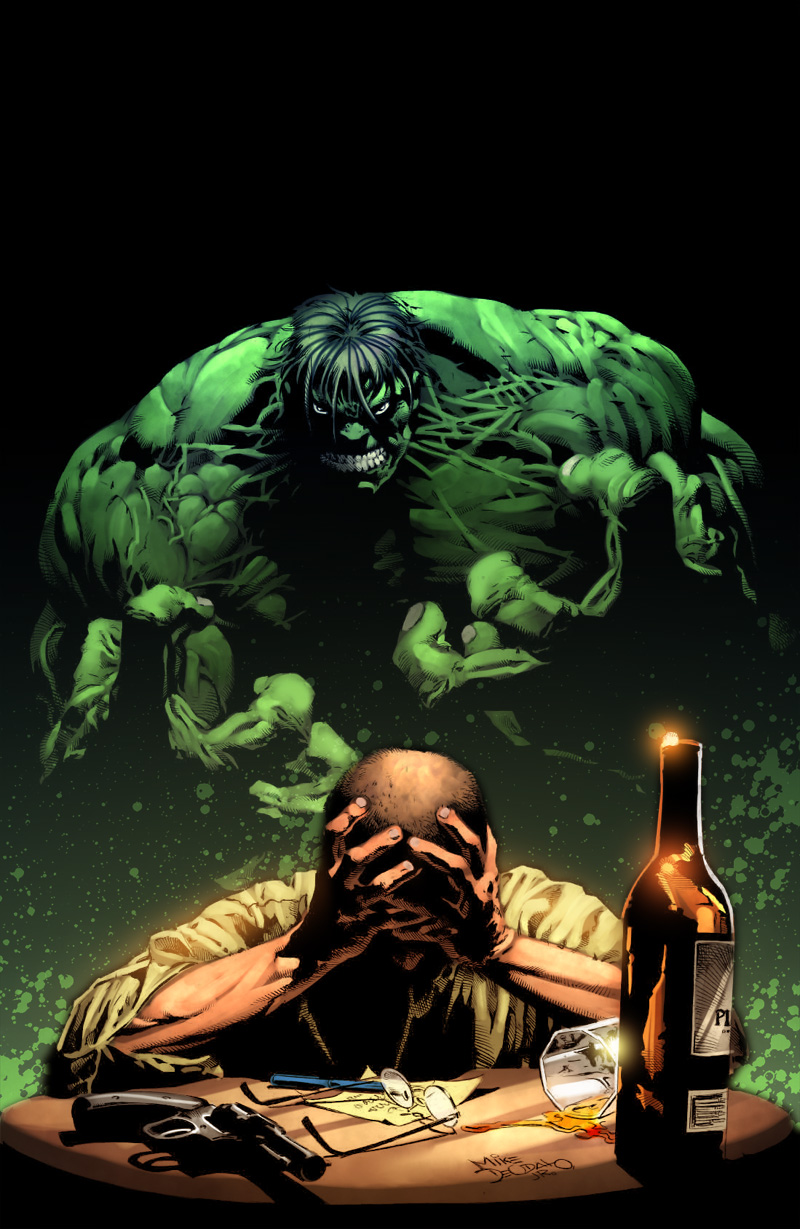
Now, if you watch Mark Ruffalo's performance of Bruce Banner, you'll notice that he purposefully shrinks himself down. He keeps his arms close, and often holds his hands together like he's trying not to break anything. If you've ever had a friend who was on the bigger side, these are all mannerisms of someone who is very large, and very strong, who is trying to be careful around delicate things. It shows that, even when he's in his weaker form, Bruce is keenly aware of the power he contains in himself, and that one wrong move might turn this whole thing into the proverbial rampaging bull in a China shop.

Incidentally, I have a Pathfinder conversion for Hulk, for those who are interested.
 
This mannerism makes perfect sense when you track it back to its source, and it's a fun exercise in character building. That's why, when you sit down to make a character, ask yourself why they speak, act, fidget, or believe a certain thing. The answers you find are often surprising, and can make for some fun character moments.

For example, if your character is a gnome, they've had the ability to talk to animals their entire life. It might not even occur to them that other people can't do that, especially if they were raised in communities where magic was common. Does this lead to them being unusually sensitive to the moods of animals around them? Are they confused when people treat nature like a tool, rather than a living thing? Do they have opinions about animals that are wildly different from those held by other races, making them seem like a tiny version of the crocodile hunter?

You can pick almost any racial modifier/ability and apply this kind of logic to it. Elves get a bonus on Perception, for example, but does that also make the world around them unbearably loud beyond the quiet boundaries of deep forests? Is this why an elven character might speak softly, or keep their hood up, providing their sensitive ears some protection against the violence of the louder world? Tieflings and ifrit both have natural fire resistance, so does it feel good for them to drink scalding tea, or to relax into a fire the way other people would enjoy a sauna? Goblins are capable of eating spoiled and rotten meat, but does what smells and tastes putrid to humans instead have a more nuanced palate to this sharp-toothed race? And is a food or fruit humans would find sweet something that tastes rancid to a goblin, their tongues not being built to handle that flavor?

And that's before we get into the weirdness of cultural norms.
 
Even if you're playing a bog-standard human, though, you can find unusual tics, quirks, and attitudes in the cultural norms of where they grew up. Everything from fashion, to forms of address, to food, to language, to little rituals that have clung for life can make them seem odd or strange... and every one of them can add some flavor to who your character is, and why they are they way they are.

As an example, did your character come from a culture with a strong warrior ethic, where even childhood games were meant to make you a canny fighter (such as how the wrestling martial art Glima was sort of a national pastime among the Norsemen)? Alternatively, was your character raised in a communal society where everyone was referred to with familial terms since the whole village raised the next generation? Were weapons seen as a taboo where you came from, or were they to be displayed proudly? Did you pray to the spirits, to the elements, to your ancestors, or to the gods? Do you wash, groom, and comb yourself every day, keeping a razor and comb in a kit on your belt? Or do you go for days, maybe weeks, between full baths without noticing?

Every Habit Started Somewhere


No matter who your character is, they had a life before they show up at the table. If they have a quirk, ask where it came from. Is it something they picked up during their stint with the militia? Was it something their uncle taught them? Or is it just how they deal with having sharper eyes, feeling less pain, or living in a world made of cardboard?

As a note for readers, I cover a lot of aspects like this in articles like 5 Tips For Playing Better Tieflings and Aasimar and 5 Tips For Playing Better Paladins, and I keep the full archive of these tips over on my 5 Tips page. So stop on in, check it out, and see if you find yourself some inspiration!

Like, Follow, and Stay in Touch!


That's all for this week's Fluff post! If you've used this in your games, share a story down in the comments!

For more of my work, check out my Vocal archive, and stop by the YouTube channel Dungeon Keeper Radio. Or if you'd prefer to read some of my books, like my sword and sorcery novel Crier's Knife or my recent short story collection The Rejects, then head over to My Amazon Author Page!

To stay on top of all my latest releases, follow me on FacebookTumblrTwitter, and now Pinterest as well! To support my work, consider Buying Me a Ko-Fi, or heading to The Literary Mercenary's Patreon page to become a regular, monthly patron. That one helps ensure you get more Improved Initiative, and it means you'll get my regular, monthly giveaways as a bonus!

Friday, March 30, 2018

The Weird And Wild World of Outsiders (Exploring Alternative Aasimar and Tiefling Heritages)

Aasimar and tieflings are often thought of as two sides of the same coin. The dalliances, blessings, and curses of the celestial and the infernal, both mixed with the blood of mortals. This heritage grants their scions power, along with signs (some subtle, and others not-so-subtle) as to the origin of that power.


For most of us, though, these two native outsider races just means we get access to some fun racial feats, some resistances, darkvision, decent stat mods, and a spell-like ability. However, there is a whole slew of weird stuff that you can use to modify these outsiders. All you have to do is look at the tiefling and aasimar pages, paying particular attention to the charts along the bottom of the page with the alternative features.

99 Options


Each chart gives you 99 different options you can take, instead of the tiefling or aasimar's standard spell-like ability (darkness and daylight respectively). In some cases, the options aren't really all that great (gain a +2 bonus on a skill check or specific saving throw), while in other cases the options are pretty goddamn awesome (like switching out daylight for spear of purity, which is going to be a nasty little surprise for enemies who don't know you've got an offensive spell up your sleeve).

Say hello to my little friend!
If you're looking for specific abilities and concepts that would be enhanced by the alternative traits, I did come across a few that stuck out.

- You have oversized limbs, and can wield Large-sized weapons without penalty (tiefling).
- You gain spell resistance equal to 10+1/2 your hit dice (tiefling and aasimar).
- You can cast spear of purity once per day as a spell-like ability (aasimar).
- You can levitate yourself, plus 10 pounds, as per the spell at-will (tiefling).
- You have a natural fly speed of 20 feet (aasimar).
- Your body produces intense heat/cold/acid, and deals damage to those grappling you (tiefling).

These are just a sample of the abilities you can gain, without even needing to burn a feat slot. There's also the option for minor damage reduction, unusual abilities such as being able to turn on a halo for aasimar, or being able to eat ashes and cinders for sustenance for tieflings. There's an option that allows a tiefling to never need sleep, and one that allows an aasimar make any weapon they hold holy for three rounds as a move action once per day.

In most circumstances, these abilities provide a small bonus, or some additional flavor. Used for the right build, though, such as a titan mauler with large weapons, a grappler who specializes in burning his foes, or even an inquisitor who hunts demons and wants an extra edge on top of their bane, these little abilities can make a big impact.

Stranger Things in Heaven and Earth


Even though this is Crunch week, I'd like to take a moment to direct folks' attention to the two charts to the right of the aasimar and tiefling mechanical abilities. Because despite the infinite variety outsiders come in, it feels like our tieflings just look like nightcrawler with horns, while all of our aasimar look like cover models under perfect lighting.

There are so many more options than that.

Like this adorable little prince by Tamaj.
Just glance through some of the choices. Aasimar whose fingerprints always look like holy symbols. Translucent tieflings with see-through skin. Aasimar who make bells ring as they walk past. Tieflings with constantly smoking breath, or eyes. Aasimar with metallic lips and jeweled eyes. Tieflings with fingers that bend backwards.

All the examples I listed above are in the books for effects these native outsiders can possess. And that is just a small selection of the bizarre things their presence and anatomy can do just because they exist. Because while there is nothing that says you have to be a bizarre collection of inhumanly inherited features, there is also nothing that prevents you from being a bird-headed, gold-beaked, ruby-eyed peacock warrior with abnormally long legs. And if that's the sort of native outside that appeals to you, then my collection 100 Unusual Aasimar along with 100 Tieflings To Meet in Your Travels will both be right up your alley!

Just remember, next time you get a chance to play one of these native outsiders, feel free to go absolutely nuts with it!

That's all for this week's Crunch topic! For more of my work, check out my Vocal and Gamers archives, and stop by the YouTube channel Dungeon Keeper Radio! Or if you'd like to read some of my books, like my sword and sorcery novel Crier's Knife, head over to My Amazon Author Page!

To stay on top of all my latest releases, follow me on FacebookTumblrTwitter, and now on Pinterest as well! And if you'd like to help support me and my work, consider Buying Me A Ko-Fi or heading over to The Literary Mercenary's Patreon page to become a regular, monthly patron! Even a little bit of help can go a long way, trust me on that one.

Friday, March 3, 2017

Add Some Spell-Like Abilities To Your Character For An Ace-in-The-Hole (in Pathfinder)

Magic is a powerful force in Pathfinder. Whether it's the arcane study of the wizard, the eldritch power of the sorcerer, the blade lore of the magus, or the prayers of a cleric, magic can completely change the game. It can burn enemies to cinders, cure diseases, or curse those who wrong you. However, despite all the different ways magic can be used, spells are all pretty similar. They have a verbal component, a somatic component, and some of them have a divine/arcane focus component, along with a material component.

Those components are often seen as a spell's choke point. If you can take away one of those components (steal the component pouch, pin the caster's arms, put them in an area of silence, etc.), then you cripple the caster's ability to make that magic happen.

At which point they can't let the lightning out of the bottle.
There are a lot of ways around these requirements. Silent Spell and Still Spell, for example, allow you to cast without a verbal or somatic component respectively. Eschew Materials lets you ignore inexpensive spell components. The problem is that the two metamagic feats will raise the spell slot level needed to cast a given spell significantly, and it will take more time for spontaneous casters to apply. Eschew Materials is useful, but it still requires you to be a spellcasting class to make use of it.

What if you could just add magic onto a character that wasn't a spellcaster, though? If you could still acquire your normal class levels, but throw a few spells in for flavor? There is a way to do this, but it is rarely pursued. Partially because it's very narrow in its application, and partially because it gets overlooked.

That way is acquiring spell-like abilities.

What Makes Spell-Like Abilities So Special?


Well, according to page 221 of the Core Rulebook, spell-like abilities use none of the components of actual spells. While they still provoke attacks of opportunity, they have no verbal, somatic, or focus components. They also don't have any material components, unless expressly stated. What's even better, though, is that spell-like abilities cannot be counterspelled as you use them.

A particular problem for those facing someone with "baleful polymorph" as a spell-like ability.
While all of that is pretty great, Pathfinder tends to keep most spell-like abilities firmly on the DM's side of the screen. That doesn't mean you can't get them as a player... it just means it's going to be tough. And you probably aren't going to get high-level spells.

Still, there are ways you can gain access to all kinds of helpful powers. Here are some of my favorites.

Races and Feats


The most common way to get spell-like abilities is as a racial benefit. Gnomes, for example, get dancing lights, ghost sound, prestidigitation, and speak with animals once per day as spell-like abilities. Tieflings have darkness once per day, and aasimar have daylight. There are other options, particularly when you start getting into more restricted races, but these work perfectly well as examples.

What you'll run into, though, is that racial spell-like abilities for playable races aren't really that big of a deal. They're useful, surely, and clever players can turn these in-born powers to their advantage... but they're rarely the sort of thing that will turn the tide of an encounter.

That's where feats come into it.

This is where the crunch gets started.
One type of feat modifies racial spell-like abilities, or uses them as a prerequisite for more powerful abilities. Heavenly Radiance, for example, is an aasimar feat that allows you to choose an additional spell-like ability from a chart. The higher your level, the more powerful the spell-like ability you can choose (including the spell Sunbeam, which can be an encounter killer if you're fighting something like a vampire). The Drow Nobility feats increase the power of your initial spell-like abilities as a drow, and add new ones to your bag of tricks (including making your darkness into deeper darkness, making detect magic constantly active, and giving you feather fall and levitate a certain number of times per day).

You'll find others in the Racial Feats section, though you should also look through Monster Feats just to cover your bases. Also, remember what I mentioned in Bored Playing Regular Humans? Try Racial Heritage on For Size. You don't have to be an exotic, monstrous race to take their feats, as long as they're humanoids, and you can count as that race with Racial Heritage.

It's also worth pointing out that many sorcerer bloodlines grant you spell-like abilities that increase in power with your sorcerer level. And as I said in How To Power Up Your Pathfinder Characters With The Eldritch Heritage Feats, the Eldritch Heritage feat tree is a great way to snag a part of that power. The Infernal bloodline, the Fey bloodline, the Undead bloodline, and others all have an assortment of powers. Even better, your sorcerer level is considered your level -2, so even low-level powers can grow as your character progresses.

One more method, for those who just want a simple, first-level sorcerer/wizard spell up their sleeve, is to take a pair of rogue tricks. Minor Magic grants you a cantrip, and Major Magic grants you a 1st-level spell, using your rogue level as your wizard level. So if you're playing a straight rogue, a ninja, or even a multiclass character, you could keep a true strike or a vanish up your sleeve for an emergency.

Remember To Keep An Eye on The Big Picture


The thing about spell-like abilities is that they're a lot of fun, but rarely are they the meat and potatoes of your character. They're a back-up plan, or a reserve resource you call on when the chips are down. This is partially due to how relatively low-powered they are (barring some of the more potent powers given to specific races), but it's mostly because really powerful spell-like abilities tend to be limited to once-per-day use.

On the one hand, it's just the ticket if you end up stripped of all your gear and need an ace-in-the-hole for a way to shadow-step out of your prison cell. Or if you need to lay a hand on your guard and put him to sleep. Spell-like abilities are also great when you're being observed, and you don't want to be seen using the more traditional components of a spell. But building your entire character around a single-use power, or even a collections of limited-use powers, is going to run into some serious flaws. So, if you want to acquire a few unique spell-like abilities, make sure they're going to mesh with your overall character goals. Otherwise you may have found you spent all your money on a submarine, and your mission is going to the middle of the desert.

That's all for this week's Crunch topic! Hopefully some of you found it interesting, and potentially inspiring. If you'd like to support me, and help Improved Initiative keep bringing content just like this to your screen, then head over to The Literary Mercenary's Patreon page. If you pledge at least $1 a month, you'll get some sweet swag, in addition to my undying gratitude. Lastly, if you haven't followed me on Facebook, Tumblr, or Twitter yet, why not start now?

Saturday, February 6, 2016

The Saga of Majenko Part 10: Down With The Queen

Today we have the final installment of the whirlwind adventure that is The Saga of Majenko (or Curse of The Crimson Throne to give it the name on the cover of the adventure path). From dingy dock wards to undead castles, to fighting dragons in the streets, to slaying devils in the throne room, our party has gone above and beyond the call of duty in protecting their city, and trying to bring down the thing Queen Ileosa has become.

Before we get started, though, make sure you're caught up on all the previous installments.

Part One: Finding The Main Character of "Curse of The Crimson Throne"
Part Two: How Much Damage Could One Pseudodragon Do?
Part Three: Scourge of The Red Mantis
Part Four: Blood Pig Champion
Part Five: Brother to The Shoanti
Part Six: The Assault on Castle Scarwall
Part Seven: The Return to Korvosa
Part Eight: Re-Taking Korvosa
Part Nine: The Assault on Castle Korvosa
Part Ten: Down With The Queen

There, all caught up? Beautiful! Because now it's time for the grand finale!

Down in The Dungeon


We realized after fighting the infernal thing living in the Ileosa's bedchamber, that the queen herself was not in the castle. She had, in fact, left quite some time ago. With the Bloat Mage's notes, and the testimony of his spirit, we confirmed that the erstwhile ruler of the city had fled to a half-sunken temple for a purpose we couldn't guess. We were all confident that it was nothing good, though.

Before we left, however, we had one last promise to fulfill. So we walk in through the front doors of the now de-populated Castle Korvosa, and take the stairs down to the dungeon below. Our party, which doesn't even have a token human in it at this point, takes in the grim, brooding atmosphere, and the claustrophobic vaults. We also completely avoid a high-level trap whose trigger is that the room is filled with light, which was unnecessary between the dwarf, the aasimar, the two tieflings, and the pseudodragon. So, we explore, and eventually find the body that had been unceremoniously walled-up.

Like ya do...
We bring the bones back to the attic room, and the ghost of the tiefling merges with the gypsy in our harrow deck, and allows each of us to draw a card from a Harrow Deck of Many Things, with the special allowance that we could re-draw one card each. So, we all decide to draw. The dwarf gains a level, loses a level, and then gains a small team of followers in Blood Pig jerseys. Majenko gains the ability to automatically confirm a critical hit, though the same ability works against him. One of Egil's enemies has a change of heart and becomes his ally, though with the sheer number of arrested NPCs the DM never got around to choosing one. The paladin becomes immune to sonic damage. Cards chosen, we receive a blessing from the ghosts, and set off southward toward the final confrontation.

One Long Series of Unfortunate Events


We travel southward, following the map we were given. We make our way down rivers, and through swamps, until we find an ancient pyramid, half-sunken into a lake. Unfortunately, there's no bridge to that lake, and no guarantee that there isn't something awful lurking beneath the waters.

Something more awful than me, I mean.
So, we take stock of our options. We quickly realize, through burning a powerful scroll, that we can't simply phase through the stone. Apparently it is protected by ancient magics, and our modern-day shortcuts aren't going to hack it. Deciding that we are not doing another underwater combat in murky liquid we can barely see through, the cleric wind walks us all across the water, and through the vents leading into the upper floor. Everything's quiet, at least until the dwarf touches a stone, and gets sucked into it. That's when the paladin has to turn corporeal again, and start smashing away with his adamantine hammer until we crack the dwarf out of his soul prison.

Which, of course, means the level's guards are well aware of our presence. Which is why we have yet another pack of Erinyes trying to turn us into pincushions. The fight is frustrating, but we've taken down enough of these particular devils by now to know what we should expect. We emerge triumphant, for the most part, and only down a few, minor resources. We also find a massive pool filled with blood, and a dead body floating in it. It looks almost like Ileosa, but clearly isn't. This is around the time we all get a bad feeling regarding the blood samples that were being taken from the citizens of Korvosa before the revolution got rolling.

We come across a shaft, and Majenko stealthily slips up to take a look. What he finds is...

The Final Encounter


At the top of the shaft, waiting for us, is Queen Ileosa. Floating regally above the ground, she's admiring a floating ball of blood. The ball is, of course, constantly shifting and pulsing, with faces and even buildings pressing against the surface before receding. Even the highly-experienced magic users have no clue what it's for, but we have an inkling that we don't want to find out.

So we roll initiative.

Which may have been our first mistake.
The first thing that comes our way is a trio of powerful wraiths. No worries, since a charge from the staff of Necromancy makes them hold still for the paladin to walk by and dust. They get a few nasty slices in, but we emerge triumphant. Before we've dealt with them, though, a line of Ileosa clones appears, and they all start singing. Which is when the wand of silence starts getting plenty of use, since there's no Will save allowed if the spell affects an area and not a person. Ileosa flies higher, and Egil locks her behind a wall of force. Which she then dimension doors herself past.

Despite the chaos of the battle, it's soon down to just us, and just her. And that is where things started to get tough. Not hard, not deadly, but tough.

You see, the queen had plenty of time to buff herself, thanks to our less-than-quiet entrance. Given the level she's at, and the horror that lives inside her skull, she's got a lot of tricks. She's flying, she has freedom of movement (as we found out), her AC is buffed to a mirror shine, and she's throwing down magic like there's no tomorrow. Very little of her magic, though, actually does damage. Most of it's just a debuff, or an obstacle, meant to hamper us for a time. She even managed to get control of the dwarf for a bit, but a smoke screen rendered him ineffective as a threat to the party.

The problem we're having is that we're actually fighting to a standstill. None of the aid the cleric is summoning hits hard enough to get through the queen's defenses, and even the paladin wielding the relic sword is only hitting once a turn or so. Spell resistance, and various deafening effects, have eaten away most of Egil's spells, and even the great and powerful Majenko is little use against her. In a battle that lasted three, full sessions, we accomplished an ignoble goal that I doubt most gamers have ever sought.

Both sides started running out of magic.

The Conclusion


The party retreats with the intention of regrouping. Which is when a line of barbarian frogmen come out of the flooded depths, and we enjoy a brief round of wiping them off the map like a greasy stain. Ileosa follows, but now she's under the effects of greater invisibility. She still can't seem to do us any real damage, but she's getting down to magic items and bard tricks.

Well, shit, we've tried everything else...
That's when the cleric pulls another friend out of her bag. She summons a creature who, while it can't penetrate the queen's defenses, does have invisibility purge as a constant aura. So, at least we can see her again. The paladin lays into her, and the rest of the party is rallying to make one, final strike. Unfortunately for us, though, her contingency spell goes off, and she vanishes. She is nowhere near the pyramid, and there's no way to tell where she went.

Not My Problem


The vanishing act Ileosa pulled seems like the worst sort of adventuring blue balls, particularly after such a knock-down, drag-out slog. However, the personalities of this particular party, and their definition of victory conditions, rendered expectations quite skewed. The ritual was stopped, for example. The citizenry was saved, and we lost no companions in the final fight. Not only that, but as far as we can tell, Ileosa fled from Varisia in its entirety, off to who knows where.

Out of my jurisdiction, that's what matters.
Egil, and by extension Majenko, have done their jobs as well as they can. With the city of Korvosa in ruins, and rebuilding taking place, that is where their duty lies. Balen has no real investment, now that the queen is overthrown, but would be just as comfortable returning to a life of drug use broken up by occasional bouts of Blood Pig. The cleric and paladin both feel that Ileosa should be pursued, in time, but as for the time being they hold a major relic of the church in their hands, and they want to know what the best use of it is. So, singed but triumphant, the party returns to the dockyards and waterfronts, sinking into the hustle and bustle to decide what they're going to do with themselves, and to try and restore what parts of the broken city, nation, and world they can.

And that, my friends, is the end of the Saga of Majenko.

If you enjoyed this story, and would like to hear some others, then leave me a comment and let me know! If you'd like to help support Improved Initiative, then consider stopping by my Patreon page to become a patron. All I ask is $1 a month to help keep the content flowing. Lastly, if you want to make sure you don't miss any of my updates, then follow me on Facebook, Tumblr, and Twitter as well.

Monday, October 26, 2015

Hell Yes! TPK Releases "Feats of Legend" and "The Demonologist"

Normally I dedicate my Monday posts to helping promote others in the gaming industry, or to bring unusual bits of interesting trivia to the attention of my readers. This week, though, I'm giving the post over to complete self-aggrandizement because not one, but two, great products just came out from TPK Games with content by yours truly!

These must-have items? Feats of Legend: The Infernal Feats, and The Demonologist.

You know you want it!

What Are They?


I'm glad you asked, bold, italicized text! Feats of Legend is a small, ongoing feature that TPK Games recently embarked on. The idea is simple; put out a little collection of feats every month, each of them gathered around a theme, so that players can add a little extra oomph to their games. The first installment, The Infernal Feats, has 20 feats by yours truly. Future editions, like Undead feats, will also feature contributions from other RPG designers, both well-known developers and up-and-comers.

The Demonologist, though, is the meat to Feats of Legend's potatoes.

The Abyss yawns open at your feet, filled with legions of howling demons bent on death, destruction, and corruption. Most sane mortals oppose these creatures, using sword and spell to keep the madness of the pit at bay. There are some, though, who seek to harness the power of the Abyss, and the creatures who lie within it. These men and women, called demonologists, hold truck with terrible forces. Attended by powerful demons, and with all the ferocity and knowledge of their servants to hand, they can be valued allies, or dangerous enemies.

Just sign on the dotted line.
The demonologist is a level 1-20 base class that's an alternate version of the Summoner. Based largely off the Pathfinder Unchained rules, this book comes with history, feats, eidolon evolutions, class archetypes, and a variety of other tools to help bring the full power of the pit to your game. My contribution was a good-aligned demonologist archetype, which is meant to let players utilize the class under DMs who disavow evil characters.

And remember, even if the players can't have it, demonologists make for tasty antagonists as well!

As always, thanks for stopping in to check out my Monday update. If you don't want to miss any of my posts, then follow me on Facebook, Tumblr, and Twitter. If you'd like to help support me and my blog, then head on over to The Literary Mercenary's Patreon page to toss a little bread in my jar. There's a free book in it for you, too, if you become a new patron by the end of November!

Friday, June 12, 2015

The Saga of Majenko Part Three: Scourge of The Red Mantis

When last the Saga of Majenko left off I'd detailed how in Curse of the Crimson Throne we'd freed a tiny pseudodragon NPC, and said pseudodragon had gone on to steamroll entire encounters with his poisonous sting. Seeing the inherent value of such a potent ally, but wary of his fragility as a 15-hit point, cat-sized dragon, I made him my character's familiar. Not content with that (and because I could find no rules banning it), I also made him my cohort. So in addition to being able to share spells, gaining additional natural armor, and sharing an empathic bond with the little guy, Majenko also gained 5 levels of rogue with all the associated trimmings.

It's a good thing too, because this was right around the time the campaign got serious. It's also around the time Majenko fell in love. If you need to review, here's the full list of the Saga of Majenko installments.

Part One: Finding The Main Character of "Curse of The Crimson Throne"
Part Two: How Much Damage Could One Pseudodragon Do?
Part Three: Scourge of The Red Mantis
Part Four: Blood Pig Champion
Part Five: Brother to The Shoanti
Part Six: The Assault on Castle Scarwall
Part Seven: The Return to Korvosa
Part Eight: Re-Taking Korvosa
Part Nine: The Assault on Castle Korvosa
Part Ten: Down With The Queen

All caught up? Great!

Part Three: The Scourge of The Red Mantis


When last we left our intrepid adventurers they'd managed to uncover the secret plot to destroy the city with a plague of bloodveil, arrest the head doctor behind it all, and descended into the bowels of the city to fight a priestess of Urgathoa. In short our crack law enforcement task force managed to save the city, and stem the tide of death that was pouring out of the guts of Korvosa.

We also discovered (gasp) that the queen was tacitly behind the plague!

This is my surprised face.
Now, we know that we're sitting on a few tons of black powder with this information. The queen may not be much liked, but attempting to depose her would lead to civil war regardless of her guilt. Unless, that is, we could find Neolandis Kalapopolis, the royal seneschal. As the seneschal, Neolandis had the legal authority to remove Queen Ileosa, assuming we could present him with the appropriate evidence.

The only problem with that is that Neolandis seems to have up and vanished. So we've got to track him down somehow. Fortunately for us a letter from the city's most esteemed vigilante Blackjack happens to show up on our doorstep, asking us to meet him in Old Korvosa; the northern island district that's been sealed off due to the plague.

Why not, what's the worst that could happen?

It's Dangerous Out There, Take A Cleric With You!


It just so happened that our regular cleric couldn't make that session. So rather than go off adventuring without such a crucial class, I checked my followers chart and saw that, in addition to Majenko, I qualified for a single 4th level follower. I asked the DM if, for a session, she would let us bring an NPC pseudodragon cleric to help out with the heals. I got permission, and that's where Aoefa came in.

I'll say she did!
Aoefa wasn't just a pseudodragon who happened to have 4 levels of cleric. She had been born as a living holy symbol of Apsu, and she was silver from snout to tail. With a breathy voice, a haughty demeanor, and a definite sense that she was the queen of the castle, there was at least one vote that when we brought down Ileosa that we gave Aoefa the crown in her place.

With her added to our party we headed north to Old Korvosa. We eventually found the meeting place, which was the personal quarters of the resident fencing master (a man who couldn't possibly be Blackjack, because he was missing two fingers!). We enter the building, investigate, and as soon as we reach his upstairs living room two red-sheathed figures drop down from the rafters.

A pair of the legendary Red Mantis Assassins were waiting for us!

Time To Make A Move


Aoefa, disdaining the physicality of combat, flits up to one of the rafters and stretches out like a Siamese cat. The assassins hurl alchemist fire, setting the room ablaze and giving us a definite time period to end this fight by (since only Egil has the ability to walk through fire mostly unscathed). The barbarian and the fighter are cornering one of the elite killers, and the other is dealing with Egil and Majenko.

Or at least he was planning on dealing with us. Because it seems that with Aoefa looking on Majenko really wanted to show off his prowess to prove what a good mate he would be. This led to Egil taking several, ineffective swipes at the assassin before Majenko sprung up behind the Red Mantis, stabbed the sweet spot where the helmet met his armor, and gave him a full load of sneak attack and poison before springing away. The assassin whirled, failed his save, and just before sleep could overpower him committed seppuku in order to turn himself into a red mist and prevent his identity from being discovered. The other assassin was dispatched in short order, and when the party asked for their wounds to be tended Aoefa was only too pleased to help.

She wanted to show Majenko he had impressed her, and thus was willing to be kind to his party mates. Even if two of them were lowly humans.

Musical Character Sheets


Our regular cleric arrived soon after the battle, and the barbarian decided to take his earnings and go. He'd just met a girl in the southern half of the city (a broad-shouldered, wide-hipped nurse who was going to bear him many strong children), and he wasn't about to do something that would get him locked up (that, and the player wanted to bring in a different PC). The last thing we hear as Aoefa alights on Spatters arm, their boat fading off into the night, is, "Oh, you have a woman. Tell me all about her. Disgust me..."

What Happened Next?


Well, the story doesn't end there (as anyone who's played this adventure path knows. Next time I'll detail the battles in Old Korvosa, and perhaps begin the quest into the high desert country where our party faced even stranger challenges than they had in the plague-ridden gutters of Korvosa.

Tune in next time!

Also, if you'd like to support Improved Initiative then please stop by The Literary Mercenary's Patreon page to become a patron today! $1 a month can go a long way toward keeping the game going. Also, if you want to make sure you don't miss a single post, follow me on Facebook, Tumblr, and Twitter as well.

Friday, March 20, 2015

The Saga of Majenko Part One: Finding The Main Character In "Curse of The Crimson Throne"

Say what you will about adventure paths, they provide an adventure that any dungeon master can run. Some DMs use them because they don't want to do all the hard work of plotting (since these noble storytellers often have day jobs and real lives), and others use them because it's just reassuring to know that a team of professionals bolted this beast together for maximum player enjoyment.

One of Paizo's older adventure paths is Curse of the Crimson Throne, and for those of you who have never heard of it, the books pre-date the Pathfinder system. They were originally written for Dungeons and Dragons 3.5. While my group is closing in on the end of the adventure I'd like to relate to you the story of Curse of the Crimson Throne's true protagonist.

His name is Majenko, and this is his story.

What's up, bitches?
Additionally, this story has now been posted in its entirety. If you want to hit all the chapters in order, here's an easy-to-navigate list.

Part One: Finding The Main Character of "Curse of The Crimson Throne"
Part Two: How Much Damage Could One Pseudodragon Do?
Part Three: Scourge of The Red Mantis
Part Four: Blood Pig Champion
Part Five: Brother to The Shoanti
Part Six: The Assault on Castle Scarwall
Part Seven: The Return to Korvosa
Part Eight: Re-Taking Korvosa
Part Nine: The Assault on Castle Korvosa
Part Ten: Down With The Queen


The Setup


For those of you who have never played Curse of the Crimson Throne, the adventure takes place in the Varisian capital city of Korvosa. It's a corrupt place, from the sky-bound ghettoes of the Shingles where men and women live in squalor among condemned towers to the floating warrens and gambling dens where ganglords and bully boys ply their trade. It's a city full of dark corners, shadowy intents, and where anything can be had for a price.

It's like Gotham City, but with magic.

Enter the party. We begin with three members of the town guard (a human of Shoan-ti descent named Karanthiira, and her more experienced colleagues a human paladin named Armitage Poe and his partner a tailed tiefling rogue named Egil Skinner), and their acquaintance a cleric of Shelyn named Durai. The first session they arrest a local slum lord named Gaedren Lamm. All of his associates are put in manacles, and he himself is beaten to within an inch of his life before being cuffed and brought in on charges, complete with evidence.

This gets our DM's attention. Not only are we choosing to go with the flow of being town guards (something we knew was going to happen anyway due to meta-knowledge), but we're pretty serious about not killing people. This focus on capturing people and proving they've committed offenses continues through two or three more opening side quests, until our group is given a sensitive assignment.

What's The Job?


Our party is tasked with going to an area of ill repute in Old Korvosa and meeting with a criminal figure known as The Spider. He has three barges moored offering illicit services, and we need to go there on the down-low to acquire politically salient information from him so we can then blackmail a foreign politician to ease up off the city's back.

Remember how I said Korvosa was a lot like Gotham, but with magic?

Pictured: a good neighborhood in Korvosa.
Our paladin has left the party, but in his place we've recruited a broad-shouldered barbarian by the name of Arum Eld (a fellow who went by "Spatters" down at the docks). We take the bribe money, leave our badges at home, and proceed to the ship looking like any other band of heavily armed thugs out to score something illicit and dangerous.

We find the ship without a problem, and we even manage an audience with The Spider. He says he'll agree to talk business if we play a game of knivesies with him. Karanthiira volunteers, and steps onto a table with a hapless underling tied to her wrist. She handily slams him off the table, winning the game and giving us our opening to talk with the lord of the floating ghetto.

Where Things Start To Go Sideways


Spoiler alert for anyone planning on playing this adventure path. When you first walk into The Spider's chamber you see a pseudodragon slumped in a hanging cage. Korvosa is rife with pseudodragons, so his presence isn't all that unusual. The little fellow is telepathic though, and begs members of the party to rescue him as he's being made to fight giant spiders to the death.

In case you forgot who the bad guy was in this scenario.

Egil had become party leader because with his partner's transfer he was now the guard with the most seniority, and he'd used his high intelligence to pick up levels of magus. Magically inclined and naturally skulky he was the most obvious choice for the pseudodragon's plea. He told Egil his name was Majenko, and that he needed help to escape. Egil waited until Durai (the face of the party) had completed the negotiations for the damning documents we'd been sent to get. The Spider's cohorts had lost interest and the rest of the party was getting ready to leave when Egil asked The Spider whether he'd be willing to part with the pseudodragon.

The answer was, of course, no.

Wrong answer.

Letting The (Pseudo)Dragon Off The Chain


Negotiations quickly fell apart when it was made clear the only way to get this pseudodragon away from The Spider was to fight him and all his men. So Egil, being chaotic good and not wearing his badge, pulled a smokestick out of his belt, tossed it under the cage, and then parkour-ed up the wall to open the lock.

Chaos, as you can imagine, ensued.

We were outnumbered two to one, and no one could roll high enough to take down the crew (we were only level 3 or 4, after all, and hadn't come loaded for bear). I get the cage open, but rather than fleeing Majenko decides to enact revenge on his captors. Our DM hands me the monster manual and says, "here, those are his stats, you run him for this fight."

So I did. Did you know that pseudodragons have a sleep venom that knocks out enemies for 1d4 minutes on a failed save?

We totally do.
All of the high numbers I'd been missing started showing up for Majenko, and because his stinger was lashing out from within the smoke cloud he had concealment. The first enemy takes a single point of damage, rolls a 1 on his save, and goes down. The next round his companion steps over the body, gets stung, and goes down. Rinse and repeat. The barbarian comes back in swinging, and crushes one of the villain's skulls in. The cleric, wielding a reach weapon, manages to trip some of his enemies who are handled by Karanthiira. Even Egil manages to get a few good licks in, though he came away bloodied.

The Spider ran below decks. At final count two or three of his men were dead, but all the others were sleeping. It appeared that instead of rescuing a tiny victim we had instead unleashed a flying, house cat-sized ball of pure, envenomed vengeance. Deciding that discretion was the better part of valor we straightened our cloaks and walked out as if nothing had happened. Majenko flitted onto Egil's shoulder, kneading the leather and chain until he was comfortable.

That would have been so much easier if you were dragons, he said, laying his head down. But you did pretty well.

Things only got stranger from there...


If you have a gaming story of your own that you'd like to share then feel free to send it to Improved Initiative and we'll give you a moment in the Table Talk spotlight! If you'd like to support Improved Initiative (and get a free book during the month of March) then stop by The Literary Mercenary's Patreon page and become a patron today. To ensure you get all of my updates make sure you're following me on Facebook and Tumblr as well.