Showing posts with label cool. Show all posts

Monday, October 16, 2017

A Skull Armchair For The Necromancer In Us All!

It's been a while since I did a Monday post that was just about something fun, weird, and a little silly. And since we're elbow-deep in the Halloween season, I figured it was time to share something off my personal wish list with folks. Because I fully intent to DM a game while seated in a chair like this one before I shuffle off this mortal coil.

Hell, if I owned this thing, I might have to haul it to conventions. Just because!
What you're looking at is a skull chair made by French designer Gregory Besson. The chair represents humanity's questioning of death, the designer says, and it shows how we often try to face away from our memento mori, even when our backs are resting right against it. The skull and frame are made from fiberglass, and the interior of the chair is made from high-quality leather. So it's probably lighter than it looks, but it will last for quite a time if properly taken care of. And given an occasional buffing by a minion in your doom fortress.

And, according to Besson's interview with Bored Panda, you can get one of these chairs custom made for your lair... living room, whatever.

Before you reach out to the artist, though, there are two things that are important to keep in mind. Firstly, and most importantly, these chairs are not mass-produced. As such, each chair is going to have unique features, coloring, etc. Secondly, because the pieces aren't churned out from a factory, you're not just buying a cool piece of furniture for your home... you're buying a piece of art. And, as we all know, when it comes to art, you pay for what you get.

That's all for this week's Moon Pope Monday post. I figured I'd keep it short and sweet, but I'll likely get back into the thinky stuff next week. If you'd like more of my gaming articles, check out my Gamers archive. If you want to keep up with all my updates, follow me on Facebook, Tumblr, and Twitter. Lastly, if you want to help support Improved Initiative, head over to The Literary Mercenary's Patreon page to leave a little tip in my jar. Every little bit helps, but if you pledge at least $1 a month, I'll send you some gaming swag as a thank you!

Monday, March 20, 2017

Critical Perception Check Leads To Hidden Templar Caverns in Shropshire

Have you ever had one of those players who just wants to roll Perception checks every time you finish a description? It doesn't matter how pedestrian the scene you just described is, they want to switch on their detective vision to find every clue they assume is waiting under the inn's rug, or tucked into the knothole of a random tree. Most of the time you can just make up a few details to justify a good roll, such as noticing that the innkeeper is wearing a ring given only to champions of the Iron Legion, or noticing that some trees in the forest bear a certain symbol that seems to mark territory.

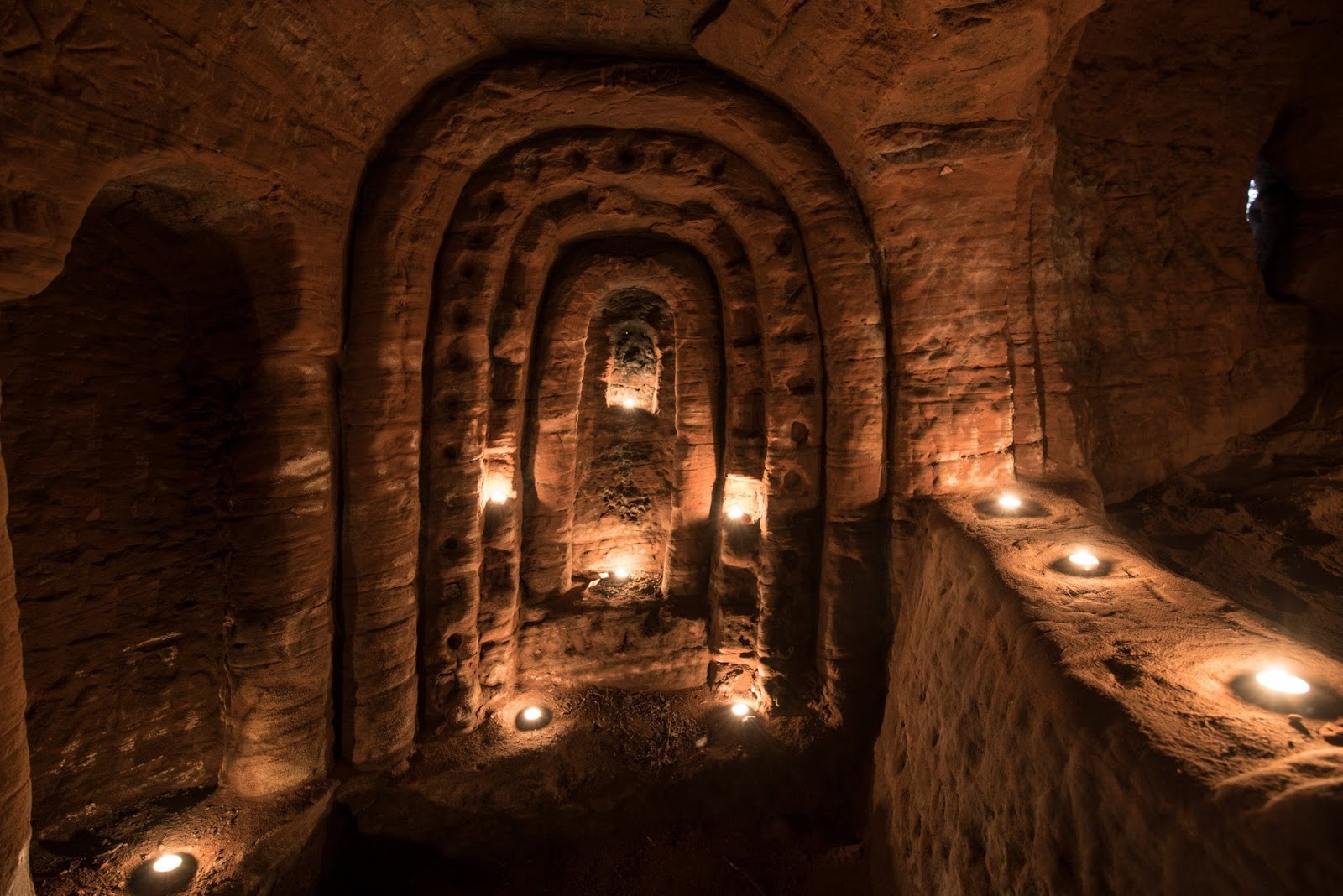
But what do people notice if they're just walking across an empty meadow, or a farmer's field? Well, how about a rabbit hole that leads to a forgotten series of underground caverns once used by a famous order of knights? Because that's apparently what happened in a farmer's field out in Shropshire, according to the Metro.

That's what your natural 20 gets, Brent. Happy now?

Wait, What Happened?


You know how, when you're running through a campaign, it always seems ridiculous that there would be ancient ruins from a thousand years ago sitting in some out of the way hamlet? Or an entire underground dungeon that had been lost and forgotten about, perfectly preserved just out of sight? Well, it seems that sometimes art imitates life.

A real-life plot hole.
Since we're all geeks, I'm going to assume we know who the Knights Templar were. The most visible symbol of the crusades, and arguably one of the biggest contributors to the image we have of paladins, the Templar fought for the church, but they answered to no one but the pope. The order was eventually destroyed, with many of the members put to death, and others tortured until they signed confessions of devil worship, as well as other crimes. Ever since the order crumbled, there have been legends of where their huge hoards of treasure wound up.

And, every now and again, we stumble across places the order used for their own purposes. Forgotten strongholds, lost way stations, and sometimes caverns where they hid from the rain... and perhaps stored more than arms.

So what was in these 700-year-old caverns? Well, there weren't any skeletons clad in rusted armor, bearing the rags of stained crusader cloaks. There also wasn't any treasure, at least in the jewel-encrusted-goblets sense. However, the caverns less than a meter below a farmer's field were carved with elegant arches, and they bore testimony to the men that had once used them. So, historically, they provide another piece to the puzzle of what was going on during the reign of the Knights Templar.

Of course, who's to say the caverns would be so benign in your world? Or so empty of threats to those who randomly stumble across them?

EDIT: So, it seems your humble author got caught. Fortunately, someone shot me the Snopes link that clears up the facts. Rather than being from the era of the crusades, the cave pictured above is likely from the Victorian era. It has been documented pretty extensively, and was sealed to the public due to litter and other considerations. Ah well, sometimes things that sound too cool to be true really aren't. Apologies all!

That's all for this week's Moon Pope Monday post. Hopefully you're intrigued, and this plants a seed you could use for your next campaign. If you'd like to help support Improved Initiative so I can keep bringing you fun little plot bunnies like this one, then head over to The Literary Mercenary's Patreon page to become a patron today. All it takes is $1 a month to help me pay my landlord, and to get yourself some sweet swag. Lastly, if you haven't followed me on Facebook, Tumblr, or Twitter yet, today is as good a day as any to get started!

Monday, February 27, 2017

Sir Pencival, The Knight of The Silver Signature

For those who've been following me, you know I've been a freelancer for a long time. Any dirty job, if you've got the green, I'll sharpen up my nib and get it done. You need a news piece on the local summer hot spot? I've got it. You need a comic script by the end of the month? Consider it done. You need a list of feats for that new class you came out with? Not a problem, just have your checkbook handy for when I deliver.

Like any experienced mercenary, though, I can't do the job on my own. While I've had plenty of backing from the Mountain clans in all their colors (Code Red, Voltage, and classic atomic green, among others), it was time for me to accept a follower. Someone loyal, steadfast, and experienced. Someone who would always be there, and who would not balk even in the face of looming deadlines. Someone who, when we stared into the darkest depths of the human imagination, and the swamp of the purple prose in need of a red pen, would hold out his hands and say, "Your weapon, Sir."

I would like to introduce you all to Sir Pencival, the Knight of the Silver Signature!

It's a dangerous job, my liege. Take this with you.
Pencival has already proven his unflinching loyalty, and he has been at my right hand ever since I acquired him. Not only that, but he has traveled with me to Capricon, where his presence pulled plenty of attention to my signing table. I'd say he was even directly responsible for me selling out of copies of New Avalon: Love and Loss in The City of Steam.

Of course, Pencival's prowess extends beyond my work desk and the signing table. Just this past evening I checked his measurements, and found that he is a nearly perfect fit on a grid map.

You hear a click, as of a massive spring. The statue regards you all. Roll initiative!
Though he has only been my squire for a short period of time, I feel that Sir Pencival and I will fight many battles before we part ways. If you would be interested in locating his brothers in arms, I'd recommend heading over to Amazon, and seeing if you can find one of your own.

Don't delay, though. These squires are fewer than you'd think, and there are more authors than there are pen-bearers.

That's all for this week's Moon Pope Monday post! I hope you all enjoyed, and if you find yourself at a convention with yours truly, keep an eye out for Sir Pencival! If you'd like to help support us in our efforts to bring you the very best content, stop by The Literary Mercenary's Patreon page today. If you become a patron, and pledge at least $1 a month, then you'll get some sweet swag along with my undying gratitude. And if you haven't followed me on Facebook, Tumblr, or Twitter yet, well, why not start now?

Monday, February 6, 2017

The 10 Trials of The Master Bladesmith

When we think of master bladesmiths, we tend to imagine old men forgotten in the woods, or sequestered in a monastery. Men with heavily-muscled arms and thick beards, who have solved the riddle of steel. The sorts of people adventurers and warriors seek out, begging them to forge weapons that can slay dragons, or cleave through enemy armor like it was made of paper.

How sharp can you make it?
What a lot of us tend to forget, though, is that in this age of mechanization there are still real master bladesmiths. And while they might not be able to wield magic, the blades they create are astonishing. Works of art, unmatched pieces of craftsmanship, and deadly weapons, they are truly something to behold.

Not just anyone can call themselves a master bladesmith, though. They have to undergo the 10 trials.

The 10 Trials of The Master Bladesmith


There are, according to Atlas Obscura, fewer than 200 people in the world who hold the title of master bladesmith. This title is granted by the American Bladesmith Society (which, to be fair, has only been around since the 1970s), and it was designed as a way to recognize and encourage mastery of a trade in a world where traditional bladesmithing was quickly going extinct.

So what does it take to become a master?

Well, first someone has to join the organization. This officially makes them an apprentice (in the sense that they're new, not in the sense that they're actually working for another smith, though that can happen if members decide to join forces). After three years of membership, or two for those who complete a course offered by the Society, an apprentice can take their first test. The apprentice forges a blade, and then that blade has to cut a rope in a single swing (the rope is unsecured, and the cut must be roughly 6 inches from the bottom). The same knife must then chop through two 2 x 4 pieces of wood, and immediately after must be proven keen enough to still shave hair from someone's skin. Lastly, the blade is bent at a 90-degree angle to prove it was forged with skill. If the blade shatters, even if it's passed all the other tests, the apprentice fails.

Once the performance test is done, the apprentice must bring five carbon steel blades of their own to be examined by master smiths. If those on the panel decide the individual displays the proper skill, then they advance to the rank of journeyman.

Gaining two craft feats, and one spell-like ability.
That's tough enough, but it's nowhere near as grueling as what comes later. Journeymen must train apprentices by sharing wisdom and skill with them, and it takes another 2 to 3 years of work and refinement before they can attempt to be named a master. They have to undergo the same performance test on a blade, but this time the blade must be Damascus steel, and have a hidden tang.

If the journeyman passes the performance test, they must again come before the masters with five new blades. At least one of those blades must be made of Damascus steel, and there must be a Damascus steel quillion dagger, which is considered one of the most difficult pieces to make by the Society. If the journeyman's work passes muster, they are bestowed the rank of master by those who earned it before them.

6 Years to Earn, A Lifetime to Master


Those are some pretty rigorous standards, and the results are beautiful blades. But ask yourself, what is the standard of a master bladesmith in your game? What difficult weapons must they make to prove their mastery over steel, and what tests must their weapons pass before they are deemed sufficient enough to earn the title for their maker?

That's all for this week's Moon Pope Monday post. Thanks for stopping in, and I hope it's provided you with a bit of food for thought. If you'd like to support Improved Initiative so I can keep bringing you content just like this, stop by The Literary Mercenary's Patreon page. For as little as $1 a month, you get some sweet swag, as well as my undying gratitude. Lastly, if you haven't followed me on Facebook, Tumblr, or Twitter yet, why not start today?