Showing posts with label elves. Show all posts

Monday, December 27, 2021

Combining Half-Orcs and Half-Elves Into One Category... The Blooded

When it comes to fantasy species in RPGs there is never more debate than you find around the so-called "half" options. Whether it's arguing about which species can have children with which, what powers their offspring inherit, or stating that you need X amount of a bloodline in order to qualify for these species at all, these arguments often get pretty far into the weeds.

It was with these discussions in mind that I recently created the Blooded for my Sundara setting... a category of species that I hope gives more players more freedom, and expands options in a way that everyone can enjoy.
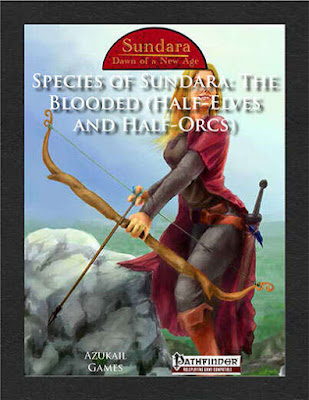
Because more options leads to better games all-around!

Before we get too deep into the latest release, don't forget to sign up for my weekly newsletter. If you've got a little extra dosh, and you want to help me keep the content coming, then consider becoming a Patreon patron, too!

Lastly, if you want to make sure you're following all of my followables, make sure you stop by my Linktree, too!

What Are The Blooded?


I've been putting out more and more setting expansions with the Species of Sundara splat books for Pathfinder, and so far I've covered elves, dwarves, orcs, and halflings (and if you prefer the DND 5E versions you can get them here at elves, dwarves, orcs, or halflings). And in those books I've made it clear when individuals are capable of having children with other species, and when they aren't. Elves, for example, are capable of having children with any other sentient species... some partners may take more work (and pose more risk) but it is possible. While orcs are not as capable as elves, the fact that they can have so many children of mixed heritage is one of the reasons so many people believe that orcs were created by the elves (or, in some tales, that orcs were elves who had transformed themselves far enough away from their base species that they became something entirely new).

This, of course, led to the "half" question that has led to so many debates around so many tables. So I thought I would change things up with the creation of the Blooded as a category of creature.
My great-grandmother always said we had elven blood...

First and foremost, this eliminates the "half" idea that one parent was one species and the other parent was a different species. The status of "Blooded" simply means that whatever your heritage, it is dominant enough that particular traits manifested in you, conferring the species template. So someone may have had elven ancestors on their grandfather's side, but it's not until their birth that those traits manifested. Alternatively, someone might have orcish blood on their mother's side, but it doesn't become dominant until they've had children.

In addition to the Blooded not necessarily being the specific, first-generation offspring of an elf or an orc with another species, this species option makes it clear that anyone capable of having children with elves and orcs may fit under this category. This means you may have Blooded who are small-sized, combining halflings and elves. You may have an orcish child of elven blood. And so on, and so forth, according to the limitations put out in the respective splats. Other than those rules, and the fact that you only gain elven or orc blood as the dominant part of your Blooded heritage, the sky's the limit!

Lastly, there's been this pervasive idea in RPGs that so-called half-elves and half-orcs are always outsiders or outcasts in some way, shape, or form. Half-elves are stifled by their elven culture, and fetishized or misunderstood by humans. Half-orcs are sneered at by "true" orcs, and feared by humans. We've seen this time and time again, and I kicked this idea right to the curb.

Each of the five cultures laid out for elves and orcs has specific names and social niches for the Blooded within their ranks. I expanded on them, listing alternative species traits and abilities to represent their unique heritages, and talked a bit about the sort of treatment they receive, and the expectations (or lack thereof) that are placed on them. Because the Blooded aren't some new and strange phenomenon, so the cultures of Sundara have grown and changed over time to accommodate them.

And because I seem to have forgotten to put the link in here in the first place, check out The Blooded for both Pathfinder Classic, as well as Dungeons and Dragons 5E!

Don't Forget To Check Out The Rest of Sundara As Well!


I'm taking a short break from Sundara for the holidays, but I'll be coming back to add more to the setting once I'm back home and stuck in for more heavy lifting.  But while you wait, consider checking out the stuff that's already come out to bring yourself up to date while you get ready for new cities, new species, items, and more!

- Ironfire: The City of Steel (Pathfinder and 5E): Built around the Dragon Forge, Ironfire is where the secret to dragon steel was first cracked. The center of the mercenary trade in the region, as well as boasting some of the finest schools for teaching practical sciences, Ironfire is a place where discovery and danger walk hand in hand!

- Moüd: The City of Bones (Pathfinder and 5E): An ancient center of trade and magic, Moüd was lost to a cataclysm, and then buried in myth. Reclaimed by the necromantic arts of the Silver Wraiths guild, this city has once again become a place teeming with life. Despite the burgeoning population, though, it is the continued presence of the undead that helps keep the city running, ensuring that Moüd is not swallowed up once more.

- Silkgift: The City of Sails (Pathfinder and 5E): Built on the cottage industry of Archer cloth (an extremely durable material used for sails, windmills, etc.), Silkgift is a place that prizes invention and discovery. From gravity batteries that store the potential of the wind, to unique irrigation systems, to aether weapons, the city positively churns out discoveries... and then there's the canal they cut through the mountains that makes them a major center of trade across the region.

- Hoardreach: The City of Wyrms (Pathfinder and 5E): A center of power across an entire region, Hoardreach is ruled over by a Cooperation of five different dragons. A place for refugees and outcasts of all sorts, Hoardreach boasts some of the most unusual citizens and creations from across Sundara. Infamous for their sky ships, which require the cast-off scales and unique arcane sciences of the Dragon Works to take to the air, one never knows just what they'll find in this city built atop a mountain.

- Archbliss: The City of The Sorcerers (Pathfinder and 5E): A floating city in the sky, Archbliss has been a refuge for sorcerers for thousands of years. It's only in relatively recent years that the city has allowed those from the ground below who lack the power of a bloodline to join them in the clouds. However, while there are certainly amazing wonders to behold, there is a darkness in Archbliss. Something rotting away at its heart that could, if not healed, bring the city crashing to the ground once more.

Gods of Sundara (available for Pathfinder and DND 5E): In a world with no alignment, and where the gods are often genuinely mysterious forces that are far too large for mortals to truly comprehend, the divine feels genuinely strange and unknown... something that really does have to be taken on faith. This supplement provides a sample pantheon for Sundara, but also provides instructions on how to easily make your own gods in a world where you can't cast a spell and tell whether someone is good or evil.

Like, Follow, and Stay in Touch!


That's all for this week's Moon Pope Monday. To stay on top of all my content and releases, make sure you subscribe to my newsletter at the bottom of the page!

Again, for more of my work, check out my Vocal archive, and stop by the YouTube channel Dungeon Keeper Radio. Or if you'd prefer to read some of my books, like my cat noir thriller Marked Territory, its sequel Painted Cats, my sword and sorcery novel Crier's Knife or my latest short story collection The Rejects, then head over to My Amazon Author Page!

To stay on top of all my latest releases, follow me on FacebookTumblrTwitter, and now Pinterest as well! To support my work, consider Buying Me a Ko-Fi, or heading to The Literary Mercenary's Patreon page to become a regular, monthly patron. That one helps ensure you get more Improved Initiative, and it means you'll get my regular, monthly giveaways as a bonus!

Monday, August 30, 2021

"Species of Sundara" Takes Aim at Monolithic Fantasy Races

If you've played most mainstream fantasy RPGs for any length of time then you've likely noticed the issue where all the non-human creatures become monolithic. Flip through most books out there, and you'll find that humans get half a dozen different ethnicities and cultures, each varying wildly across the setting. Then you look at halflings, and find they're all basic copy/pastes of the Shire. You look at orcs, and they have a nearly universal culture of violence and 'might makes right.' You flip to goblins and find they're just this big, discordant wad of gnashing teeth and chaos no matter where you go. And so on, and so forth.

Some settings will change things up and give you a few different varieties of a particular creature. You see this in elves and dwarves in DND 5E, where they have sub-races for players to choose from at character creation. Even in games where there's some variety, though, we tend to fall back into tropes and stereotypes where elves are all aloof ancients of the forest, dwarves are all brash, heavy-drinking Scotsmen from the mountains, etc.

And I wanted to do something to break players and game masters alike out of that mindset. Which is why I've been working on the latest series of releases for my setting titled Species of Sundara!

Get your copy today!

As always, before I get deeper into today's post, remember to subscribe to my weekly newsletter if you want to stay on top of all my latest news and content! Also, if you want to help me keep the wheels turning around here, consider becoming a Patreon patron... it really does make a difference.

Cultures, Customs, Languages, and More!


As a designer I understand the purposes these monolithic cultures serve as a tool. It takes a lot of time, effort, and energy to develop parts of a world, and giving every single species its own set of involved customs and culture, its own history and languages, and its own unique religious beliefs can be exhausting when taken along with all the other aspects of designing a game. And that's before you come up with dozens of different languages and dialects, and try to envision what physical differences (both cosmetic and more-than-cosmetic) that exist between different iterations of the same species. Every new addition is one more thing that needs to add value to the game, and provide useful tools for players and GMs alike, and that's a tall order.

But I'm trying to do that anyway.

There's more to us than meets the eye.

That's the goal of my Species of Sundara project, which debuted recently with Elves of Sundara (which is currently available for Pathfinder Classic, as well as Dungeons and Dragons 5E). Each of these books takes a look at a player species, discuss the various languages they use and how they developed, discuss at least 5 different variations of the species, and provide broad discussions of their environments, their cultures, and their customs.

As an example, elves in Sundara are still recognizable in many ways. They have an extremely long lifespan, they are often thought of as keepers of ancient wisdom, and many times they keep themselves apart from even their proximate neighbors. However, the central theme of elves in this setting is that they are able to adapt themselves to their environments and purposes. This is often done on a deeply physical level, which means that elves you find living in the old growth forests are quite different from those who live atop the mountains, or those who have honed themselves to the singular purpose of war. This adaptability also means that elves are capable of having children with any sentient species, which leads to its own unique permutations that will be covered in a later book.

But while there are defined physical changes between different broad groups (the Rashar, for example, have developed fast-clotting blood that makes them nearly immune to bleed effects, whereas the Malisus have developed light sensitivity due to their primary adaptation being in the Underworld), a point I make clearly is that not every culture is made up solely of certain heritages and bloodlines. Cultures are fluid, and elves who may boast features and abilities inherited from one family may be adopted by, or simply raised in, a different elven culture. Some may have extended family, political alliances, or simply be neighbors with, those who are different than themselves. Additionally, intermarrying may result in traits broadly associated with one group of elves showing up in someone born to a different group. So while there are different sections in the book, there's quite a lot of bleed over that creates gray areas for players and GMs to get creative with.

Also, for those who didn't catch it, go check out my 5 Tips For Playing Better Elves over on my 5 Tips page!

Thinking Outside Defined Boxes


The goal with this series is to break down the ideas of species-based monoliths, not just by providing a larger number of more defined cultures and physical heritages, but to also make it clear that these things are fluid. There are no firm lines drawn that keep someone in a box, and players and GMs are encouraged to get creative with the specifics regarding backgrounds in their games. Because language, culture, family, religion, and experience should all come together to form a unique individual who will have influences from all these different aspects, but who should still be more than just the sum of their parts.

Mostly what I said recently in Remember That Characters Are Still Individuals.

Lastly, though I am trying to fill these splats with as much useful information as I can, there is another important point made in them; that these options are far from the only ones available in the setting. So if players or GMs want to create unique settlements and cultures with their own rules and traditions, that's to be encouraged in Sundara! Because while I can provide a sample to get one's creativity started, I don't want players to feel like they have to color within certain lines when it comes to the cultures their characters can be from, or the influences that shaped them into who and what they are.

Because if I had to choose, I'd much rather have enthusiasm to be creative and unique than to have other players or GMs arguing that because a particular species or culture tends to be one way, then a player has to fall in line with those elements.

Like, Follow, and Stay in Touch!


That's all for this week's Moon Pope Monday. To stay on top of all my content and releases, make sure you subscribe to my newsletter at the bottom of the page!

Again, for more of my work, check out my Vocal archive, and stop by the YouTube channel Dungeon Keeper Radio. Or if you'd prefer to read some of my books, like my cat noir thriller Marked Territory, its sequel Painted Cats, my sword and sorcery novel Crier's Knife or my latest short story collection The Rejects, then head over to My Amazon Author Page!

To stay on top of all my latest releases, follow me on FacebookTumblrTwitter, and now Pinterest as well! To support my work, consider Buying Me a Ko-Fi, or heading to The Literary Mercenary's Patreon page to become a regular, monthly patron. That one helps ensure you get more Improved Initiative, and it means you'll get my regular, monthly giveaways as a bonus!

Saturday, October 17, 2020

Remember, Elves Need Blacksmiths and Dwarves Need Fletchers

Archetypes are everywhere when it comes to tabletop RPGs, and the stories we tell with them. All you need to do is mention a class or race you'd see in a fantasy game, and you immediately have an image leap to your mind. When someone says elf, you probably picture a long, lithe figure holding a bow, a scimitar, or both. They probably have long, flowing hair as well. When someone says dwarf you probably picture the opposite; a bulky, bearded figure with an ax or a hammer, likely bearing armor and a shield and ready for battle (assuming you're not a Gotrek and Felix fan, that is).

If you haven't read it yet, seriously, go check it out!

This applies to other games, as well. If you say the word Ventrue to a Vampire player (Masquerade or Requiem) they'll also have a very particular image immediately spring to their minds. Likely a man in a power suit, or a woman in an elegant sheathe dress. If you say to a Werewolf: The Apocalypse player Get of Fenris that immediately calls up images that are one part Boris Vallejo and one part Harley Davidson.

To be clear, these traditional images we have of classes, clans, tribes, fantasy races, etc. in our games are not wrong. From the paladin who is a handsome, holy knight in shining armor, to the half-orc barbarian who's allergic to shirts, those archetypes became archetypes for a reason. However, at the same time, it's important to remember that they are not a requirement by any stretch of the imagination. There is more beneath the surface-level reading of what characters can be, and choosing to disregard some (or even all) of a stereotypical imagery associated with your rules chassis doesn't make you a "special snowflake" who's trying to be different.

Because if the rules don't say you must be, do, or have X,Y, and Z, then it's not a requirement for your character.

Elves Need Blacksmiths, and Dwarves Need Fletchers


Thurandill shall be your name, and you'll be as deadly as you are beautiful.

This phrase was a gold nugget that someone dropped at my feet in the White Wolf subreddit, and it's become a part of my personal philosophy (permission was granted to steal it, which is why I'm sharing it with you fine folks). Basically, any time there is a role that would be common to a society, a race, a clan, etc., there is going to be someone fulfilling that role. The dwarven smith might be the stereotypical image you think of, but there are smiths among the elves, among the orcs, the halflings, gnomes, and humans, too. There will be differences, sure, but there will also be similarities. Elves may be the ones we associate with archery, but there are half-orc and halfling longbow snipers that may be just as deadly.

And so on, and so forth.

Despite what sounds very obvious on its face, there are a lot of DMs, GMs, STs, and others who will immediately lose their cool if someone proposes a character they deem too far outside that stereotype. A character who is, "too special," "too weird," or, "too unique," so they throw on the brakes. If you find yourself in that position, I would recommend taking a step back and asking yourself why you're doing that? Because as long as a character concept follows all the rules, and is consistent with the lore and physics of a setting, what do you gain by denying your players something they want to play?

Think Deeper, Think Broader


The stereotypes in our games are meant to be a starting off point, but they're by no means the law of the land. Unless the rules expressly state something is required, then enforcing that status quo does nothing but narrow the potential of your setting, your characters, and your players. It puts additional limits on our flights of fancy, whose only limits should be the agreed-upon rules of the setting and game.

And we've got enough of those to deal with as is.

To be clear, I'm not saying you can immediately ignore anything that gets in the way of your character concept. If there's a particular form of magic only accessible to those of elven blood, then only characters who have the proper DNA can learn and harness that magic. If you can only learn a certain fighting style at a particular temple, and from a particular teacher, then you need to have that as part of your backstory. And so on, and so forth.

But if there is nothing in the setting or rules that creates a requirement for a character to possess the skills they have, or to look or act the way they do? You get a lot more out of disregarding the stereotype in favor of saying to your players, "All right, lay it out for me. How did they get like this?"

If someone wants to play a half-orc barbarian who was adopted and raised by the duke and his husband, where does it say in the setting rules that this mounted fury who's infamous on the melee field during tournaments isn't a valid concept? If someone wants to play a Ventrue in your vampire game, but instead of a business suit and a red tie he wears leathers and runs a motorcycle gang of ghouls like a pack of Old West desperadoes, what do you gain by telling the player they can't do that? If a player has a broad-shouldered armorer with rippling thews and a grip that can crush a man's skull, why would you insist they play a dwarf instead of an elf if their concept is based entirely around being an elven smith who maintains old elven relics while attempting to recreate the styles of the old masters?

Pick your battles, and work with your players so that they can be happy with the characters they're bringing to your game. It really does set the tone for everything else.

Additional Reading and Thoughts


This isn't exactly a new concept, so I thought I'd leave some links to times I've talked about this before. Not to get too repetitive, but I thought it would be of interest to some folks. Also, while I have your attention, my new supplement A Baker's Dozen of Fantasy Vigilantes just dropped today! I'm pretty excited about that, and I wanted to bring it up. Also, if you want to make sure you never miss any of my updates and fresh content, consider signing up for my newsletter! One update goes out every week, recapping all the news and releases in a single missive.

- DMs, Learn To Take Your Foot Off The Brake: One of my more recent talks on this subject, a DM looking for reasons to say no instead of reasons to say yes is one of the most common causes of table enthusiasm flagging, then going out entirely.

- Everything is Weird in Fantasy RPGs (But That's Not How You Make a Character Stand Out): A reminder that just because something is weird or unusual in your experience, that doesn't mean it's all that strange by the standards of the setting.

- DMs, Please Stop Arbitrarily Limiting Race Choice in Your Games: There are few things more frustrating than showing up to a game that is full of possibilities, and then being told you can only play characters of X, Y, and Z races, for reasons. You want your players enthused, and you don't do that by narrowing down their options for no reason.

Like, Follow, and Stay in Touch!


That's all for this week's Fluff post!

For more of my work, check out my Vocal archive, and stop by the YouTube channel Dungeon Keeper Radio. Or if you'd prefer to read some of my books, like my alley cat thriller Marked Territory, my sword and sorcery novel Crier's Knife or my recent short story collection The Rejects, then head over to My Amazon Author Page!

To stay on top of all my latest releases, follow me on FacebookTumblrTwitter, and now Pinterest as well! To support my work, consider Buying Me a Ko-Fi, or heading to The Literary Mercenary's Patreon page to become a regular, monthly patron. That one helps ensure you get more Improved Initiative, and it means you'll get my regular, monthly giveaways as a bonus!

Monday, September 21, 2020

To Avoid Racial Monoliths in World Building You Need To Think Small

One of the big issues that we run into in our games is the idea of a racial monolith. The short version of this is that, most of the time, humans are going to get a wide variety of cultures and languages, ethnicities and religions... and then the non-human races are just treated as variations on a theme. We've all seen it. The orcs are just low-brow cockneys (if you're a Warhammer 40k fan), or else they universally use a kind of Hulk-speak when they communicate. The elves are all like something out of Tolkien, with the same ethereal voice and aloof bearing. The dwarves are all thickly bearded and Scottish, no matter what part of the world they're actually from.

And so on, and so forth.

Beings of light and love? You must have me confused with the Eladurin, friend.

While I talked about this back in Tear Down The Monoliths (No Race, Religion, Etc. Is Universal) over on The Literary Mercenary, and it's one of main tips I give for playing unique, interesting non-human characters in my ongoing 5 Tips series, I figured this week I'd make a recommendation that gets to the root of the problem.

If you're running a game, and you want to avoid the problem of racial monoliths (or really monoliths of any variety), then you need to start thinking small.
 
Also, if you haven't checked out Ancestry & Culture: An Alternative to Race in 5E, then you're going to want to give it a look. It's gone Mithril at time of writing, and is worth the flip through for those interested in this topic. Lastly, if you want to make sure you don't miss any future updates from yours truly, consider signing up for my newsletter, either at this link or on the form at the bottom of the page.

What Is This Community Like?


The problem comes about when we try to make broad, sweeping statements about the entirety of a race, an ethnicity, a culture, a country, or a faith. The broader a view you take, the more universal your statements are going to get, and the bigger a problem you're going to run into.

So take a moment and scrub your brain of anything beyond the physical characteristics/bonuses of a particular fantasy race. Dwarves still get a Constitution bump, elves still live for centuries, and orc physiology still grants them the ferocity ability. But all that other stuff we usually think of? From the idea of racial languages, to universal faiths, to cultural touch stones... chuck it in the bin, and don't look back.

Trust me, it's better this way.

Once you've dumped all of that baggage, take a look at a community of these creatures, and ask what they, specifically, are like.

For example, do you have a clan of mountain dwarves who've made their home in a chain of volcanic islands in the southern seas, like I mentioned in Do Dwarves Surf? Tips For Diversifying Non-Human Fantasy Races? Do they still have a caste system, or are they more of a family hierarchy? Is there a communal understanding among the island chain, or do they draw up specific agreements? Are they heavily tattooed because it's impractical to wear badges of offices and medals of accomplishment in the heat and the wet?

You can do this with any group of fantasy creatures. Do the elves of the eastern prairie country have a tribal structure? Is it matriarchal, perhaps? Do they travel in time with the moving of the seasons, coming and going through long familiarity as if by magic? Do they refuse to wear shoes, staying in contact with the earth without barriers? Do they not have a concept of personal property, merely taking from the whole as is needed for the tasks they are set to accomplish?

Are your gnomes in a particular area highly charged with magic, because they live on top of a ley line and their fey blood is sensitive to it? Are the orcs who live at the foot of the black mountain polyamorous, creating layers of complexity for tracking who holds what rank in their power structure? Do the halflings in the valley have an entire wine culture, because grapes just grow better than barley and hops, and that's what they're known for?

Bring It Down To The Local Level


The smaller you think of your communities, the easier it is to avoid big missteps. Avoiding racial languages and focusing on unique local dialects, for instance, can do a lot to make parts of your map feel organic. Asking how a particular faith plays out in a certain community, what it values, and what its unique history is can let you paint a more unique picture as well.

Then, once you have the small picture painted, you can move up to the bigger, grander image. What is the region like? In what ways is this community typical, in what ways isn't it? As you move up the chain, you can construct a nation out of these smaller, more varied bricks that let you make a varied, vibrant culture.

Most importantly, it stops you from saying, "Well your character is X, so they Y and Z." It lets you take a step back, look at the culture they grew up in, what parts of the world they've been to, and what they've seen and done to get a more nuanced take.

It's a lot of extra work, no doubt... but it's totally worth it.

Lastly, for those who haven't seen it yet, I have a newsletter going out once per week! It sums up all my new releases, projects, updates, etc., and ensures you never miss out on what's going down. If that sounds like something you'd like to check out, the first one dropped today, so give it a look. And once you've seen it, just hit that subscribe button to make sure you don't miss a thing going forward.

Like, Follow, and Stay in Touch!


That's all for this week's Moon Pope Monday. To stay on top of all my content and releases, make sure you subscribe to my newsletter at the bottom of the page!

Again, for more of my work, check out my Vocal archive, and stop by the YouTube channel Dungeon Keeper Radio. Or if you'd prefer to read some of my books, like my sword and sorcery novel Crier's Knife or my latest short story collection The Rejects, then head over to My Amazon Author Page!

To stay on top of all my latest releases, follow me on FacebookTumblrTwitter, and now Pinterest as well! To support my work, consider Buying Me a Ko-Fi, or heading to The Literary Mercenary's Patreon page to become a regular, monthly patron. That one helps ensure you get more Improved Initiative, and it means you'll get my regular, monthly giveaways as a bonus!

Saturday, January 11, 2020

How Do Your Characters Sleep (And What Does That Say About Them)?

Ergoni woke with a sudden start, her eyes shooting open and her muscles tensing. The smell of wood smoke filled her nostrils, and the quiet breathing of her companions mixed with the sound of crickets rang in her ears. She uncurled her fingers from the hilt of her sword, and let her jaw relax.

"There is nothing in those woods that means you harm," a soft, gravelly voice whispered. "Go back to sleep. I will wake you at dawn."

Ergoni rolled over, squinting against the firelight. The hulking figure silhouetted against the flames had blued-steel skin, with hair the color of soiled snow. The naked blade across his thighs glimmered dully. She'd never once seen the sword sharpened, nor seen its owner rest his eyes.

"I could watch," she said.

"No need," Cithaugua said. "Though if you wish to keep me company for a time, I could make tea."

It does get lonely, some nights.

How Do Your Characters Sleep?


Sleeping is one of those universal experiences we all have out-of-game, and it's something we often hand-wave in game. After all, as long as a character receives their 8 hours of rest for the purpose of regaining all their abilities, healing, etc., most of us don't really think that sleep is all that interesting. But like a lot of other elements, as I mentioned in What Do Your Characters Eat? as well as Why Does He Do That ? (Thinking About Your Character's Habits), those little mundane things are often where you find some of the most memorable impacts.

Just one more cup... I want to finish transcribing this scroll before dawn.
The most obvious place to begin with is to ask whether your character has some ability that renders their sleep schedule completely unique, and thus makes them unusual in the world (or at least in the party). In Dungeons and Dragons 3.5, for example, elves didn't truly sleep; they simply meditated in a trance for four hours or so to refresh themselves. In Pathfinder there is an alternative tiefling trait that says the character never has to sleep, though they may sleep if they wish to, or can be forced to through magical means. Pathfinder also has traits like Awakened From Stasis that state a character was kept in a kind of cryo-stasis for years, and one of the effects on their system is that they only sleep for 2 hours a night with no ill effects. I even wrote a trait for the game in Bastards of Golarion, Rest For The Wicked, that allows a character to heal rapidly from ability damage while they sleep.

Once you know the mechanics of how your character sleeps (or doesn't), the next question to ask is what kind of sleep they get, and how it affects their lives.

For example, is your character used to roughing it in the outdoors, able to curl up on roots or in a cave and awaken refreshed and ready to go the next day? Or are they the sort of character who at least needs a bedroll and a pillow made from their folded cloak in order to get any real rest? Alternatively, is your character so inured to the trail that a bed is just too soft for them, and even at an inn they have to curl up on the floor, or sleep out on the balcony in order to have a familiar-enough environment to nod off? Or do they travel with a cart or wagon, allowing them to bring a little bit of civilization out into the wilds with them?

I swear, I don't know how those lords in their castles ever manage real rest.
The last thing you should ask is what kind of sleep routine your character has, and what sleep means to them.

For example, does this character pray before sleep, or conduct any other sort of ritual? Are they an early-to-bed, early-to-rise sort, or are they used to standing the third watch so they only get really sleepy around the time the first gray light of dawn peeks through the trees? Do they drink a particular blend of tea to help make sure they get good rest? Lastly, is this character's sleep quiet and restful, or challenging and full of terrors?

Night terrors are surely common among adventurers (especially those with the all-too-common backstory of seeing their parents murdered before their eyes when they were children by ogres, trolls, and other monsters), but it's far from the only sleep-related condition a character might find themselves dealing with. Characters who've come into contact with potent magic items, or who have a grand destiny before them, might have recurring dreams on the subject. Those with mysterious magic, or inscrutable patrons, might receive visions and commands in their dreams to provide guidance to their actions (and you might find 100 Random Oracular Pronouncements quite useful if you're looking for phrases for someone to remember upon waking).

You might even have something as simple as a tendency to sleepwalk, necessitating precautions before you turn in for the night.

Explore, and See Where It Takes You


The oddest details crop up in the most mundane places, and sleep preferences can say all kinds of things about a character. For example, the career mercenary who sleeps in her armor and just rolls herself up in her cloak might just be doing that out of habit, or it could be a metaphor for how even when she's unconscious she's not leaving herself vulnerable. The wolf druid might have trouble sleeping alone, always trying to curl up to others for a sense of community and protection, reassuring themselves that they're safe so they can fall deeply asleep. And the former bandit might come awake at the slightest change in the ebb and flow of the natural world around them, on their feet and ready to fight before even those on watch know they're being attacked.

There's a lot of potential in this area... so poke around, and see what comes out as a result!

Also, if you're looking for more nocturnal inspiration, check out 100 Dreams and see if anything in it speaks to you.

Like, Follow, and Stay in Touch!


That's all for this week's Fluff post! If you've used this in your games, share a story down in the comments!

For more of my work, check out my Vocal archive, and stop by the YouTube channel Dungeon Keeper Radio. Or if you'd prefer to read some of my books, like my sword and sorcery novel Crier's Knife or my recent short story collection The Rejects, then head over to My Amazon Author Page!

To stay on top of all my latest releases, follow me on FacebookTumblrTwitter, and now Pinterest as well! To support my work, consider Buying Me a Ko-Fi, or heading to The Literary Mercenary's Patreon page to become a regular, monthly patron. That one helps ensure you get more Improved Initiative, and it means you'll get my regular, monthly giveaways as a bonus!

Saturday, December 14, 2019

4 Tips For Making Long-Lived Characters FEEL Old

Have you ever stopped to really look at just how many playable races have ridiculous lifespans when compared to humans? We know that elves and dwarves can live for centuries, but half-elves, aasimar, tieflings, gnomes, and dozens of other racial options can all live through several generations of humans before age starts catching up with them in any meaningful way.

My, my... you look just like your great-grandfather. The resemblance is eerie, child.
While it can be fun playing characters with decades of experience under their belts, bringing across just how long they've been around can be tough when the character doesn't look that old. However, there are a few tricks I've found to really bring across how long your PC has been in the game, so to speak.

Also, if you're looking for tips for specific races (I've already written RP guides for elves, dwarves, gnomes, and for tieflings and aasimar), then you should stop by and check out the 5 Tips page, too!

Tip #1: What Does Your Gear Say About Your Life?


Huh, that old thing? Oh I've had it... a while, now.
 As I mentioned back in Do Clothes Make The Adventurer?, it's possible to learn a lot about someone based on what they wear, or the gear they carry. This goes double for characters who have been around for decades, and possibly centuries, since something they've had long-term could be a clue about exactly how long they've been around.

This could take dozens of different forms. For example, it might be that your character still wears a particular accessory that's been out-of-fashion for a few generations, such as a brass serpent cloak pin that was all the rage under the last king, or a heavy silver belt buckle that was fashionable among mercenaries during a war that's mostly remembered in history books. Maybe they wear their hair in a particularly old style (a single warrior's braid in an interlocking pattern), or they sport an amulet or a ring that hasn't been since the Academy Magique shuttered its doors.

One of my personal favorites is a character who carries around a noticeable weapon, shield, or suit of armor that tells its own history. The skull-marked blade of Braddock's Privateers that were disbanded over 50 years ago, or one of the fire-touched axes given only to the victors of the siege of Harrastrad, for example.

Possession of an item doesn't mean someone got it when the item was new, but it can raise a few eyebrows, and get the imagination wheels turning round the table for those who made the history check. Also, if you're looking for more fun examples of stuff to throw in there, you should take a moment to check out 100 Legendary Weapons!

Tip #2: For You, It's Not In The Past


You weren't there... you don't know.
 When you're older, the past isn't just a land of dry, dusty facts. These are place you've been, people you've known, and things you've seen; they're real to you in a way they simply aren't to others. These matters aren't just academic; they're your life.

As an example, take the rise of the House of Thrune in the Golarion setting. Cheliax's black and red banners have flown ever since the civil war, and the infernal queens have ruled their evil empire with an iron hand... but they have not been in power long. A few generations, and not much more. Before that, with the god Aroden spurring the nation and its warriors to greater heights, it was a kingdom of glories, and of noble principles, before it fell into corruption.

An elven warrior may have traveled with Chellish knights in his youth. He may have studied under their war masters, and seen the great, selfless acts they could accomplish. He may even have stood shoulder-to-shoulder with them at the Worldwound as they fought against demons and their own hopelessness in the face of their patron god's death, and then watched their nation spiral into depravity and corruption. Seeing them embrace order over justice, and the quiet of the fist over the peace of a prosperous land is a tragedy that he carries with him every day. This character might be disgusted by the hellknights and what they represent, or quietly sad over the state of the nation that was once a beacon of light in the world. They might mourn the loss of what was, or fight tirelessly to push back this black tide. And when they meet someone who upholds the ideals of the old nation, it makes them smile, because all is not lost as long as that spirit yet lives.

These kinds of events (wars, plagues, the rise of nations, or the falls of empires) are mere history for some. For long-lived characters, these are the events that truly make them feel old; burdens they carry with them that can wipe the smiles from their faces, and let those around them see, just for a moment, the ghosts that haunt them.

#3: What Marks Do You Bear?


The Kadashan warlocks were disbanded 200 years ago... but there are some who remember those days.
 No one gets through life without a few marks to show for it, and which marks your character bears can testify as to where they've been, and what they've done.

For example, does your character have the brand of a pirate on their hand; a punishment that's been outlawed for over 70 years now? Does your old soldier have the unit tattoo of the Storm Crows, an irregular fighting force that was removed from service after the fall of the city of Thracean half a lifetime ago? Do they have the blue rings tattooed round the wrists of prisoners of war from the struggle for the throne over 90 years ago? Alternatively, do they have the unique scars worn only by members of the Cultari hunters, a tribe thought extinct for generations? Or do they have the unusual marks of the Iron Mountain monastery, whose monks were slain to a man over a century past?

Tattoos, scars, and brands can all add to your character's story, and make it clear that they've been around for far more than might appear to be the case. Also, they can be marks that distinguish this character in an order or organization, like the Marked or the Razor Skulls found in 100 Gangs For Your Urban Campaigns.

#4: How Do Other People React To You?


Shush, dearie, and tell gran what it is that's upset you so.
 If your character has been around for a long time, how does that manifest in the places they go, and the people they meet? For example, if you're a regular fixture in a particular town, how many generations call you uncle or auntie? Is your name on the charter of the town's founding? Do the old militia sergeants still call you sir, because you were the one who trained them when they were just green farm boys?

This can be as light-hearted or as deep as you want it to be. For example, you might have a reserved table in the local tavern because you've been coming there so long that your total bill has been more than the cost of the place three times over down the years. Alternatively, the other characters might think it's sort of cute how the old woman is sweet on the aasimar... until they find out that he saved her from raiders when she was a little girl. He was her first crush, and though she tried to persuade him, refused to be her lover in the bloom of her youth. She got married, had children, became a grandmother, and buried her husband... but to him she's still the same little girl he carried out of the woods some 80 odd years ago.

Hearing a story like that, and then looking at the character, imparts a weightiness to their experiences that just quoting a number can't do. Because it's not just how many years you have... it's what you've done, and who you've done it with, during those years.

Like, Follow, and Stay in Touch!


That's all for this week's Fluff post! If you've used this in your games, share a story down in the comments!

For more of my work, check out my Vocal archive, and stop by the YouTube channel Dungeon Keeper Radio. Or if you'd prefer to read some of my books, like my sword and sorcery novel Crier's Knife or my recent short story collection The Rejects, then head over to My Amazon Author Page!

To stay on top of all my latest releases, follow me on FacebookTumblrTwitter, and now Pinterest as well! To support my work, consider Buying Me a Ko-Fi, or heading to The Literary Mercenary's Patreon page to become a regular, monthly patron. That one helps ensure you get more Improved Initiative, and it means you'll get my regular, monthly giveaways as a bonus!

Friday, June 17, 2016

Do Dwarves Surf? Tips For Diversifying Non-Human Fantasy Races

We all know dwarves. They're short, hirsute, and they're known far and wide for their love of ale, their craftsmanship, and their brusque demeanor. But what if, instead of living in a mist-shrouded mountain with a snowswept peak, you had a city of dwarves who'd made their home in a volcano on a tropical island? How would that location change dwarven culture, and the ways in which they demonstrate their inherent racial traits?

Never challenge the Tide Hearts... they'll sweep you under, and drown you.

As a quick for instance, would the dwarven love of wealth, mixed with their inherent toughness and difficulty to move, mean that pearl diving is a specialty among these islanders? Would tattoos be more common than heavy necklaces and bracers because of the heat, allowing dwarves to create fine artistry, and list their achievements proudly on their bodies for all to see? Do these dwarves still fight with heavy steel axes and hammers, or do they prefer to use lighter, more refined weapons like obsidian blades whose edges are equal to any steel weapon? Do they have a martial art that focuses on wrestling in the water, as well as on land? Do they use the banked heat of their volcanic home to forge items found nowhere else in the world?

Most importantly, do these dwarves surf?

Also, while we're on the subject, check out my 5 Tips For Playing Better Dwarves!

Humans Aren't The Only Diverse Species in Fantasy


Too often we fall into what I refer to as "The Tolkien Trap" when it comes to fantasy RPGs. We acknowledge that humans come in a wide range of shapes, styles, colors, and cultures, but no matter where we go the orcs, elves, dwarves, halflings, and gnomes are always the same. The elves are always aloof and dismissive, the dwarves have thick Scottish accents and drink all the time, the halflings are stomachs with feet, and gnomes are random jokesters who don't understand why everyone is always so upset with them.

Now, there's nothing inherently wrong with having archetypes. But we see that human civilizations in different parts of our fictional world have different cultures, attitudes, and traditions... so why wouldn't the non-human races follow suit?

At what point do elves trade in their lutes for heavy metal ballads?
 
The easiest way to run the thought experiment is to do what I did above; take the non-human race out of its traditional element, and plop it down in a different location. How does this race change and adapt to fit this new environment, while still remaining true to the core of what it is (those mechanical bonuses you get for playing a member of this race)?

For example, we usually associate elves with trees. But how would their culture change if we took them out of the forests, and put them in the desert? Would they maintain their grace and stealth, blending in with shifting sand dunes, suddenly appearing and disappearing when it seems there was nowhere for them to go to or come from? Would they still wield bows, and if so, would they be the longbows we're used to, or would they wield shorter bows made from horn and heartwood? Would desert elves allow outsiders to see their faces, or would that act be something reserved only for close friends and family?

Another approach you could take is to shift an important aspect of the race's stereotypical culture, and then look at what ripples that would create. For example, what would be the result of a clan of orcs choosing to follow a god like Erastil, instead of depending on Gorum? While the Lord in Iron represents strength, power, and conquest, how would the values of community, family, and living in balance with nature alter a group, generation after generation? Would these settlements focus more on woodcraft, child-bearing, and living as good neighbors with those around them, using their in-born abilities and strengths to reach out hands of friendship, instead of the swords and spears of war?

Don't Be Afraid To Be Different


While the title of this section seems pretty straightforward, I'd like to include an asterisk. A big, fat asterisk. One which I will give its own name: The Dritzzt Exception.

You should have seen this one coming.
 
As someone who loves the versatility of fantasy as a genre, and who supports players in making characters which buck stereotypes, I do feel a need to point out that the burden is on players when they're trying to go against established canon regarding specific places and trends which already exist in their specific game world.

Let's look at Golarion, for example. If you want to play an orc or haf-orc from Belkzen, you have a pretty bad history to overcome. That nation has been at constant war, it's a savage wasteland, and the most common gods worshiped there are Rovagug, Lamashtu, and Zon Kuthon. The country is, on the whole, chaotic evil. Not only that, but it is the orc hordes of Belkzen who supported the lich lord known as the Whispering Tyrant in his bid to destroy life as we know it. That history does not force a character from Belkzen to be evil. However, players need to look at the context in which their character was raised, and then ask what lessons he took away from that rearing. And in a place where might makes right really is the law of the land, it's important for the player to be able to explain how a character with a lawful good alignment came out of that mess.

On the other hand, Golarion is a wide and varied world. An orc from the deserts of Osirion, the frozen peaks of the Land of The Linnorm Kings, or the depths of the Mwangi Expanse has none of the cultural baggage of the savage hordes of Belkzen. In fact, as has been expressly stated in books like Bastards of Golarion, orcs and half-orcs who fall outside the regions that have warred with Belkzen don't even experience the kind of racism orcs are assumed to be treated with in most fantasy RPGs. Because if there's no history of conflict between a nation and groups of orcs, then why would they be treated with suspicion?

Just some food for thought.

As always, thanks for stopping in to check out this week's Fluff post. If you'd like to help support Improved Initiative, then why not stop by The Literary Mercenary's Patreon page to become a patron? As little as $1 per month is a big help, but more than that, it gets you some sweet swag as a new patron. Lastly, if you haven't done so already, why not follow me on Facebook, Tumblr, and Twitter?

Monday, January 5, 2015

Daffy Duck Shows You How To Be An EPIC Wizard!

Fantasy roleplaying games have steadily wormed their way into common culture over several decades. From movies and novels to television shows and video games fantasy RPGs have left indelible marks everywhere, and on practically everything.

If you needed further proof of this fact, here is Daffy Duck as an epic level wizard.


This clip is taken from the 17th episode of this particular run on Merrie Melodies, a show which has never been shy about paying homage to pop culture. If you are from a younger generation you might not remember the starts of the silver screen like Humphrey Bogart and Peter Lorre showing up in every other cartoon, but you might remember similar celebrity cameos in Tiny Tunes.

We've come that far. Daffy being an epic wizard on a mind quest is something that the writers and animators never even considered the audience wouldn't get. In short my fellow culture warriors, we have won.

Mostly with the aid of a Daffy wizard.
If you'd like to help support Improved Initiative then stop by my Patreon page and become a patron today! If you want to make sure you don't miss any of my updates then plug your email address into that box on your right, or follow me on Facebook and Tumblr!