Folks occasionally ask me when I'm going to put out new content for my Sundara: Dawn of a New Age setting. While I've been working on a lot of stuff for other properties for the past few months, Isaiah Burt's second story has dropped for the setting! So if you enjoyed Legacy of Flames, a tale about an unusual lizardfolk sellsword on a hunt for a deadly creature in the hills outside of Ironfire, then you are definitely going to want to pick up a copy of Blight Bane's Gambit for yourself!
As always, don't forget to sign up for my weekly newsletter to get all my updates right in your inbox. Also, if you've got a bit of spare cash that you'd like to use to help keep the wheels turning, consider becoming a Patreon patron! Also, be sure you're following all of my followables, check out my LinkTree.
Lastly, for hundreds of extra articles on gaming, weird history, and for more free fiction, check out my Vocal archive, too!
What Is This Story About?
Despite the story being named for one of the Founders of Hoardreach, the tale follows a story of a squad of orc mercenaries. Drawn from across Sundara's various clans, this squad came to Hoardreach in search of fame and fortune... and what they found was a unique opportunity from an unexpected patron. Blight Bane is well known for his tricks, but the green dragon also gives rewards to those who serve him. And if the squad can find the item he seeks, they may find that their fortunates will rise higher than they've ever thought before!
That is, of course, assuming the infamous green dragon isn't sending them on a wild wyrm hunt...
I told you not to trust anyone, didn't I?
For those who really want to check out this novella (and I urge you to do so), I wanted to also remind you to check out some of the source material in order to get yourself a little more familiar with this corner of Sundara as a setting first. It's not necessary, but it will help put things in context.
For coming to grip with our protagonists, consider picking up a copy of Species of Sundara: Orcs for either Pathfinder Classic, or DND 5E, whichever version you're more likely to use at your table!
Also, if you want to know more about Hoardreach, the City of Wyrms, it was the 4th of my Cities of Sundara to get a release! So check out this supplement for either Pathfinder Classic or for DND 5E, again, based on whichever one you're more likely to use at your table.
Lastly, for more information about how dragons work in the Sundara setting, and what makes them unique, consider checking out the following video I made about these amazong creatures! Also, while you're there, consider subscribing to the Azukail Games YouTube channel to help us keep the wheels turning!
Who Would Like To See Me Expand Sundara's Stories?
At the moment, Isaiah has written the only two novellas that take place in Sundara. Folks who know that I started out my career as a novelist might find this a little weird... after all, if I put so much effort into bringing Sundara to life as a setting, wouldn't I like to tell some of my own stories in it?
Yes, I would... but so far I've limited myself to the vignettes in the supplements, and the audio dramas that I've made from them.
The main reason that I haven't cracked open a fresh word document to write a novella or two of my own for the setting is, honestly, the same reason I haven't put together any adventure modules for Sundara yet... return on investment. It might sound crass to say, but these are (historically) the formats that sell the fewest copies, and which are hardest to make any kind of money from. This is the main reason I've consigned my fiction to the introductions of the supplements, and put it up on the company channel for free... I feel people are far more likely to come across it that way than they are to buy a full story by yours truly.
But tell me, is that true? Do you want to see more stories from Sundara? And if so, would you prefer them in text, in audio format, or something else entirely? Please, comment below, reach out on my social media, or leave comments on the Azukail Games YouTube channel, because those are the best ways to make your desires known!
Like, Follow, and Stay in Touch!
That's all for this week's Moon Pope Monday. To stay on top of all my content and releases, make sure you subscribe to my newsletter at the bottom of the page!
To stay on top of all my latest releases, follow me on Facebook, Tumblr, Twitter, and now Pinterest as well! To support my work, consider Buying Me a Ko-Fi, or heading to The Literary Mercenary's Patreon page to become a regular, monthly patron. That one helps ensure you get more Improved Initiative, and it means you'll get my regular, monthly giveaways as a bonus!
When it comes to fantasy species in RPGs there is never more debate than you find around the so-called "half" options. Whether it's arguing about which species can have children with which, what powers their offspring inherit, or stating that you need X amount of a bloodline in order to qualify for these species at all, these arguments often get pretty far into the weeds.
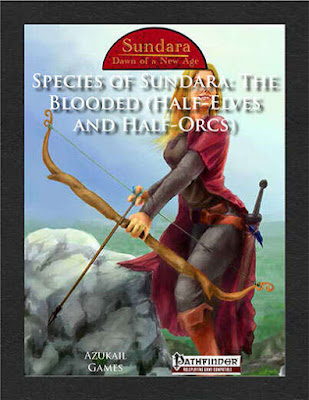
It was with these discussions in mind that I recently created the Blooded for my Sundara setting... a category of species that I hope gives more players more freedom, and expands options in a way that everyone can enjoy.
Because more options leads to better games all-around!
Lastly, if you want to make sure you're following all of my followables, make sure you stop by my Linktree, too!
What Are The Blooded?
I've been putting out more and more setting expansions with the Species of Sundara splat books for Pathfinder, and so far I've covered elves, dwarves, orcs, and halflings (and if you prefer the DND 5E versions you can get them here at elves, dwarves, orcs, or halflings). And in those books I've made it clear when individuals are capable of having children with other species, and when they aren't. Elves, for example, are capable of having children with any other sentient species... some partners may take more work (and pose more risk) but it is possible. While orcs are not as capable as elves, the fact that they can have so many children of mixed heritage is one of the reasons so many people believe that orcs were created by the elves (or, in some tales, that orcs were elves who had transformed themselves far enough away from their base species that they became something entirely new).
This, of course, led to the "half" question that has led to so many debates around so many tables. So I thought I would change things up with the creation of the Blooded as a category of creature.
My great-grandmother always said we had elven blood...
First and foremost, this eliminates the "half" idea that one parent was one species and the other parent was a different species. The status of "Blooded" simply means that whatever your heritage, it is dominant enough that particular traits manifested in you, conferring the species template. So someone may have had elven ancestors on their grandfather's side, but it's not until their birth that those traits manifested. Alternatively, someone might have orcish blood on their mother's side, but it doesn't become dominant until they've had children.
In addition to the Blooded not necessarily being the specific, first-generation offspring of an elf or an orc with another species, this species option makes it clear that anyone capable of having children with elves and orcs may fit under this category. This means you may have Blooded who are small-sized, combining halflings and elves. You may have an orcish child of elven blood. And so on, and so forth, according to the limitations put out in the respective splats. Other than those rules, and the fact that you only gain elven or orc blood as the dominant part of your Blooded heritage, the sky's the limit!
Lastly, there's been this pervasive idea in RPGs that so-called half-elves and half-orcs are always outsiders or outcasts in some way, shape, or form. Half-elves are stifled by their elven culture, and fetishized or misunderstood by humans. Half-orcs are sneered at by "true" orcs, and feared by humans. We've seen this time and time again, and I kicked this idea right to the curb.
Each of the five cultures laid out for elves and orcs has specific names and social niches for the Blooded within their ranks. I expanded on them, listing alternative species traits and abilities to represent their unique heritages, and talked a bit about the sort of treatment they receive, and the expectations (or lack thereof) that are placed on them. Because the Blooded aren't some new and strange phenomenon, so the cultures of Sundara have grown and changed over time to accommodate them.
And because I seem to have forgotten to put the link in here in the first place, check out The Blooded for both Pathfinder Classic, as well as Dungeons and Dragons 5E!
Don't Forget To Check Out The Rest of Sundara As Well!
I'm taking a short break from Sundara for the holidays, but I'll be coming back to add more to the setting once I'm back home and stuck in for more heavy lifting. But while you wait, consider checking out the stuff that's already come out to bring yourself up to date while you get ready for new cities, new species, items, and more!
- Ironfire: The City of Steel (Pathfinder and 5E): Built around the Dragon Forge, Ironfire is where the secret to dragon steel was first cracked. The center of the mercenary trade in the region, as well as boasting some of the finest schools for teaching practical sciences, Ironfire is a place where discovery and danger walk hand in hand!
- Moüd: The City of Bones (Pathfinder and 5E): An ancient center of trade and magic, Moüd was lost to a cataclysm, and then buried in myth. Reclaimed by the necromantic arts of the Silver Wraiths guild, this city has once again become a place teeming with life. Despite the burgeoning population, though, it is the continued presence of the undead that helps keep the city running, ensuring that Moüd is not swallowed up once more.
- Silkgift: The City of Sails (Pathfinder and 5E): Built on the cottage industry of Archer cloth (an extremely durable material used for sails, windmills, etc.), Silkgift is a place that prizes invention and discovery. From gravity batteries that store the potential of the wind, to unique irrigation systems, to aether weapons, the city positively churns out discoveries... and then there's the canal they cut through the mountains that makes them a major center of trade across the region.
- Hoardreach: The City of Wyrms (Pathfinder and 5E): A center of power across an entire region, Hoardreach is ruled over by a Cooperation of five different dragons. A place for refugees and outcasts of all sorts, Hoardreach boasts some of the most unusual citizens and creations from across Sundara. Infamous for their sky ships, which require the cast-off scales and unique arcane sciences of the Dragon Works to take to the air, one never knows just what they'll find in this city built atop a mountain.
- Archbliss: The City of The Sorcerers (Pathfinder and 5E): A floating city in the sky, Archbliss has been a refuge for sorcerers for thousands of years. It's only in relatively recent years that the city has allowed those from the ground below who lack the power of a bloodline to join them in the clouds. However, while there are certainly amazing wonders to behold, there is a darkness in Archbliss. Something rotting away at its heart that could, if not healed, bring the city crashing to the ground once more.
- Gods of Sundara (available for Pathfinder and DND 5E): In a world with no alignment, and where the gods are often genuinely mysterious forces that are far too large for mortals to truly comprehend, the divine feels genuinely strange and unknown... something that really does have to be taken on faith. This supplement provides a sample pantheon for Sundara, but also provides instructions on how to easily make your own gods in a world where you can't cast a spell and tell whether someone is good or evil.
Like, Follow, and Stay in Touch!
That's all for this week's Moon Pope Monday. To stay on top of all my content and releases, make sure you subscribe to my newsletter at the bottom of the page!
To stay on top of all my latest releases, follow me on Facebook, Tumblr, Twitter, and now Pinterest as well! To support my work, consider Buying Me a Ko-Fi, or heading to The Literary Mercenary's Patreon page to become a regular, monthly patron. That one helps ensure you get more Improved Initiative, and it means you'll get my regular, monthly giveaways as a bonus!
When I say the word Viking to you, chances are it conjures a very particular image in your mind. You probably picture a huge warrior with a flowing beard, bellowing battle cries while he lays about with his ax, slaying men, burning towns, and stealing anything not nailed down. Even if you have enough historical literacy to know they didn't have horned helms, or that they may have had red hair instead of blonde, this image of the defiling raider is firmly etched into our collective consciousness.
And while this sort of individual certainly existed in the historical record (a Viking is, by trade, often a pirate after all), this one aspect has grown to encompass an entire people in the minds of a lot of us. Even if you were a trader, a farmer, a skald, or a normal sailor, there was the fear of what the most dangerous and violent of the Norsemen had done when one laid their eyes upon you.
Which brings me to orcs, and how we could have some fun examining them.
She was huge! Ten feet tall, with blood dripping from her tusks!
As always, before we get into it, remember to subscribe to my weekly newsletter to get all my updates sent right to you. And if you want to help me keep the blog going you should consider becoming a Patreon patron today! Every donation, no matter how small, helps keep the wheels turning.
What Contact Do You Have With Them, Really?
Despite the vast reach of Viking longships, which ranged from the shores of North America all the way to the heart of the Eastern Roman Empire, from the frozen Russian steppes to deep into the Muslim world, the Norse people weren't some huge players on the world stage in the way that empires tended to be. They were relatively small in number, came from a remote, frozen place, and though they did some very notable things (the raid on Lindisfarne and populating the ranks of The Varangian Guard as examples), they weren't some massive influence that was going to take over the world.
Probably the biggest thing about Vikings that has survived (we're talking specifically about the raiders and pirates, not Norse people in general) was the legendary fear they produced. Their raids were ruthless, they ignored the conventions that so many other cultures followed, and the sheer maneuverability of their ships meant they could turn up nearly anywhere. If there was water nearby (and even if the water was miles away) it meant the Vikings could reach you. And in the dark, with the fires barely holding the night at bay, it was easy to imagine dangerous pirates with minds full of murder and robbery, their hands tight on the hilts of their weapons as they drew ever closer at the behest of their strange, foreign gods.
Hope the waterfront property was worth it!
Because I've had orcs on the brain ever since my latest Species of Sundara dropped where I talked about several of the varieties of these creatures that populate my setting (available for both Pathfinder Classic and Dungeons and Dragons 5th Edition), this has been a natural connection that I figured might be of-use to players and GMs alike.
To be clear, I'm not saying to pattern orcs off of the culture and/or pop culture we associate with the Norse (there's more than enough GMs and designers who've taken a stab at that already). However, as orcs and characters of orc heritage have grown and changed over the years we've had to re-imagine them, and expand on their place in our worlds and our games. Original orcs were the Tolkien model of monsters who served dark masters, and this is very much in line with the outlandish myths of Vikings told by those who survived their raids, or who merely observed the carnage left behind. The idea that the children of orcs with other species could only have been the product of violence or threats of violence is also much in-line with the sorts of tales told about the brutality of the Northmen.
As we expanded orcs further, we've seen that their violence toward towns and cities may be for more reasons than sheer wickedness, or raw personal gain. They might have been pushed off their old lands, and are fighting against resettlement. They might be fighting against prejudices that have led others to shun and mistreat them. They might even be fighting for the families and communities that those on the other side never even thought about, because to them there are no children or civilians among orcs; they're just a nameless, faceless hoard of roaring warriors because that's all they've ever seen, or all the legends have told of them. Yet much like the Norse people there was a vibrant, shifting, ever-changing culture that went beyond the Ulfbehrt and the Dane ax, and that was more than golden armbands and berserkers. Those things were a part of it, yes, but they were by no means what defined the whole of who they were. There were multiple nations, holds, and smaller clans within the larger whole, and examined on that small scale you could see stark differences between the myths of their culture, and who they really were at ground-level.
For GMs and players alike who want to bridge that gap between the orcs of older RPGs who were brutal, savage raiders at the behest of a violent, one-eyed god of battle and death, and newer RPGs where orcs are diverse and varied, each with their own cultures and interior life, this strategy might be worth thinking about.
Like, Follow, and Stay in Touch!
That's all for this week's Moon Pope Monday. To stay on top of all my content and releases, make sure you subscribe to my newsletter at the bottom of the page!
To stay on top of all my latest releases, follow me on Facebook, Tumblr, Twitter, and now Pinterest as well! To support my work, consider Buying Me a Ko-Fi, or heading to The Literary Mercenary's Patreon page to become a regular, monthly patron. That one helps ensure you get more Improved Initiative, and it means you'll get my regular, monthly giveaways as a bonus!
Anyone that's been on my blog for a bit knows I am a huge fan of the Savage Company setting. A game filled with monstrous mercenaries, blazing guns, and all the high-fantasy nonsense you could ask for. From books like the Savage Company Operations Guide (which provides pre-made modules and missions to send your squad on) as well as the Infantryman's Handbook (which gives you a bevy of high-caliber solutions to any problems a ground pounder might find on the field), this setting is pedal-to-the-metal nonsense in all the best ways.
And though there's currently a Savage Company bundle covering all their releases to-date, there's something new for this setting currently on Kickstarter. Something titled Machines of War!
Evocative, ain't it?
I recently got a chance to talk to the creators (Owen and Adam Martin) about what this book is, and what it adds to the game. So if you, like me, have wanted to see mechs, war bikes, arcane-drive tanks, alchemical artillery, and more, this is definitely something you should consider checking out.
And, of course, backing if you have the cash.
For those who want to make sure they don't miss any of my fresh content, make sure you sign up for my newsletter as well!
How would you describe Savage Company for players who haven't heard of it before?
Adam: Savage Company is a campaign setting that can be used as a base for expanding into a player-driven homebrew world, or dropped into your favorite game world. It focuses heavily on militarized monstrous races and has tons of tools for expanding vehicles and firearms use.
Owen: Guns, monsters, and high-octane action. We set out to make content for military fantasy games that were still compatible with all the first party content that already exists. So you still have dragons and wizards, but you can add motorcycles and machine guns and all of them are equally good options.
What does "Machines of War" add to the game setting and rules?
Adam: Machines of war adds large scale combat with walking tanks and also squads of smaller vehicles and units. Along with new class options and mechanics for allowing that to balance with classic RPG fantasy elements.
Owen: We’re expanding on all the things from the first book, races, classes, weapons, equipment, feats, spells, and vehicles, but the new wargame aspect allows you to play large scale, or mass combat quickly and easily. The wargame itself can be played competitively against friends or incorporated into your tabletop game, combining or switching between modes easily and fluidly.
Do you have any other plans for expansion? Modules, adventure paths, etc.?
Adam: We are never without ideas, our next planned publication is an ambitious Halloween adventure that should be popular with horror fans, drama kids, and everyone in between. After that we’re going to write an entire AP that uses all the mechanics we’ve brought into the game and guides a group through a massive war against Hell, all the way to level 20. We’re aiming for about 48 4-hour sessions worth of game content, with all the varied narrative options we always like to include
Owen: Oh yeah, so many plans. I’ll just say it, the adventure is named “Curse of the Phantom” and it should take you about four sessions to complete. It can be approached with multiple different playstyles, there are many routes and multiple endings. It’s an adventure that offers new things with each playthrough. And Green Hell, that’s our big project for 2022. I hope people want a full 20 level AP for 1st edition Pathfinder because we’re really excited to write it.
What sort of reception has Savage Company received, overall?
Adam: The reception has been overwhelmingly positive! In an era where anonymous internet critics are a dime a dozen, we’ve managed to cultivate a small but dedicated following of gamers. We like to keep them involved with previews and planning on our Discord server.
Owen: For being mostly unknown by the greater gaming public, those who do read our books like what we’re doing and offer a lot of constructive criticism, which we love. We try to listen to everyone and learn from that. I really like the group that has gathered on Discord and throws hard questions at us or joins the voice chat while we’re writing or working on art. Actually it was the Discord crew that came up with the idea for the “Chair” book and made it happen, and it has over 200 downloads now!
Is the setting going to grow significantly with these additions?
Adam: With the addition of 4 new factions there will be some growth to the setting. We’re still trying to keep things unobtrusive so we’re not forcing groups into using our world, but eventually we may have to break away from canon sources and grow our own lore.
Owen: I don’t think it's a secret that the world of Savage Company is set in (NOT) Golarion™, we started there, but left all the larger aspects of the world unwritten to make it easier to place the setting into your own games. With the new factions and some of the other things we have planned, we’re going to have to start fleshing out more and more aspects of the world into its own thematically (and legally) distinct and unique place. We plan on writing in this setting for a very long time so we’re in no rush to fill up all the space right away.
What drives this particular setting? What made you put it together?
Adam: We played a homebrew game for fun with a theme of Orcs with guns. It was so fun we kept playing it for years, eventually all the homebrew classes and firearm options became the backbone of our rules material.
Owen: In addition to our own desire to play things that didn’t exist, we also wanted to create a space for veterans to tell their stories. Everyone on the team is a military veteran or has worked in the defense industry closely with veterans, and we have an open call for short story submissions. Several vets who I have worked with in the past have sent in stories based on their experiences and we worked them into the greater narrative of the book.
Is there anything I didn't ask that you want folks to know about your setting, Kickstarter, etc.?
Adam: Savage Company has always served to find a niche we liked that was underserved by 1st and 3rd-party material. We ask ourselves, “what do we want to play that isn’t there, or wasn’t done well, and how can we make a difference?” Everything we write is stuff that we desperately want at our table, and it turns out there are others that want it too.
Owen: In addition to the obvious “please check out our Kickstarter” I would encourage anyone interested to go look at our publisher page on DriveThruRPG, we have 6 books that are totally free for anyone to download including two adventures, so you can go check those out and get an idea what our stuff is like. Also we have a Discord server that is open to the public and we love talking to people about games and ideas, plus you get a lot of previews of what we’re working on. Thank you so much Neal for this opportunity, reaching new people is always the hardest aspect about being a new publisher and we cannot thank you enough.
That's all for this week's Moon Pope Monday. To stay on top of all my content and releases, make sure you subscribe to my newsletter at the bottom of the page!
To stay on top of all my latest releases, follow me on Facebook, Tumblr, Twitter, and now Pinterest as well! To support my work, consider Buying Me a Ko-Fi, or heading to The Literary Mercenary's Patreon page to become a regular, monthly patron. That one helps ensure you get more Improved Initiative, and it means you'll get my regular, monthly giveaways as a bonus!
One of the big issues that we run into in our games is the idea of a racial monolith. The short version of this is that, most of the time, humans are going to get a wide variety of cultures and languages, ethnicities and religions... and then the non-human races are just treated as variations on a theme. We've all seen it. The orcs are just low-brow cockneys (if you're a Warhammer 40k fan), or else they universally use a kind of Hulk-speak when they communicate. The elves are all like something out of Tolkien, with the same ethereal voice and aloof bearing. The dwarves are all thickly bearded and Scottish, no matter what part of the world they're actually from.
And so on, and so forth.
Beings of light and love? You must have me confused with the Eladurin, friend.
While I talked about this back in Tear Down The Monoliths (No Race, Religion, Etc. Is Universal) over on The Literary Mercenary, and it's one of main tips I give for playing unique, interesting non-human characters in my ongoing 5 Tips series, I figured this week I'd make a recommendation that gets to the root of the problem.
If you're running a game, and you want to avoid the problem of racial monoliths (or really monoliths of any variety), then you need to start thinking small.
Also, if you haven't checked out Ancestry & Culture: An Alternative to Race in 5E, then you're going to want to give it a look. It's gone Mithril at time of writing, and is worth the flip through for those interested in this topic. Lastly, if you want to make sure you don't miss any future updates from yours truly, consider signing up for my newsletter, either at this link or on the form at the bottom of the page.
What Is This Community Like?
The problem comes about when we try to make broad, sweeping statements about the entirety of a race, an ethnicity, a culture, a country, or a faith. The broader a view you take, the more universal your statements are going to get, and the bigger a problem you're going to run into.
So take a moment and scrub your brain of anything beyond the physical characteristics/bonuses of a particular fantasy race. Dwarves still get a Constitution bump, elves still live for centuries, and orc physiology still grants them the ferocity ability. But all that other stuff we usually think of? From the idea of racial languages, to universal faiths, to cultural touch stones... chuck it in the bin, and don't look back.
Trust me, it's better this way.
Once you've dumped all of that baggage, take a look at a community of these creatures, and ask what they, specifically, are like.
For example, do you have a clan of mountain dwarves who've made their home in a chain of volcanic islands in the southern seas, like I mentioned in Do Dwarves Surf? Tips For Diversifying Non-Human Fantasy Races? Do they still have a caste system, or are they more of a family hierarchy? Is there a communal understanding among the island chain, or do they draw up specific agreements? Are they heavily tattooed because it's impractical to wear badges of offices and medals of accomplishment in the heat and the wet?
You can do this with any group of fantasy creatures. Do the elves of the eastern prairie country have a tribal structure? Is it matriarchal, perhaps? Do they travel in time with the moving of the seasons, coming and going through long familiarity as if by magic? Do they refuse to wear shoes, staying in contact with the earth without barriers? Do they not have a concept of personal property, merely taking from the whole as is needed for the tasks they are set to accomplish?
Are your gnomes in a particular area highly charged with magic, because they live on top of a ley line and their fey blood is sensitive to it? Are the orcs who live at the foot of the black mountain polyamorous, creating layers of complexity for tracking who holds what rank in their power structure? Do the halflings in the valley have an entire wine culture, because grapes just grow better than barley and hops, and that's what they're known for?
Bring It Down To The Local Level
The smaller you think of your communities, the easier it is to avoid big missteps. Avoiding racial languages and focusing on unique local dialects, for instance, can do a lot to make parts of your map feel organic. Asking how a particular faith plays out in a certain community, what it values, and what its unique history is can let you paint a more unique picture as well.
Then, once you have the small picture painted, you can move up to the bigger, grander image. What is the region like? In what ways is this community typical, in what ways isn't it? As you move up the chain, you can construct a nation out of these smaller, more varied bricks that let you make a varied, vibrant culture.
Most importantly, it stops you from saying, "Well your character is X, so they Y and Z." It lets you take a step back, look at the culture they grew up in, what parts of the world they've been to, and what they've seen and done to get a more nuanced take.
It's a lot of extra work, no doubt... but it's totally worth it.
Lastly, for those who haven't seen it yet, I have a newsletter going out once per week! It sums up all my new releases, projects, updates, etc., and ensures you never miss out on what's going down. If that sounds like something you'd like to check out, the first one dropped today, so give it a look. And once you've seen it, just hit that subscribe button to make sure you don't miss a thing going forward.
Like, Follow, and Stay in Touch!
That's all for this week's Moon Pope Monday. To stay on top of all my content and releases, make sure you subscribe to my newsletter at the bottom of the page!
Again, for more of my work, check out my Vocal archive, and stop by the YouTube channel Dungeon Keeper Radio. Or if you'd prefer to read some of my books, like my sword and sorcery novel Crier's Knife or my latest short story collection The Rejects, then head over to My Amazon Author Page!
To stay on top of all my latest releases, follow me on Facebook, Tumblr, Twitter, and now Pinterest as well! To support my work, consider Buying Me a Ko-Fi, or heading to The Literary Mercenary's Patreon page to become a regular, monthly patron. That one helps ensure you get more Improved Initiative, and it means you'll get my regular, monthly giveaways as a bonus!
If you're a gamer on any social media right now, then you've no doubt seen the firestorms surrounding the Why Orcs Are Problematicpost that's been going around. On one side of the argument you have players shouting, "We know, we've been saying this for years!" and on the other side of it you have players rolling their eyes and shouting back, "Orcs aren't even real, Jesus Christ not everything is racist!"
Artist's depiction of the comments section.
The problem here is that the argument is often couched in black-and-white, binary terms. Either orcs are problematic, or they're not. However, there's a lot going on beneath the surface, and a lot to think about. Not just in gaming in general, but also in terms of the fiction we draw on, the stories we tell, and the attitudes that are often baked-in with the games we consume.
So if you're looking for a deeper dive beyond the two options presented above (or if you're confused and looking for context) hopefully this Monday's post will help you out a bit.
But if that's not really your bag, well, my latest Critical Hits module from TPK just dropped this weekend, so you could go check out The Ghosts of Sorrow Marsh instead!
Seriously, go give it some love!
First Things First, What is an Orc?
Most of us already know the answer, so go ahead and say it with me! Orcs, as a creation of J.R.R. Tolkien were inherently evil humanoid creatures who served the dark lord and made up the ranks of his foot soldiers. They were corrupted, wicked, and they made up the muscle of the threat our heroes had to face.
Check out so far?
In their original incarnation, the orcs were symbolic as much as they were an actual threat to be dealt with. They were also monolithic; the orcs were a hoard, and there was no real, important difference between them. Some might be bigger, some might be meaner, some might be more skilled, but orcs were generally painted with a pretty broad brush. Which, one might argue, was one part of the initial problem.
The Depictions (And Evolution) of Orcs
Elements of this mythology maintained in Dungeons and Dragons' early days. Orcs were repulsive creatures who were brutal, violent, disorganized, and they typically worshiped/were bound to a dark god who demanded slaughter, sacrifice, and debased acts. While I would argue that maintaining a monolithic culture, and not giving orcs a great deal of depth were issues in the writing, the other issues actually came from their art in the early days.
And speaking of problematic art...
As was mentioned in the article, orcs were often depicted bearing weapons and armor inspired by non-European nations of the real world. Now, this was definitely fantasy, and there was no one issue of an orc carrying a kukri or wearing mirror armor that was a problem individually... it was the trend. It was the broad overall pattern that drew the battle lines in purely visual terms. Orcs were universally savage, brutal, and they carried weapons that bore a striking resemblance to India, China, Mongolia, and the Middle East. The heroes were drawing on the aesthetics and inspiration of Western European heroes, and so we have what might literally look like caricatures of East v. West.
Was that intentional? No, probably not. Just as Tolkien didn't state in his books that orcs were supposed to be based on any particular ethnicity or to represent any one group (though he did state in his letters he was drawing on specific ethnicities to make them seem more foreign to his projected European readers), the initial intent was probably not to say Europe good, non-Europe bad. Doesn't mean that's not how it came across, though.
Things got more problematic when orcs stopped just being corrupted evil beings and were given free will and choice. The creation of half-orcs (and eventually of orcs becoming PCs) meant that monsters who had once been entirely used for plot devices now had to become a varied and organic part of the world. But as we saw in Volo's Guide, as mentioned in the original article, there is still a clinging to the idea that all orcs are brutish, savage, and incapable of true empathy and understanding. They're always, at their core, monsters by their very nature. Inhuman. Other.
This becomes really problematic when you look at orcs as a big picture under those circumstances. Because if they can have children with humans, that raises questions of agency, of decisions, and of stereotyping. What was once a generic plot-filler threat is now an entire category made up of individuals who by the lore can be, do, and become what they want the same as any other character. Yet they're still treated as savage, backward, and lesser at the same time. That's frustrating for players who want to be orcs, but it also continues the trend of maintaining that problematic message.
Our Fiction Inherits Baggage (Whether Like It Or Not)
I grew up reading pulp fiction, and there is a breathtaking amount of racism and sexism in those stories. A lot of it was a product of its time, but many among us forget that the stories and tropes of that time didn't just get uprooted and replaced with shiny, new stuff that nixed the problematic descriptions. Many of these elements endured and maintained, until we didn't see them as products of prejudiced attitudes; they were just the way these stories were told.
Bob Chipman explained it particularly well using the trope of The Lost City.
For those who didn't watch it, the trope of The Lost City has its roots deep in European colonialism to Africa. Explorers would find these ancient ruins, and they would be flabbergasted that something like this could be found in Africa. They turned themselves inside out trying to explain it, ignoring the obvious that perhaps they were built by the ancestors of the people who still lived there. Nonsense! Black people could never comprehend the skill or ability it would take to build a castle, ridiculous!
And as Bob points out, that trope kept coming back over the generations. It existed in the time of the pulps, and early adventure fiction, it showed up in Indiana Jones, it was latched onto by games like Tomb Raider and Uncharted... it's a part of so many stories it would take a huge list to lay them all out.
Does that make all the stories who used this trope racist simply because they have their roots in a colonialist view? No, it doesn't. But it is important to hold these stories at arm's length, and ask what part of the original ancestor has survived and thrived in the current example, and how it was able to make it all the way into the modern incarnation. And, perhaps, what to do to fix it so that baggage doesn't weigh on the narrative.
For those looking for a real-world example, The Liberal Redneck Manifesto talks about the battle flag of northern Virginia... what a lot of people immediately think of as the Confederate flag. It was flown in a losing war, and then it was resurrected as a symbol of hate by organizations like the KKK, and by segregationists who wanted to cow and frighten black people. The flag became a symbol of several Southern musicians as well, and it was adopted by many who saw it as a rebel icon... the problem was that it still held all those older, more awful connotations for black people, and other ethnic minorities. So even if someone wears that flag because it's something waved around by a musician they like, or it's something they associate with family and good times at home, it's important to recognize that there's more to its legacy than the parts you've seen and know. You have to look at all of it, and at what message it sends to other people.
Oh, So Now It's Racist To Have Orcs as Bad Guys?
This is probably the dumbest thing I've seen come out of this conversation, so I'm going to address it here. It is not racist to have orcs as bad guys in your game. It's not racist to play an orc character. The issue arises when people ignore the history of how orcs have been depicted (and the real-life cultures often associated with them through their art, cultural trademarks, etc.), and when they don't put in the work of actually developing orcs in their settings.
There is no replacement for hard work.
As an example, I'm going to turn to Paizo's Golarion setting. When most people think of orcs in this world, they tend to think of the orc hold of Belkzen. This nation is a loose confederation of warring tribes who worship harsh and brutal gods, who value strength, and who were the foot soldiers of a powerful lich king who sought to conquer the world a handful of generations ago. They are, in a very real sense, one of the best takes I've seen on Tolkien's orcs as an organic part of a setting.
However, they are one of dozens of different settlements around the world, and each of them has their own unique culture, background, history, and feel in the context of the setting. The settlement of Averaka is a hard-working fishing village on a northern coast. Orcs and half-orcs in the Mwangi Expanse are often valued for their strength and durability, and they often hold important positions in tribes. Orcs in the deserts form their own familial groups, trading and intermarrying with others. Orcs and half-orcs have a wide variety of traits players and DMs can pick to customize them to a given area, but more importantly the lore of the setting makes it clear that attitudes, styles of society, etc. are a product of their history in a given area, rather than some in-born sameness that all orcs share.
That's the level of work it takes to make a sentient race a real, breathing part of a world and setting, and all of that has to carry through to how they're treated in the world as well. If a settlement is being raided by orcs, ask why, and build that into the adventure. Are they a war band who can't find a master, and they would rather take from the farmers than lay down their swords? Are they starving and pushed out to the edge of the badlands, so they have to steal in order to live? Is there a disagreement over the terms of a peace treaty, or are they mercenaries whose services have been bought by a bigger NPC with a hidden agenda? Is this a land-bound group of pirates looking to get back on the river, but they need the resources to repair their ship?
All of those are workable, and they add extra depth and meaning, allowing orcs to stand on their own as characters instead of as caricatures.
Lastly, Consider The Problematic Core of Many Adventures
Now, I know we're talking about orcs here, but this is something that Mark T. Hrisho brought up on his blog and I think it's a point worth adding to the discussion. Because a lot of our fantasy RPGs have another piece of baggage that has colored many of our monstrous races; mainly that if a given area of the map doesn't have people who look like our party living in it, then it doesn't really qualify as settled or explored territory. It is, instead, the edge of the known world, and the last edge of real civilization beyond which lives only darkness, and savagery.
Helmets on, I hear comments coming!
How many adventures have you played in tabletop RPGs, or even in video games, where you took on quests to "clear out" local monster infestations in the area? Caverns full of goblins, hills teeming with kobolds, mountaintop ogres, or the ever-present roving bands of orcs? If you've been in the hobby any length of time, you can probably think of several games that started you off this way.
And I'm not the first one to point out that in these scenarios we're basically barging into these creatures' homes, killing their families, and taking their stuff.
Even if it's not a job to kill a certain number of non-humans, these scenarios are often painted as, "protecting the light from the darkness of the savage lands," or something similar. Which basically states that none of the cultures of the other beings who call this region home, from the lizard men, to the catfolk, to the gnolls, are "real" people. They're just savages. Monsters. Little better than animals, and often not even worth as much XP.
Am I saying that fantasy RPGs who use this framework purposefully set out to be some kind of subliminal argument for the ideas of Manifest Destiny, or declarations in favor of colonialism? No. However, messages exist in fiction whether they're intended or not. Just like how early Disney princesses being damsels in distress wasn't likely intended to send the message to young girls that they had no agency and should wait to be rescued, but it can be argued that message is present regardless of the intention.
"Problematic" isn't a term reserved only for racial slurs and misogynist rants; it means that we need to look at the history of something, the messages within it, and how it came to be what it is. We need to be intellectually curious, honest with the history, and we need to understand that just because someone didn't intend something to send the wrong message, say the wrong thing, or to smuggle in an offensive attitude, that doesn't mean it didn't happen. Because it's only by looking these elements full in the face that we can make the games we love better, deeper, more complex, and in the end, less problematic.
And like I said in It's Okay To Admit There Are Problems in Your Hobby, you can like something problematic without being problematic by association. But we should all seek to be intellectually curious about these issues, and to remember that just because it may not affect us personally, that doesn't mean it's somehow not a real issue.
Again, for more of my work, check out my Vocal archive, and stop by the YouTube channel Dungeon Keeper Radio. Or if you'd prefer to read some of my books, like my sword and sorcery novel Crier's Knife or my latest short story collection The Rejects, then head over to My Amazon Author Page!
To stay on top of all my latest releases, follow me on Facebook, Tumblr, Twitter, and now Pinterest as well! To support my work, consider Buying Me a Ko-Fi, or heading to The Literary Mercenary's Patreon page to become a regular, monthly patron. That one helps ensure you get more Improved Initiative, and it means you'll get my regular, monthly giveaways as a bonus!
It's been a while since I've reviewed something new in my Monday slot, and if you are a Pathfinder Classic player then have I got a treat for you! Because I managed to snag a review copy of Savage Company, and if you haven't seen it yet then you should go get yours right now.
If all you wanted was my opinion, it is rip-roaring nonsense that is exactly the kind of insane, high-octane fun that I feel Pathfinder was made for. Keep reading if you want more information, but if that's all you needed to go download the free Recruit Orientation Guide, then go do that.
Seriously, I haven't been this pleased with a campaign setting in a while.
If you'd like to know more, however, keep on reading.
What Is "Savage Company" Exactly?
The short version is that Savage Company is a campaign setting meant to be used in conjunction with Pathfinder Classic (or Pathfinder 1st Edition, if you choose to use that label). It can be used with the game as it stands (since Pathfinder already has rules for both primitive and advanced firearms in it), or it can be used in a more modern or modern-esque technological level (anywhere from just after the Renaissance to the tech level of today).
Oh yeah... the safety's coming off!
The backstory for this setting is that it takes place in the town of Tombstone. This place was an abandoned fort in the middle of an area blasted by magical war, and devoid of non-hostile forms of life. The place was claimed by the orcs and half-orcs of the mercenary band known as Savage Company, and they held onto it. As their reputation grew, and their numbers swelled, they started to recruit more and more adventurers to their cause... particularly individuals from "monstrous" races who had a hard time finding reliable work, and trusting companions anywhere else.
As time went by, Savage Company managed to bribe, strongarm, and make diplomatic entreaties to its neighbors, eventually declaring its holding as legitimate. Now the town of Tombstone, as well as the underground network of tunnels that holds everything from the gangs of Trox laborers, to goblin tinkerers, to billets of orcs, hobgoblins, and other well-trained mercenaries who can respond at a moment's notice, is a company town where anyone who needs the best in the business can come to hire mercenaries of any stripe.
The tone of the setting is kept purposefully vague so that you can fit it into Pathfinder's usual blend of fantasy/sci-fi (where armored paladins and gunslinging vigilantes may fight side-by-side), or you can expand the more modern military feeling to the rest of the setting as well. It's entirely up to you!
Flavor, Crunch, and a Whole Lot of Cheese
The first thing that I adore about this setting is that it purposefully takes aim at the ingrained attitude of, "monstrous races are inherently evil." Players and DMs alike have clung to this attitude even as Pathfinder made more and more traditionally "bad" races playable (orcs, goblins, hobgoblins, drow, duergar, etc.) without any form of alignment restriction.
What Savage Company does is acknowledge the history of adversity that these races have had, but turned it around by showing those in the company as people looking to make a better life for themselves through teamwork, cooperation, and using the advantages they were born with to find a calling in life. In fact, the outfit reminds me very strongly of The Devil's Own out of my collection 100 Random Mercenary Companies. This group recruited primarily monstrous humanoids, and most of them created personas for themselves because showing the world that face was often an advantage that left their enemy unsure of their true capabilities and weaknesses.
I'm sorry, I was told there would be cheese?
There is, of course, more to Savage Company than just a fancy setting, some solid fiction, and a bunch of pre-generated characters to get you started. It also gives you new classes (from the medic to the infantryman), as well as archetypes of existing classes from Pathfinder. It's got a slew of new feats (nothing game breaking, but there's more than a little spicy cheddar on the list), and perhaps my favorite section, new gear.
And as someone who's spent the past year tooling around in Warhammer 40k's orbit, I am very pleased to see chain blades, mini mechs, Mad Max-style war bikes, and the iconic orc chin piece, along with sensible bayonets, downright brutal custom machine guns, and dozens of other delicious upgrades for your armory.
Bringing Out The Big Guns
If you are one of those DMs who firmly believe that guns don't belong in fantasy games, or that traditionally evil races are always bad and they should never rise to the status of genuine heroes, this is not the setting for you. If you're one of those players who always reaches for the scarred tiefling soldier who would die for their comrades, the hulking half-orc tank who's the heart of the squad, or the goblin bombardier who is the deadliest mascot the party could ask for, then this book is going to find a place of honor on your shelf faster than you can say, "Roll initiative."
So if you like your characters weird, your guns blazing, and your adventures absolutely crazy, go get your copy of Savage Company today!
Like, Follow, and Stay in Touch!
That's all for this week's Moon Pope Monday.
Hopefully you found this term useful!
For more of my work, check out my Vocal archive, and stop by the YouTube channel Dungeon Keeper Radio. Or if you'd prefer to read some of my books, like my sword and sorcery novel Crier's Knife or my latest short story collection The Rejects, then head over to My Amazon Author Page!
To stay on top of all my latest releases, follow me on Facebook, Tumblr, Twitter, and now Pinterest as well! To support my work, consider Buying Me a Ko-Fi, or heading to The Literary Mercenary's Patreon page to become a regular, monthly patron. That one helps ensure you get more Improved Initiative, and it means you'll get my regular, monthly giveaways as a bonus!